How to Calculate the Volume of a Rectangular Prism: Precision Meets Practicality
Table of Contents
- The Complete Overview of Calculating the Volume of a Rectangular Prism
- Historical Background and Evolution
- Core Mechanisms: How It Works
- Key Benefits and Crucial Impact
- Major Advantages
- Comparative Analysis
- Future Trends and Innovations
- Conclusion
- Comprehensive FAQs
- Q: What units should I use when calculating the volume of a rectangular prism?
- Q: Can I calculate the volume of a rectangular prism if one dimension is missing?
- Q: How does calculating volume differ for a cube versus a rectangular prism?
- Q: What if the prism has irregular edges or is not perfectly rectangular?
- Q: Why is volume important in real-world applications like construction?
- Q: Are there digital tools to help calculate the volume of a rectangular prism?
- Q: How can I verify my volume calculation for accuracy?
The volume of a rectangular prism is more than a classroom exercise—it’s the invisible force behind storage solutions, architectural blueprints, and even the dimensions of your morning coffee mug. Whether you’re a student verifying homework or a professional estimating material costs, understanding how to calculate the volume of a rectangular prism ensures accuracy in every measurement. The formula isn’t just a sequence of numbers; it’s a gateway to visualizing three-dimensional space, solving real-world problems, and bridging the gap between abstract theory and tangible results.
Yet, for many, the process remains shrouded in confusion. Missteps in identifying length, width, or height can lead to costly errors in construction, logistics, or design. The key lies in precision: recognizing that every rectangular prism—from a shoebox to a shipping container—follows the same mathematical rule. This isn’t just about memorization; it’s about applying a universal principle to diverse scenarios, where the difference between a guess and a calculation can mean the difference between efficiency and waste.
Architects rely on it to determine cubic capacity of rooms; engineers use it to optimize fuel tanks; even interior designers leverage it to plan furniture layouts. The formula V = length × width × height is deceptively simple, but its implications ripple across industries. What follows is a deep dive into the mechanics, historical context, and future of this fundamental geometric operation—one that transforms raw dimensions into actionable intelligence.
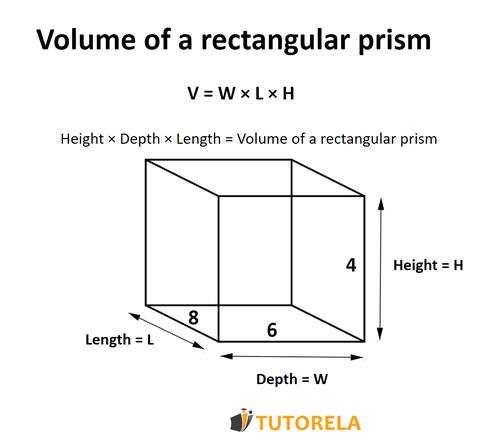
The Complete Overview of Calculating the Volume of a Rectangular Prism
The ability to calculate the volume of a rectangular prism is rooted in the intersection of geometry and practicality. At its core, the process hinges on three linear dimensions: length (the longest side), width (the shorter adjacent side), and height (the vertical measurement). Multiplying these values yields the volume in cubic units (e.g., cubic meters, cubic feet), a metric that quantifies the space an object occupies. This method isn’t limited to perfect rectangles; it extends to any prism with parallel, rectangular faces, including cuboids and even irregular shapes when decomposed into simpler components.
What makes this calculation universally applicable is its adaptability. Whether you’re measuring the capacity of a grain silo, the displacement of a submarine, or the storage space in a data center, the principle remains identical. The challenge often lies not in the formula itself but in accurately determining the dimensions—especially in real-world scenarios where edges may be obscured or measurements require estimation. Tools like laser measurers, digital calipers, or even basic rulers become extensions of the mathematical process, ensuring that theoretical knowledge translates into field-ready precision.
Historical Background and Evolution
The concept of calculating volume traces back to ancient civilizations, where early mathematicians grappled with quantifying space for trade, construction, and astronomy. The Egyptians, around 1800 BCE, used geometric principles to design pyramids, implicitly understanding volume through proportional scaling. Later, Greek mathematicians like Euclid formalized these ideas in Elements, though their focus was on two-dimensional shapes. The leap to three-dimensional volume calculations came with the work of Archimedes, who developed methods to determine the volume of irregular solids by submerging them in water—a technique still taught today.
By the Renaissance, architects like Brunelleschi applied volume calculations to domes and cathedrals, blending art with engineering. The Industrial Revolution further cemented the practice, as factories required precise measurements for mass production. Today, digital tools like CAD software automate volume calculations, but the foundational formula—length × width × height—remains unchanged. This evolution underscores a timeless truth: while technology advances, the core principles of geometry endure.
Core Mechanisms: How It Works
The formula to calculate the volume of a rectangular prism is a direct application of the multiplicative principle in three dimensions. Imagine a cube with sides of 1 unit: its volume is 1 cubic unit. Extend this to a rectangular prism with sides of a, b, and c units. The volume becomes a × b × c, representing the number of unit cubes that fit inside. This isn’t just arithmetic; it’s a spatial reasoning exercise, where each dimension contributes multiplicatively to the total capacity.
For example, a room measuring 5 meters long, 4 meters wide, and 3 meters high has a volume of 60 cubic meters (5 × 4 × 3). The process scales seamlessly to larger objects, such as a shipping container (20 × 8 × 8.5 = 1,360 cubic feet) or microscopic structures like a DNA helix model. Even when dimensions are fractional or involve mixed units (e.g., feet and inches), conversion to a single unit ensures consistency. The mechanism’s simplicity belies its power: it’s a universal language for describing space.
Key Benefits and Crucial Impact
Understanding how to calculate the volume of a rectangular prism transcends academic exercises—it’s a skill with tangible economic and operational benefits. In construction, accurate volume calculations prevent material shortages or excesses, directly impacting project budgets. Manufacturers use this knowledge to optimize packaging, reducing shipping costs and environmental waste. Even in everyday life, homeowners rely on it to plan storage solutions or select appropriately sized appliances.
The ripple effects extend to scientific fields, where volume measurements inform fluid dynamics, material science, and structural integrity. A slight miscalculation in a chemical reactor’s volume could alter reaction yields; in aerospace, fuel tank dimensions must be precise to avoid weight discrepancies. The formula’s versatility makes it a cornerstone of interdisciplinary problem-solving, where precision translates to efficiency, safety, and innovation.
"Geometry will draw the soul toward truth and create the spirit of philosophy." — Plato
Major Advantages
- Precision in Design: Architects and engineers use volume calculations to ensure structural stability and spatial optimization, reducing redesign costs.
- Cost Efficiency: Accurate measurements minimize material waste in manufacturing and construction, lowering operational expenses.
- Logistical Optimization: Shipping and storage industries rely on volume data to maximize cargo space, improving delivery timelines and reducing fuel consumption.
- Scientific Accuracy: Researchers in physics and chemistry depend on volume formulas to conduct experiments with reproducible results.
- Educational Foundation: Mastery of this concept builds spatial reasoning skills, essential for advanced mathematics and technical fields.
Comparative Analysis
| Rectangular Prism Volume | Alternative Shape Volume |
|---|---|
| Formula: V = length × width × height | Cylinder: V = πr²h (requires radius and height) |
| Use Case: Boxes, rooms, containers | Use Case: Pipes, tanks, wheels |
| Complexity: Low (three linear dimensions) | Complexity: Moderate (involves π and radius) |
| Real-World Example: Calculating storage space in a warehouse | Real-World Example: Determining fuel tank capacity |

Future Trends and Innovations
The future of volume calculation lies in integration with emerging technologies. Artificial intelligence is already being used to automate measurements in 3D scanning, where algorithms calculate the volume of a rectangular prism (or any shape) from point-cloud data in milliseconds. Augmented reality tools overlay digital dimensions onto physical spaces, allowing real-time volume adjustments during construction or interior design. Meanwhile, advances in nanotechnology may require volume calculations at atomic scales, pushing the boundaries of traditional geometry.
Sustainability is another driver of innovation. Smart packaging designs use volume optimization to reduce plastic waste, while renewable energy projects rely on precise volume assessments for battery storage and hydroelectric dams. As industries adopt Industry 4.0, the line between manual calculation and automated systems will blur, but the underlying principle—length × width × height—will remain the bedrock of spatial analysis.
Conclusion
The ability to calculate the volume of a rectangular prism is a testament to humanity’s quest to quantify the world around us. From ancient pyramids to modern skyscrapers, the formula serves as a bridge between abstract theory and practical application. Its simplicity belies its power, enabling breakthroughs in science, engineering, and daily life. As technology evolves, the core concept endures, adapting to new challenges while retaining its fundamental relevance.
For students, professionals, or curious minds, mastering this skill isn’t just about solving equations—it’s about unlocking a tool that shapes the built environment, drives innovation, and solves problems at every scale. The next time you measure a room or estimate shipping space, remember: you’re not just calculating volume. You’re participating in a tradition that spans millennia, where numbers meet the real world.
Comprehensive FAQs
Q: What units should I use when calculating the volume of a rectangular prism?
A: Always use consistent units (e.g., all in meters or all in feet). If dimensions are mixed (e.g., feet and inches), convert them to a single unit before multiplying. For example, 2 feet 6 inches becomes 2.5 feet (since 6 inches = 0.5 feet).
Q: Can I calculate the volume of a rectangular prism if one dimension is missing?
A: No, you need all three dimensions (length, width, height) to use the formula V = length × width × height. If one dimension is unknown, additional information (e.g., surface area or diagonal measurements) may be required to solve for the missing value.
Q: How does calculating volume differ for a cube versus a rectangular prism?
A: A cube is a special case of a rectangular prism where all sides are equal (length = width = height). The volume formula remains the same (V = side³), but since all dimensions are identical, the calculation simplifies to cubing a single value.
Q: What if the prism has irregular edges or is not perfectly rectangular?
A: For non-rectangular prisms (e.g., trapezoidal or triangular), decompose the shape into simpler rectangular components, calculate each volume separately, and sum them. Alternatively, use calculus-based methods (e.g., integration) for complex geometries.
Q: Why is volume important in real-world applications like construction?
A: Volume determines material quantities (e.g., concrete, drywall), storage capacity, and structural load-bearing limits. Accurate calculations prevent cost overruns, material shortages, and design flaws, ensuring projects are completed efficiently and safely.
Q: Are there digital tools to help calculate the volume of a rectangular prism?
A: Yes, software like AutoCAD, SketchUp, and even smartphone apps (e.g., "Volume Calculator") can compute volume from input dimensions. For large-scale projects, 3D laser scanners and CAD programs automate measurements, reducing human error.
Q: How can I verify my volume calculation for accuracy?
A: Double-check each dimension for measurement errors, ensure units are consistent, and re-multiply the values. For physical objects, use water displacement (for irregular shapes) or compare with known references (e.g., a standard cube’s volume).
Leave a Comment
Comments are moderated before appearing. The data you submit is processed according to the Privacy Policy of versiliasolutions.oneagency.co.