Decoding Profits: The Critical Difference Between Net Income and Revenue
Table of Contents
- The Complete Overview of the Difference Between Net Income and Revenue
- Historical Background and Evolution
- Core Mechanisms: How It Works
- Key Benefits and Crucial Impact
- Major Advantages
- Comparative Analysis
- Future Trends and Innovations
- Conclusion
- Comprehensive FAQs
- Q: Can a company have high revenue but negative net income?
- Q: How do taxes affect the difference between net income and revenue?
- Q: Why do some companies focus more on revenue than net income?
- Q: Is net income the same as cash flow?
- Q: How can a business improve its net income without increasing revenue?
- Q: What role does depreciation play in the difference between net income and revenue?
Financial statements are the lifeblood of any business, yet the difference between net income and revenue remains one of the most misunderstood concepts among entrepreneurs, investors, and even seasoned professionals. Revenue—often called "top-line" income—represents the total cash inflow from sales before any deductions. Net income, or "bottom-line" profit, is what remains after every expense, tax, and operational cost is subtracted. Confusing the two can lead to misguided financial decisions, from overvaluing a company’s health to underestimating its true profitability. The gap between these figures isn’t just numerical; it reveals the efficiency, risk exposure, and strategic positioning of a business.
This distinction becomes even more critical in an era where investors scrutinize earnings per share (EPS) as closely as revenue growth, and where startups with sky-high revenue may still operate at a loss. The difference between net income and revenue isn’t merely academic—it dictates whether a company can sustain operations, attract funding, or even survive a downturn. For example, a tech giant like Amazon may boast billions in revenue but consistently report negative net income due to heavy investments in infrastructure and R&D. Meanwhile, a lean manufacturing firm might show modest revenue but strong net margins, signaling operational excellence.
The confusion often stems from how these terms are presented in financial reports. Revenue is the first line item on an income statement, while net income appears at the bottom after accounting for costs of goods sold (COGS), operating expenses, interest, and taxes. Yet, their roles in financial storytelling couldn’t be more different. Revenue reflects market demand and pricing power; net income reflects profitability and financial health. Ignoring this difference between net income and revenue can lead to misplaced confidence in a company’s performance—or worse, blind spots in its true financial picture.

The Complete Overview of the Difference Between Net Income and Revenue
The difference between net income and revenue lies at the heart of financial analysis, serving as the foundation for assessing a company’s viability. Revenue, or gross sales, is the raw measure of a business’s economic activity—what it earns from selling goods or services before any costs are deducted. It’s the "top line" on an income statement, a figure that can be inflated by volume discounts, bulk sales, or aggressive pricing strategies. Net income, conversely, is the "bottom line," the residual amount after all expenses, taxes, and financial obligations have been satisfied. This figure is what shareholders ultimately care about, as it determines dividends, reinvestment capacity, and the company’s ability to generate wealth over time.While revenue provides a snapshot of a company’s market engagement, net income reveals its operational efficiency and financial discipline. A business might achieve record revenue but still struggle with profitability if its cost structure is unsustainable. For instance, a retail chain could see revenue surge during holiday seasons, but if its COGS or overhead costs rise proportionally, net income may stagnate or decline. This difference between net income and revenue is why investors often look beyond revenue growth to net margins—a ratio that shows how effectively a company converts sales into profit. Understanding this distinction is crucial for stakeholders, from startup founders evaluating burn rates to institutional investors analyzing long-term sustainability.
Historical Background and Evolution
The modern distinction between revenue and net income traces back to the evolution of double-entry bookkeeping in the 15th century, pioneered by Luca Pacioli. Early accounting systems separated income from expenses to provide clarity on financial performance, but the granularity of "net income" as we know it today emerged with the Industrial Revolution. As businesses grew in complexity, so did the need to distinguish between gross earnings and net profitability. The rise of corporations in the 19th and 20th centuries further solidified these metrics as critical tools for transparency, governance, and investor confidence.The difference between net income and revenue became particularly pronounced with the advent of GAAP (Generally Accepted Accounting Principles) in the U.S. and IFRS (International Financial Reporting Standards) globally. These frameworks standardized how companies report financials, ensuring that revenue is recognized only when earned (e.g., upon delivery of goods or completion of services) and that net income reflects all post-revenue deductions. The shift from cash-basis to accrual accounting in the 20th century also deepened this divide, as revenue could be recognized before cash was collected, while net income accounted for all liabilities—including deferred revenue and uncollected receivables.
Core Mechanisms: How It Works
Revenue is recorded when a sale is made, regardless of whether cash has been received. For example, a subscription-based SaaS company recognizes revenue monthly based on active users, even if payments are collected annually. This figure is then adjusted by the cost of goods sold (COGS)—the direct costs of producing the goods or services sold—to arrive at gross profit. From there, operating expenses (salaries, rent, marketing, R&D) are subtracted, leading to operating income (or EBIT). Further deductions for interest, taxes, and non-operating expenses (like one-time asset sales) finally yield net income.The difference between net income and revenue is often bridged by operational efficiency. A company with high revenue but low net income may have excessive overhead, while one with lower revenue but higher net margins is likely more cost-effective. For instance, a luxury brand might report lower revenue than a mass-market retailer but achieve higher net income due to premium pricing and controlled cost structures. This mechanism underscores why revenue alone is insufficient for evaluating financial health—net income tells the full story of profitability after all obligations are met.
Key Benefits and Crucial Impact
Understanding the difference between net income and revenue is essential for making informed financial decisions. Revenue indicates a company’s ability to generate sales, but net income reveals its true profitability and cash-generating potential. Investors, lenders, and analysts rely on this distinction to assess risk, growth potential, and shareholder value. A company with strong revenue but weak net income may struggle to reinvest in growth or pay dividends, while one with balanced revenue and net income signals stability and scalability.The impact of this distinction extends beyond internal operations. Public companies must disclose both metrics in their financial filings, ensuring transparency for shareholders. Private firms use these figures to attract investors or secure loans, as banks and venture capitalists prioritize net income over revenue when evaluating creditworthiness. Even in personal finance, the difference between net income and revenue (analogous to take-home pay vs. gross income) dictates spending power and savings capacity.
"Revenue is vanity, profit is sanity, and cash flow is reality." — Attributed to financial analyst Jack Welch
Major Advantages
- Accurate Profitability Assessment: Net income provides a true measure of profitability after all costs, whereas revenue alone can be misleading if costs are high.
- Investor Confidence: Strong net income relative to revenue signals financial health, making a company more attractive to shareholders and lenders.
- Tax and Regulatory Compliance: Net income determines taxable income, ensuring compliance with fiscal laws and avoiding penalties.
- Strategic Decision-Making: Comparing revenue to net income helps identify inefficiencies, such as excessive overhead or unsustainable pricing.
- Cash Flow Management: Net income, when positive, indicates the company’s ability to generate cash for reinvestment, debt repayment, or dividends.
Comparative Analysis
| Metric | Definition |
|---|---|
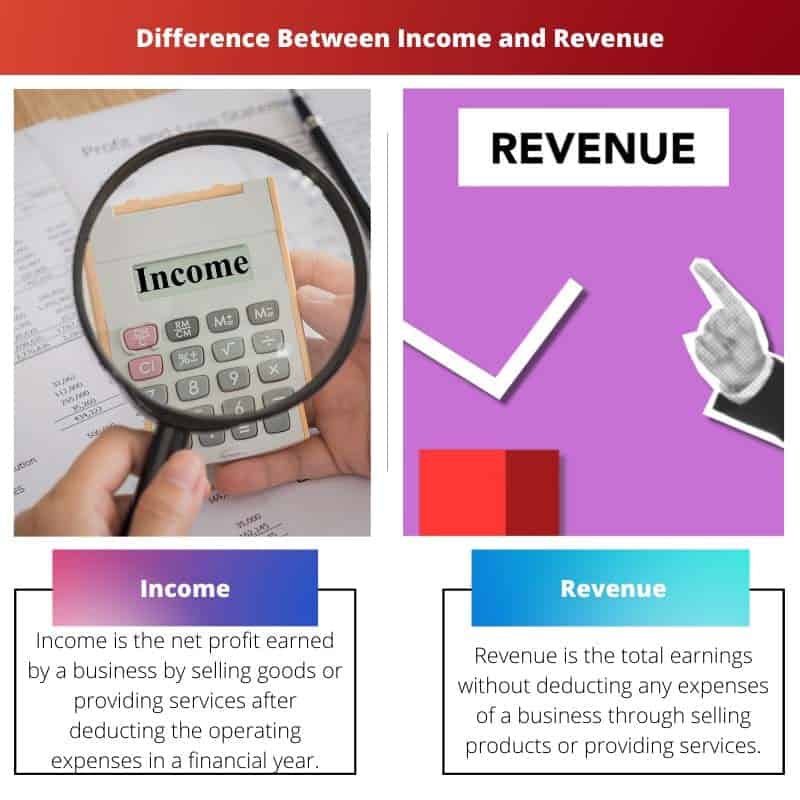
| Revenue | Total income generated from sales of goods/services before any deductions (also called "gross sales" or "top line"). |
| Net Income | Profit remaining after all expenses, taxes, and financial obligations are subtracted (also called "bottom line" or "net profit"). |
| Key Difference | Revenue measures sales activity; net income measures profitability after costs. The gap reveals operational efficiency. |
| Financial Statement Location | Revenue appears first on the income statement; net income is the final line item. |
Future Trends and Innovations
As businesses increasingly adopt cloud-based accounting and AI-driven financial analytics, the difference between net income and revenue will become even more nuanced. Real-time revenue recognition tools, powered by machine learning, will allow companies to adjust for dynamic pricing and subscription models instantly. Meanwhile, predictive analytics will enable CFOs to forecast net income with greater accuracy, factoring in variables like inflation, supply chain disruptions, and regulatory changes.The rise of digital currencies and decentralized finance (DeFi) may also redefine how revenue and net income are reported. Blockchain-based transactions could introduce new layers of cost (e.g., gas fees, smart contract expenses) that must be accounted for in net income calculations. Additionally, ESG (Environmental, Social, and Governance) metrics may soon be integrated into financial statements, requiring companies to disclose not just revenue and net income but also their "profitability" in terms of sustainability impact. These trends will further emphasize the need for clarity in distinguishing between these two financial pillars.
Conclusion
The difference between net income and revenue is more than a technicality—it’s the cornerstone of financial literacy for businesses and investors alike. Revenue tells you how much money is coming in, but net income tells you how much of that money is actually profit. This distinction is critical for evaluating a company’s health, making strategic decisions, and ensuring long-term sustainability. Whether you’re analyzing a startup’s burn rate, assessing an established corporation’s efficiency, or simply managing personal finances, grasping this difference separates informed decision-making from guesswork.As financial reporting evolves with technology and global standards, the clarity between these metrics will only grow in importance. Companies that master this distinction—balancing revenue growth with cost control—will not only survive economic fluctuations but thrive in them. For stakeholders, the lesson is clear: revenue is the beginning of the story, but net income is where the truth lies.
Comprehensive FAQs
Q: Can a company have high revenue but negative net income?
A: Yes. Many growing companies, especially in tech or manufacturing, report high revenue but negative net income due to heavy investments in R&D, infrastructure, or scaling operations. This is often called "growing at a loss" and is common in startups.
Q: How do taxes affect the difference between net income and revenue?
A: Taxes are a significant deduction in calculating net income. While revenue is pre-tax, net income reflects the amount remaining after corporate tax obligations (e.g., income tax, payroll tax) are subtracted. High tax rates can drastically reduce net income, even if revenue is strong.
Q: Why do some companies focus more on revenue than net income?
A: Companies in high-growth industries (e.g., SaaS, e-commerce) often prioritize revenue to attract investors, even if net income is negative. Revenue growth can justify future profitability, while net income may be temporarily suppressed by reinvestment or market expansion costs.
Q: Is net income the same as cash flow?
A: No. Net income is an accounting measure of profit after expenses, while cash flow reflects actual cash inflows and outflows. A company can have positive net income but negative cash flow if it’s investing heavily in assets or facing delayed receivables.
Q: How can a business improve its net income without increasing revenue?
A: Strategies include reducing COGS (e.g., bulk purchasing, automation), cutting operating expenses (e.g., remote work, lean operations), optimizing tax structures, or renegotiating supplier contracts. Improving net margins—rather than just revenue—often yields better long-term profitability.
Q: What role does depreciation play in the difference between net income and revenue?
A: Depreciation is a non-cash expense that reduces net income but doesn’t affect revenue. It accounts for the gradual wear and tear of assets (e.g., machinery, vehicles) over time, spreading their cost across multiple years. This is why net income may appear lower than cash-based profitability.
Leave a Comment
Comments are moderated before appearing. The data you submit is processed according to the Privacy Policy of versiliasolutions.oneagency.co.