How the Embedded Firmware Development Process Shapes Modern Electronics
Table of Contents
- The Complete Overview of the Embedded Firmware Development Process
- Historical Background and Evolution
- Core Mechanisms: How It Works
- Key Benefits and Crucial Impact
- Major Advantages
- Comparative Analysis
- Future Trends and Innovations
- Conclusion
- Comprehensive FAQs
- Q: What programming languages are most commonly used in the embedded firmware development process?
- Q: How does the embedded firmware development process handle real-time constraints?
- Q: What are the biggest challenges in the embedded firmware development process?
- Q: Can the embedded firmware development process support over-the-air (OTA) updates?
- Q: How does the embedded firmware development process differ in safety-critical vs. non-critical applications?
The embedded firmware development process is the silent architect of modern electronics—an invisible layer that transforms raw hardware into intelligent, responsive systems. Without it, smart devices from industrial robots to medical implants would be nothing more than inert metal and silicon. This process isn’t just about writing code; it’s about crafting deterministic behavior, optimizing for power constraints, and ensuring reliability in environments where failure isn’t an option. From the bootloader’s first instruction to the final interrupt handler, every line serves a purpose: to make machines think, react, and endure.
Yet, despite its ubiquity, the embedded firmware development process remains misunderstood. Many assume it’s a subset of general software engineering, but the realities are starkly different: memory fragmentation, hardware quirks, and real-time deadlines demand precision that desktop applications rarely encounter. The stakes are higher—bugs here don’t just crash applications; they can halt production lines, disable life-saving equipment, or even trigger safety recalls. Mastering this process requires a blend of low-level expertise, hardware awareness, and an almost artistic patience for debugging.
What separates a firmware engineer from a software developer isn’t just the toolchain—it’s the mindset. While high-level languages dominate general programming, embedded firmware often relies on C (or assembly for critical sections), where every clock cycle and nanosecond matters. The development lifecycle here is iterative, with hardware prototypes evolving alongside software, creating a feedback loop where progress isn’t linear but cyclical. This is the world where the embedded firmware development process thrives: a domain where theory meets tangible, physical constraints.

The Complete Overview of the Embedded Firmware Development Process
The embedded firmware development process is a structured yet adaptive workflow designed to translate high-level system requirements into executable code that resides in non-volatile memory. Unlike traditional software, firmware is inseparable from its hardware platform—it’s not just an application running on an OS but the OS itself, often bare-metal or paired with a minimal real-time kernel. The process begins with a deep dive into hardware specifications: understanding microcontroller datasheets, memory maps, and peripheral behaviors is as critical as writing the code. This phase isn’t just about compatibility; it’s about leveraging hardware features like DMA controllers, hardware timers, or specialized accelerators to offload processing and extend battery life.
The workflow itself is divided into distinct but overlapping phases: requirements gathering (where functionality and constraints are defined), architecture design (deciding between monolithic firmware vs. modular components), coding (often in C with assembly for performance-critical sections), testing (including unit, integration, and field testing), and deployment (flashing firmware via JTAG, UART, or OTA updates). Each phase demands specialized tools—cross-compilers like GCC ARM Embedded, debuggers such as J-Link or OpenOCD, and validation suites like DO-178C for aerospace or ISO 26262 for automotive. The process is iterative because hardware revisions can invalidate assumptions, and field conditions reveal edge cases that lab tests miss.
Historical Background and Evolution
The roots of embedded firmware development trace back to the 1960s and 1970s, when early microprocessors like the Intel 4004 began replacing discrete logic in appliances and industrial controls. These systems ran firmware written in assembly, hand-optimized for specific chips with minimal memory. The advent of microcontrollers in the 1980s—devices like the Motorola 68HC11—simplified development by integrating CPU, RAM, and peripherals on a single chip, but the process remained labor-intensive, relying on manual register-level programming. The 1990s brought C compilers and early RTOS kernels (e.g., FreeRTOS), democratizing firmware development and enabling more complex applications like automotive ECUs and medical devices.
Today, the embedded firmware development process is a hybrid of legacy constraints and modern agility. The rise of ARM Cortex-M and RISC-V architectures has standardized toolchains, while high-level synthesis (HLS) tools like Xilinx Vitis now allow firmware-like logic to be generated from C++ code. Meanwhile, the IoT revolution has introduced new challenges: firmware must now handle over-the-air updates, secure boot chains, and energy harvesting in battery-less designs. The process has also become more collaborative, with hardware engineers and firmware developers working in parallel using tools like Zephyr RTOS or Mbed OS to abstract platform-specific quirks. Yet, despite these advancements, the core principles remain unchanged: firmware is still about efficiency, determinism, and an unyielding focus on the hardware it controls.
Core Mechanisms: How It Works
At its core, the embedded firmware development process revolves around three pillars: memory management, real-time responsiveness, and hardware abstraction. Memory is the most critical constraint—firmware often operates in kilobytes or megabytes, where every variable and stack allocation must be accounted for. Techniques like static memory allocation, memory pooling, and careful choice of data structures (e.g., arrays over linked lists) are standard. Real-time responsiveness is achieved through interrupt-driven programming, where hardware events (e.g., a sensor reading) trigger immediate code execution without polling. This requires precise timing analysis to meet deadlines, often using tools like OSEK or AUTOSAR in automotive applications.
Hardware abstraction layers (HALs) are the glue that makes firmware portable across similar microcontrollers. A HAL defines a consistent API for peripherals like UART, SPI, or ADC, allowing developers to write device-agnostic code that can be recompiled for different chips. For example, a temperature sensor driver written against a HAL can switch from an STM32 to an NXP LPC with minimal changes. However, HALs introduce overhead, and in performance-critical applications, engineers often bypass them to write direct register accesses. The trade-off between abstraction and control is a defining characteristic of the embedded firmware development process, where "just enough" abstraction is the golden rule.
Key Benefits and Crucial Impact
The embedded firmware development process is the backbone of devices that define the modern world—from the firmware in your smartphone’s baseband processor to the control logic in a wind turbine’s pitch system. Its impact is measured in reliability, efficiency, and the ability to interact with the physical world. Without it, automation would stall, medical devices would fail, and consumer electronics would lack the responsiveness we’ve come to expect. The process isn’t just about writing code; it’s about creating systems that operate in harmony with their environment, often in conditions where human intervention is impossible. This is why industries like aerospace, automotive, and industrial IoT invest heavily in firmware expertise: a single bug can cost millions in recalls or downtime.
Yet, the benefits extend beyond functionality. The embedded firmware development process enables hardware innovation by pushing the boundaries of what’s possible with limited resources. For instance, firmware optimizations can extend battery life in wearables from days to weeks, or reduce the power consumption of a sensor node from milliwatts to microwatts—critical for large-scale IoT deployments. It also enables features that would be impossible in pure software, such as real-time control loops in drones or predictive maintenance algorithms in factory equipment. The process is, in many ways, the unsung hero of technological progress.
"Firmware is the difference between a machine that works and one that doesn’t—period. The embedded firmware development process isn’t just engineering; it’s alchemy, turning silicon and copper into something that thinks and acts."
— Dr. Elena Vasquez, Chief Embedded Systems Architect, Tesla Autopilot
Major Advantages
- Deterministic Behavior: Firmware executes with predictable timing, critical for applications like industrial robots or medical pumps where latency can have dire consequences.
- Hardware Optimization: Direct access to microcontroller features (e.g., hardware multipliers, DMA) allows firmware to achieve performance levels unattainable in general-purpose software.
- Low Power Consumption: Techniques like sleep modes, dynamic voltage scaling, and efficient state machines extend battery life, a key advantage in portable and IoT devices.
- Security by Design: Firmware can implement hardware-backed security (e.g., secure boot, cryptographic accelerators) to protect against tampering or reverse engineering.
- Scalability: Modular firmware architectures (e.g., using RTOS or middleware like FreeRTOS) allow systems to scale from simple sensors to complex distributed networks without rewriting core logic.
Comparative Analysis
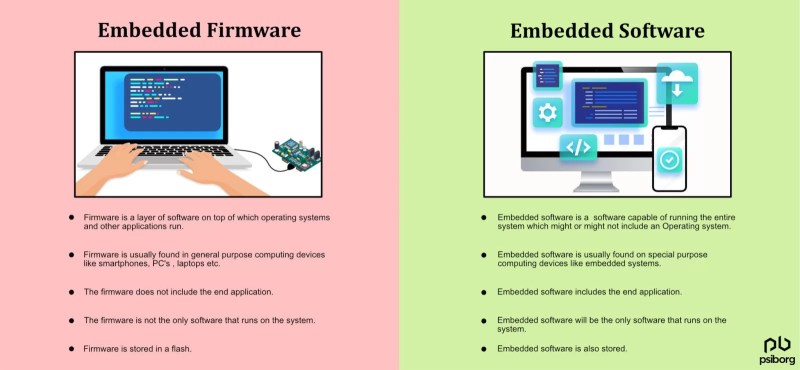
| Embedded Firmware Development | General Software Development |
|---|---|
| Focuses on hardware-specific constraints (memory, power, real-time deadlines). | Prioritizes user experience, scalability, and cross-platform compatibility. |
| Uses low-level languages (C, assembly) and minimal abstractions (HALs, RTOS). | Relies on high-level languages (Python, Java, C#) and frameworks (React, Django). |
| Testing emphasizes hardware-in-the-loop (HIL) and field validation. | Testing focuses on unit, integration, and user acceptance testing (UAT). |
| Deployment involves flashing firmware via JTAG, UART, or OTA updates. | Deployment typically uses package managers, cloud services, or app stores. |
Future Trends and Innovations
The embedded firmware development process is evolving alongside the hardware it controls, with trends like heterogeneous computing, AI at the edge, and quantum-resistant security reshaping the landscape. Heterogeneous systems—combining CPUs, GPUs, and FPGAs on a single chip—are pushing firmware to manage diverse processing units, requiring new paradigms for task scheduling and memory coherence. Meanwhile, the integration of machine learning into embedded devices (e.g., always-on voice assistants or predictive maintenance) demands firmware that can run neural networks on microcontrollers with as little as 1MB of RAM. Tools like TensorFlow Lite for Microcontrollers are enabling this shift, but they introduce new challenges in quantization, model pruning, and real-time inference.
Security is another frontier. As IoT devices become targets for ransomware and state-sponsored attacks, the embedded firmware development process must incorporate post-quantum cryptography, hardware security modules (HSMs), and runtime integrity checks. Standards like PSA Certified (Platform Security Architecture) are emerging to provide a baseline for secure firmware development, but adoption remains uneven. Additionally, the rise of "firmware-as-a-service" models—where OEMs outsource firmware updates to cloud providers—is blurring the lines between traditional embedded development and SaaS. These trends suggest that the future of firmware won’t just be about writing code but about architecting resilient, adaptive systems that can evolve alongside their hardware and the threats they face.
Conclusion
The embedded firmware development process is more than a technical discipline; it’s the invisible force that powers the devices we rely on daily. Its evolution reflects broader technological shifts—from the early days of assembly programming to today’s AI-embedded microcontrollers—yet its core challenges remain: balancing performance, power, and reliability within strict hardware constraints. As systems grow more complex, the role of firmware engineers will only become more critical, bridging the gap between silicon and software in ways that pure desktop applications never could. The process demands a unique skill set: part hardware savant, part software artisan, with an unwavering attention to detail.
For industries and developers alike, understanding the embedded firmware development process isn’t optional—it’s essential. Whether you’re designing a life-saving medical device, optimizing a smart grid, or building the next generation of consumer electronics, the principles of firmware development will shape your success. The future belongs to those who can harness its power, turning constraints into opportunities and code into capability.
Comprehensive FAQs
Q: What programming languages are most commonly used in the embedded firmware development process?
A: The embedded firmware development process primarily uses C (for its low-level control and efficiency) and assembly (for performance-critical or hardware-specific sections). C++ is gaining traction in larger systems (e.g., automotive) due to its object-oriented features, but its overhead can be prohibitive in resource-constrained environments. Rust is emerging as a contender for safety-critical applications (e.g., aerospace) thanks to its memory safety guarantees, though adoption is still limited by toolchain maturity. High-level languages like Python are rarely used in bare-metal firmware but appear in scripting layers or high-level configurations.
Q: How does the embedded firmware development process handle real-time constraints?
A: Real-time constraints in the embedded firmware development process are managed through a combination of techniques: priority-based scheduling (via RTOS kernels like FreeRTOS or Zephyr), interrupt-driven programming (where hardware events trigger immediate responses), and worst-case execution time (WCET) analysis to ensure tasks complete within deadlines. Critical sections are often protected using mutexes or atomic operations, and timing diagrams (e.g., UML sequence diagrams) are used to model and verify system behavior. Tools like OSEK or AUTOSAR provide standardized frameworks for deterministic timing in automotive and industrial applications.
Q: What are the biggest challenges in the embedded firmware development process?
A: The embedded firmware development process faces several key challenges: memory fragmentation (where dynamic allocations fail due to limited heap space), hardware dependencies (requiring deep expertise in specific microcontrollers), debugging complexity (especially in distributed systems or field-deployed devices), and security vulnerabilities (from unpatched firmware to side-channel attacks). Additionally, the lack of standardized toolchains across vendors and the iterative nature of hardware-software co-design (where firmware must adapt to changing hardware specs) add layers of difficulty. Testing is another hurdle—emulating real-world conditions in a lab is often impossible, leading to costly field failures.
Q: Can the embedded firmware development process support over-the-air (OTA) updates?
A: Yes, OTA updates are a standard feature in modern embedded firmware development, particularly for IoT devices and consumer electronics. The process involves partitioning firmware into updateable segments, using cryptographic signatures to verify authenticity, and implementing rollback mechanisms in case of failed updates. Tools like Mbed TLS or AWS IoT Core provide libraries for secure OTA, while bootloaders (e.g., MCUBoot) manage the update process. Challenges include limited bandwidth, power constraints during updates, and ensuring atomicity (no partial updates that brick the device). Some systems use delta updates to minimize data transfer, while others employ dual-bank memory to switch between old and new firmware seamlessly.
Q: How does the embedded firmware development process differ in safety-critical vs. non-critical applications?
A: In safety-critical applications (e.g., medical devices, automotive systems), the embedded firmware development process adheres to strict standards like ISO 26262 (automotive), IEC 62304 (medical), or DO-178C (aerospace). This includes requirements for formal verification, fault tolerance (e.g., triple-modular redundancy), and traceability (documenting every design decision). Non-critical applications may skip these steps, relying instead on empirical testing and best practices. Safety-critical firmware often uses static analysis tools (e.g., Polyspace) to detect runtime errors, while non-critical firmware might prioritize speed of development over exhaustive validation. Additionally, safety-critical systems may require hardware watchdogs, ECC memory, or redundant processors to handle failures gracefully.
Leave a Comment
Comments are moderated before appearing. The data you submit is processed according to the Privacy Policy of versiliasolutions.oneagency.co.