How Enterprise Value Calculation Reshapes Valuation in 2024
Table of Contents
- The Complete Overview of Enterprise Value Calculation
- Historical Background and Evolution
- Core Mechanisms: How It Works
- Key Benefits and Crucial Impact
- Major Advantages
- Comparative Analysis
- Future Trends and Innovations
- Conclusion
- Comprehensive FAQs
- Q: Why is enterprise value calculation preferred over market capitalization in M&A?
- Q: How do interest rates affect enterprise value calculation?
- Q: Can enterprise value be negative?
- Q: How do intangible assets impact enterprise value calculation?
- Q: What’s the difference between EV/EBITDA and P/E ratios?
- Q: How do private equity firms use enterprise value calculation?
- Q: Can enterprise value be manipulated?
Enterprise value calculation isn’t just another financial metric—it’s the bedrock of modern valuation, where debt, equity, and market dynamics collide to reveal a company’s true worth. Unlike earnings-per-share or price-to-book ratios, which focus on narrow snapshots, enterprise value (EV) strips away accounting distortions to expose the holistic cost of acquiring a business. This matters because, in 2024, private equity firms, strategic buyers, and even public market investors are increasingly relying on EV to price deals—especially in sectors where leverage plays a decisive role.
The problem? Most analysts still treat EV as a static number, plucked from a formula without understanding its behavioral implications. A tech startup with $500M in revenue might trade at a 12x EV multiple in a bull market, but that same multiple could collapse to 8x if interest rates spike. The difference isn’t just arithmetic; it’s a reflection of risk appetite, capital structure, and even geopolitical sentiment. Ignore these variables, and you’re not calculating EV—you’re guessing.
What separates elite valuation from the rest isn’t the formula itself, but the ability to contextualize it. Enterprise value calculation isn’t an endpoint; it’s a lens. It forces investors to ask: What does this company control beyond its balance sheet? The answer often lies in intangibles—patents, brand equity, or customer networks—that traditional metrics miss. Below, we dissect how EV works, why it dominates deal-making, and what’s next for this critical tool.

The Complete Overview of Enterprise Value Calculation
Enterprise value calculation serves as the financial equivalent of a stress test for a business. While market capitalization tells you what the public thinks a company is worth, EV adjusts for debt, cash, and minority interests to reflect the true cost of ownership. This distinction is critical because, in mergers and acquisitions (M&A), buyers rarely pay for equity alone—they’re acquiring a bundle of assets, liabilities, and growth potential. For example, a $10B market cap company with $2B in net debt might have an EV of $8B, signaling that its equity is overvalued relative to its capital structure.The beauty of EV lies in its adaptability. It’s used to compare companies across industries (e.g., a capital-intensive manufacturer vs. a cash-rich SaaS firm), benchmark performance against peers, and even predict distress before it hits the balance sheet. Yet, its power is often undermined by oversimplification. Many analysts treat EV as a one-size-fits-all metric, failing to account for how different sectors treat debt—some leverage aggressively (e.g., real estate), while others avoid it (e.g., biotech). The key insight? EV isn’t just a number; it’s a narrative about how a company deploys capital.
Historical Background and Evolution
The concept of enterprise value emerged in the mid-20th century as a response to the limitations of equity-based valuation. Before the 1960s, investors primarily relied on book value or earnings multiples, which ignored the role of debt in shaping a company’s financial flexibility. The shift began with the rise of leveraged buyouts (LBOs) in the 1980s, where private equity firms realized that a company’s worth wasn’t just its equity—it was the sum of all claims on its cash flows, including debt. This led to the formalization of EV as a standard in M&A transactions.Today, enterprise value calculation is a cornerstone of corporate finance, embedded in frameworks like discounted cash flow (DCF) analysis and comparable company multiples. The evolution reflects broader trends: the globalization of capital markets, the proliferation of debt instruments, and the increasing importance of intangible assets. For instance, in the 1990s, EV multiples for tech firms were often negative due to high R&D spending, but by the 2020s, AI-driven companies with minimal revenue but massive patent portfolios commanded premium valuations. The lesson? EV adapts to the economic era.
Core Mechanisms: How It Works
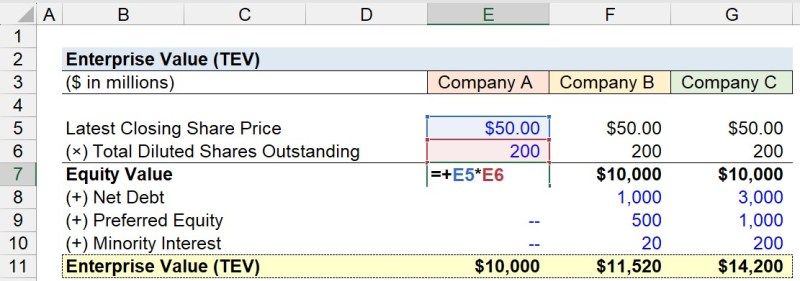
At its core, enterprise value calculation follows a deceptively simple formula:EV = Market Capitalization + Debt + Preferred Stock + Minority Interest – Cash and Cash Equivalents.
Each component serves a purpose:
The subtlety lies in the adjustments. For example, a company with $500M in cash might have an EV of $9.5B if its market cap is $10B, but if that cash is earmarked for acquisitions, its true EV could be higher. Similarly, off-balance-sheet liabilities (e.g., operating leases) must be incorporated to avoid understating the cost of capital. The process isn’t just mathematical—it’s interpretive.
Key Benefits and Crucial Impact
Enterprise value calculation isn’t just a tool; it’s a language that aligns buyers, sellers, and investors. In M&A, EV provides a common ground for negotiations, reducing disputes over whether debt should be included or cash should be netted. For public companies, EV multiples (e.g., EV/EBITDA) offer a clearer picture of operational efficiency than P/E ratios, which can be distorted by capital structure. Even in private markets, EV is the currency of choice for private equity firms evaluating portfolio companies, as it reflects the true cost of ownership.The impact extends beyond transactions. EV drives corporate strategy. A company with high EV relative to its peers may face pressure to improve margins or reduce debt. Conversely, a low EV can signal undervaluation, prompting buyout speculation. The metric also influences investor behavior: hedge funds targeting distressed assets often short stocks with high EV-to-cash ratios, betting on liquidation value.
"Enterprise value is the price you’d pay to take a company private tomorrow. If you’re not calculating it, you’re flying blind." — Martin Fridson, Portfolio Manager & Author of How to Read a Financial Report
Major Advantages
- Capital Structure Neutrality: EV adjusts for debt, allowing comparisons between highly leveraged and conservative companies. A $100M revenue firm with $50M debt and a $150M market cap has an EV of $200M, while a peer with no debt and a $200M market cap is on equal footing.
- M&A Precision: Buyers use EV to negotiate purchase prices, ensuring they account for all liabilities. For example, a $1B EV acquisition implies the buyer is paying for $1B in future cash flows, not just equity.
- Intangible Asset Visibility: EV captures goodwill, patents, and brand value, which equity-based metrics often overlook. A company with a strong IP portfolio may have a higher EV than its tangible assets suggest.
- Distress Signaling: Rising EV relative to cash flows can indicate overvaluation, while falling EV may signal distress before earnings decline. This is why activist investors target companies with "cheap" EV multiples.
- Global Standardization: EV is the default metric in cross-border deals, where currency fluctuations and local accounting rules complicate equity-based comparisons.
Comparative Analysis
| Metric | Enterprise Value (EV) vs. Alternative |
|---|---|
| Market Capitalization | EV adjusts for debt and cash, while market cap reflects only equity. A company with $1B market cap and $500M debt has an EV of $1.5B. |
| Book Value | EV is forward-looking (based on cash flows), while book value is historical (based on assets). A tech firm with $1B in intangibles may have a low book value but high EV. |
| EBITDA Multiples | EV/EBITDA is industry-standard for comparables, but EV alone doesn’t account for growth potential. A high-growth firm may trade at 15x EV/EBITDA despite negative earnings. |
| Free Cash Flow (FCF) Valuation | EV is used as the terminal value in DCF models, but FCF discounts future cash flows to present value. EV provides the "price," while DCF justifies it. |
Future Trends and Innovations
The next frontier in enterprise value calculation lies in integrating alternative data and machine learning. Traditional EV models rely on financial statements, but emerging techniques use satellite imagery (for retail foot traffic), credit card transactions (for consumer trends), and even employee reviews (for culture risk) to refine valuations. For example, a private equity firm might adjust a restaurant chain’s EV upward if its same-store sales data shows resilience in recessionary periods.Another shift is the rise of "total enterprise value" (TEV), which includes off-balance-sheet items like pension liabilities and environmental, social, and governance (ESG) risks. Regulatory changes, such as IFRS 16 (lease accounting), are also forcing companies to rethink how they report debt, indirectly inflating EV in capital-light sectors. As capital becomes scarcer, EV will increasingly reflect not just historical performance but resilience—how well a company can withstand macro shocks.
Conclusion
Enterprise value calculation is more than a formula—it’s a reflection of how capital is allocated in the modern economy. Whether you’re pricing a $50M acquisition or evaluating a Fortune 500 giant, EV cuts through the noise to reveal what really matters: the cost of controlling a business. The metric’s strength lies in its flexibility, but its weakness is the assumption that all debt and cash are equal. In reality, a $100M loan at 3% is materially different from a $100M loan at 12%, and a $1B cash hoard isn’t the same as a $1B war chest earmarked for R&D.As valuation practices evolve, the best analysts won’t just crunch numbers—they’ll ask why those numbers exist. Is a high EV justified by growth, or is it masking inefficiency? Is debt strategic, or is it a ticking time bomb? The answers will define the next era of enterprise value calculation.
Comprehensive FAQs
Q: Why is enterprise value calculation preferred over market capitalization in M&A?
A: Market cap reflects only equity, while EV accounts for all claims on a company—debt, minority interests, and cash. In M&A, buyers pay for the entire business, not just its equity. For example, a $10B market cap company with $3B in debt has an EV of $13B, which is the true purchase price.
Q: How do interest rates affect enterprise value calculation?
A: Higher rates increase the cost of debt, which can reduce EV by making companies less attractive to buyers. Conversely, low rates boost EV by lowering financing costs. This is why tech valuations surged in 2021 (low rates) and contracted in 2022 (rate hikes).
Q: Can enterprise value be negative?
A: Yes, if a company’s cash exceeds its market cap and debt. For example, a cash-rich firm with a $500M market cap, $100M debt, and $600M in cash has an EV of $0. This often occurs in distressed assets or highly liquid businesses (e.g., some financial institutions).
Q: How do intangible assets impact enterprise value calculation?
A: Intangibles (patents, brands, customer lists) are embedded in EV through goodwill and other assets. A company with a strong IP portfolio may have an EV 2-3x its tangible book value. For instance, a biotech firm with no revenue but a promising drug pipeline could trade at a high EV based on future royalties.
Q: What’s the difference between EV/EBITDA and P/E ratios?
A: EV/EBITDA is capital-structure neutral (ignores debt), while P/E depends on net income, which is affected by interest expenses. A highly leveraged firm might have a high P/E but a low EV/EBITDA, signaling it’s expensive due to debt costs rather than growth.
Q: How do private equity firms use enterprise value calculation?
A: PE firms rely on EV to assess acquisition targets, often targeting companies with EV below their intrinsic value (based on DCF or comparable multiples). They also use EV to model returns, as their IRR calculations depend on the total capital deployed (equity + debt).
Q: Can enterprise value be manipulated?
A: Indirectly. Companies can inflate EV by taking on debt (increasing the numerator) or by offloading cash (reducing the cash subtraction). Conversely, they can reduce EV by paying down debt or hoarding cash. This is why "window dressing" (e.g., delaying capex before earnings reports) can temporarily boost EV.
Leave a Comment
Comments are moderated before appearing. The data you submit is processed according to the Privacy Policy of versiliasolutions.oneagency.co.