The Hidden Power of a Fake Name Generator: Privacy, Creativity, and Control
Table of Contents
- The Complete Overview of Fake Name Generators
- Historical Background and Evolution
- Core Mechanisms: How It Works
- Key Benefits and Crucial Impact
- Major Advantages
- Comparative Analysis
- Future Trends and Innovations
- Conclusion
- Comprehensive FAQs
- Q: Are names generated by these tools legally protected?
- Q: Can I use a fake name generator for professional purposes, like LinkedIn?
- Q: How do I ensure the generated name sounds authentic?
- Q: Are there free fake name generators that don’t track my data?
- Q: Can I generate names for non-human entities, like AI characters or brands?
Every online interaction leaves a trace—yet sometimes, the name attached to that trace doesn’t belong to you. Whether it’s testing a new identity in a role-playing game, protecting personal data in public forums, or crafting a fictional persona for a creative project, the need for a reliable fake name generator has never been more precise. These tools don’t just spit out random strings; they weave believable identities from cultural nuances, linguistic patterns, and psychological plausibility. The best ones mimic the cadence of real names while adhering to the rules of syntax, phonetics, and even regional authenticity.
Consider the paradox: a tool designed to fabricate names must itself feel authentic. The algorithms behind modern fake name generators don’t just shuffle letters—they simulate the organic evolution of names across cultures, eras, and social strata. A name like "Seraphina Vexley" might sound like a fantasy character, but its structure follows the same principles as "Sophia Martinez" or "Mohammed Al-Farsi." The difference lies in the context: one is a placeholder, the other a lived identity. Yet both demand the same level of craftsmanship to avoid detection.
Behind every generated name is a story—sometimes literal, sometimes strategic. A developer might use a pseudonym generator to avoid doxxing in open-source contributions. A novelist might test a protagonist’s name for resonance before committing to print. Even in gaming, where "XxNoobSlayer69xX" once dominated, today’s players seek names that sound like they could belong to a guild leader or a legendary warrior. The shift reflects a broader cultural move: from anonymity as a shield to identity as a carefully curated artifact.
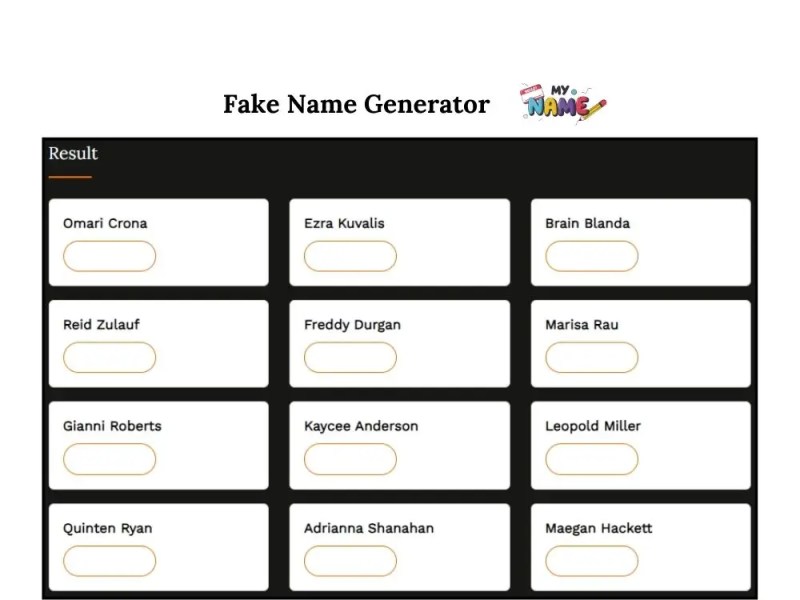
The Complete Overview of Fake Name Generators
A fake name generator is more than a randomizer—it’s a bridge between digital necessity and human psychology. At its core, the tool serves three primary functions: anonymization, creativity, and experimentation. Anonymization is the most immediate use case, where users generate names to obscure their real identities in public spaces, whether to avoid harassment, protect professional reputations, or maintain privacy in sensitive discussions. Creativity enters when writers, game designers, or content creators need names that feel organic yet distinct from their own. Experimentation comes into play for those testing personas—marketers A/B testing brand voices, researchers simulating demographic data, or even parents jokingly naming their hypothetical children.
The evolution of these tools mirrors broader technological shifts. Early versions relied on simple letter combinations or predefined lists, often producing names that felt either too generic or absurdly contrived. Modern fake name generators, however, incorporate machine learning to analyze real-world naming patterns. Some even allow customization—adjusting for gender, ethnicity, or era—to ensure the output aligns with specific narrative or cultural requirements. The result? Names that pass the "sniff test" of plausibility, whether in a high-stakes online debate or a meticulously crafted fantasy world.
Historical Background and Evolution
The concept of pseudonyms predates digital tools by centuries. Ancient poets like Homer and Virgil used pen names to distance their work from personal identity, while 19th-century authors like Mark Twain (Samuel Clemens) embraced pseudonyms for marketability or anonymity. The internet, however, democratized the need for fake name generators, turning a niche literary practice into a daily utility. Early online forums in the 1990s saw the rise of handles like "EliteGamer420," but these lacked the sophistication of today’s tools. The real turning point came with the advent of AI and big data, allowing generators to pull from vast datasets of real names, adjust for phonetic rules, and even simulate naming conventions across languages.
Today, the landscape is fragmented but specialized. Some tools focus on gaming or social media, others on academic or professional anonymity. High-end fake name generators now offer features like name validation (checking for existing domain registrations) or cultural authenticity filters (e.g., generating Japanese names with correct kanji structures). The market has also splintered into free, ad-supported tools and premium services with advanced customization, reflecting the growing stakes of digital identity management.
Core Mechanisms: How It Works
Under the hood, a fake name generator operates on two layers: algorithmic generation and contextual refinement. The first layer uses probabilistic models to combine syllables, prefixes, and suffixes based on linguistic rules. For example, a generator might favor "-son" endings for Scandinavian names or "-itz" for Slavic surnames. The second layer applies filters—such as gender distribution, geographic origin, or even celebrity name avoidance—to ensure the output meets the user’s criteria. Some advanced tools integrate with APIs to cross-reference generated names against real-world databases, flagging duplicates or overly common combinations.
Customization is where the magic happens. Users can specify parameters like name length, syllable complexity, or even the perceived "age" of the name (e.g., medieval vs. modern). The best generators also account for cultural taboos—avoiding offensive combinations or names tied to sensitive historical contexts. For instance, a generator designed for fantasy RPGs might exclude names that sound too similar to real-world figures, while one for academic research could prioritize neutrality to prevent bias in studies. The result is a name that serves its purpose without drawing unwanted attention.
Key Benefits and Crucial Impact
The utility of a fake name generator extends beyond novelty. In an era where data breaches and online harassment are rampant, these tools provide a first line of defense for digital privacy. For creatives, they unlock worlds of possibility, allowing writers to test names before committing to a manuscript or game designers to build immersive backstories without constraint. Even in professional settings, they enable discreet experimentation—such as A/B testing marketing personas or simulating user demographics without revealing real identities.
The psychological impact is equally significant. A well-crafted pseudonym can foster a sense of agency, letting users engage with online spaces on their own terms. For marginalized groups, it offers a layer of protection; for introverts, it reduces social friction. The tools also play a role in digital citizenship, encouraging thoughtful engagement by separating personal and online identities. As one cybersecurity expert noted, "A fake name generator isn’t just about hiding—it’s about reclaiming control over how you’re perceived."
— Dr. Elena Voss, Digital Identity Researcher
"The most effective pseudonyms aren’t random; they’re strategic. A name like 'Alexei Volkov' might sound plausible in a Russian forum, but 'Zorblax the Unyielding' fails the authenticity test. The best generators teach users to think like linguists, not just hackers."
Major Advantages
- Enhanced Privacy: Generates names that don’t link to real identities, reducing risks of doxxing or targeted harassment.
- Cultural and Linguistic Accuracy: Produces names that adhere to specific cultural or historical naming conventions, avoiding anachronisms or stereotypes.
- Customization for Purpose: Adjusts for gender, ethnicity, era, or even profession (e.g., a "detective" name for a noir novel).
- Avoidance of Conflicts: Cross-references against existing names (domains, social media handles) to prevent duplicates.
- Creative Freedom: Enables writers, game designers, and marketers to iterate on names without creative blocks.
Comparative Analysis
| Feature | Basic Fake Name Generator | Premium Fake Name Generator |
|---|---|---|
| Customization Depth | Limited to gender/length (e.g., "male, 5 syllables"). | Advanced filters: culture, era, phonetic rules, and even "name vibe" (e.g., "mysterious," "heroic"). |
| Validation | None; may produce duplicates or unrealistic names. | API checks for existing names, cultural sensitivity scans. |
| Output Quality | Randomized but often generic or awkward. | Contextually appropriate, with options for "realistic" or "fantasy" styles. |
| Use Cases | Casual gaming, simple anonymity. | Academic research, professional testing, high-stakes anonymization. |

Future Trends and Innovations
The next generation of fake name generators will likely blur the line between tool and collaborator. AI models trained on global naming datasets could offer real-time feedback, suggesting tweaks to a generated name based on its intended context—whether it’s a character in a sci-fi novel or a handle for a new cryptocurrency project. Voice synthesis integration might allow users to "hear" how a name sounds, further refining plausibility. Meanwhile, blockchain-based generators could emerge, offering verifiable anonymity for high-risk users, such as journalists or activists.
Ethical considerations will also shape the future. As generators become more sophisticated, debates over "deepfake identities" and the psychological effects of prolonged pseudonym use will intensify. Some tools may introduce "identity aging" features, letting users simulate how a name might evolve over decades, or "cultural blending" options, combining elements from multiple traditions. The goal? To make every generated name feel not just fake, but real—at least for the duration it’s needed.
Conclusion
A fake name generator is more than a gimmick; it’s a reflection of our digital duality. On one hand, it’s a shield against the surveillance economy, a playground for creativity, and a bridge between privacy and expression. On the other, it raises questions about authenticity in an age where even our avatars are curated. The tools themselves are evolving from simple randomizers to intelligent assistants, capable of understanding the nuances of identity across cultures and contexts. As they do, they’ll continue to redefine what it means to be—or not be—yourself online.
The choice of name, whether real or fabricated, is never neutral. It’s a statement, a strategy, or a secret. And in a world where every click leaves a trace, the right fake name generator ensures that trace belongs to someone else.
Comprehensive FAQs
Q: Are names generated by these tools legally protected?
A: No. Generated names are considered public domain unless explicitly tied to a trademarked or copyrighted work. However, using a generated name to impersonate a real person (e.g., a celebrity) could violate anti-harassment laws. Always ensure the name doesn’t infringe on existing intellectual property.
Q: Can I use a fake name generator for professional purposes, like LinkedIn?
A: While possible, it’s ethically risky. LinkedIn’s terms prohibit fake profiles, and using a generated name could damage credibility. For professional anonymity, consider a pseudonym generator designed for research or consulting, but disclose your intent if required by platform policies.
Q: How do I ensure the generated name sounds authentic?
A: Look for tools with cultural filters and phonetic validation. Test the name in context—e.g., say it aloud or check how it reads in different fonts. Advanced generators allow you to compare against real naming patterns for a specific region or era.
Q: Are there free fake name generators that don’t track my data?
A: Yes, but with trade-offs. Tools like NameMesh or Fantasy Name Generators offer free tiers with minimal tracking. For privacy-focused use, opt for open-source alternatives or those with transparent privacy policies.
Q: Can I generate names for non-human entities, like AI characters or brands?
A: Absolutely. Many generators support "brandable" names with customizable complexity. For AI characters, prioritize tools that allow syllable control and "otherworldly" adjustments (e.g., alien-like structures). Always check for trademark conflicts before finalizing.
Leave a Comment
Comments are moderated before appearing. The data you submit is processed according to the Privacy Policy of versiliasolutions.oneagency.co.