How to Use a Find the Inverse Calculator for Precision Math
Table of Contents
- The Complete Overview of Finding Inverses with Digital Tools
- Historical Background and Evolution
- Core Mechanisms: How It Works
- Key Benefits and Crucial Impact
- Major Advantages
- Comparative Analysis
- Future Trends and Innovations
- Conclusion
- Comprehensive FAQs
- Q: Can a find the inverse calculator handle non-square matrices?
- Q: How accurate are online inverse calculators compared to manual methods?
- Q: Are there free alternatives to paid inverse calculators?
- Q: Can a find the inverse calculator solve for inverses of parametric equations?
- Q: What should I do if a calculator returns "undefined" for an inverse?
- Q: How do I verify the correctness of an inverse calculator’s output?
- Q: Are there mobile apps specifically for inverse calculations?
- Q: Can a find the inverse calculator work with complex numbers?
- Q: What’s the fastest method for computing matrix inverses?
- Q: Do inverse calculators work for piecewise functions?
Mathematics often demands precision, and when solving for inverses—whether of functions, matrices, or numbers—the stakes are high. A find the inverse calculator is not just a tool but a lifeline for students, engineers, and data scientists navigating complex equations. Without it, manual calculations become error-prone, time-consuming, and prone to human oversight. The ability to instantly compute inverses transforms theoretical problems into actionable solutions, bridging the gap between abstract concepts and real-world applications.
The need for such tools arises in fields where accuracy is non-negotiable. Financial analysts rely on inverse matrices to optimize portfolios, while physicists use inverse functions to model dynamic systems. Even in everyday scenarios, like decrypting codes or adjusting algorithmic parameters, the inverse calculator becomes indispensable. Its evolution mirrors the broader trajectory of computational mathematics—from cumbersome paper-and-pencil methods to seamless digital integration.
Yet, not all inverse calculators are created equal. Some specialize in linear algebra, others in transcendental functions, and a select few handle both with equal proficiency. The choice depends on the user’s domain: a data scientist might prioritize matrix inversion speed, while a high school student may need a step-by-step breakdown for educational clarity. Understanding these distinctions is key to harnessing the full potential of a find the inverse calculator.
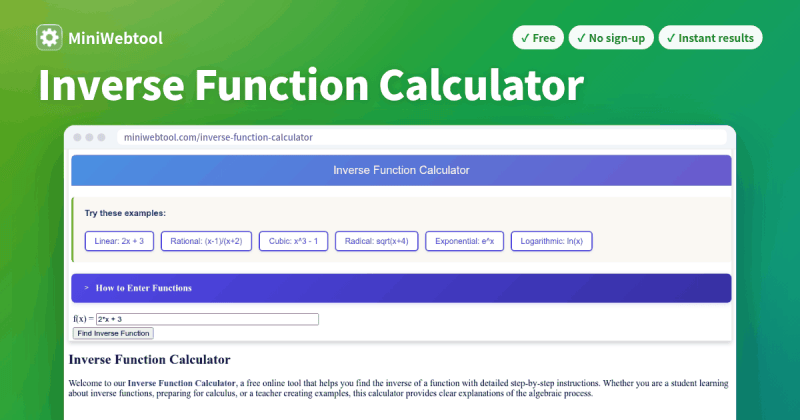
The Complete Overview of Finding Inverses with Digital Tools
At its core, a find the inverse calculator automates the process of determining the multiplicative or functional inverse of a given input. Whether it’s solving for \( f^{-1}(x) \) in calculus or computing \( A^{-1} \) in linear algebra, these tools eliminate the tedium of manual derivation. Their design varies—some are embedded in graphing calculators, others are standalone web applications, and advanced versions integrate with programming languages like Python or MATLAB. The unifying factor is their ability to handle operations that would otherwise require hours of computation.The rise of digital inverse calculators coincides with the democratization of mathematical software. Historically, inverses were computed using logarithmic tables or iterative methods like the Jacobi or Gauss-Seidel algorithms. Today, these tools leverage optimized algorithms (e.g., LU decomposition for matrices) and parallel processing to deliver results in milliseconds. For professionals, this shift has been revolutionary; for learners, it’s a gateway to deeper conceptual understanding.
Historical Background and Evolution
The concept of inversion dates back to the 17th century, when mathematicians like Leonhard Euler formalized the idea of functional inverses. However, practical computation remained limited until the advent of mechanical calculators in the 19th century. Early models, such as the Arithmometer, could perform basic arithmetic but lacked the sophistication to handle matrix inverses. The breakthrough came with the rise of electronic computers in the mid-20th century, which enabled algorithms like Gaussian elimination to be executed programmatically.The 1980s and 1990s saw the proliferation of handheld calculators—devices like the TI-83 introduced built-in inverse functions, democratizing access to advanced mathematics. Concurrently, software packages such as Mathematica and MATLAB emerged, offering symbolic and numerical inversion capabilities. Today, cloud-based find the inverse calculator tools (e.g., Wolfram Alpha, Symbolab) provide instant results with minimal input, reflecting the intersection of accessibility and computational power.
Core Mechanisms: How It Works
The inner workings of an inverse calculator depend on the type of input. For numbers (e.g., finding the reciprocal of 5), the operation is straightforward: \( x^{-1} = \frac{1}{x} \). However, for functions or matrices, the process is far more complex. Functional inverses require solving \( y = f(x) \) for \( x \) in terms of \( y \), which may involve implicit differentiation or numerical approximation. Matrix inverses, on the other hand, rely on linear algebra techniques such as determinant calculation and adjugate matrices, or more efficiently, LU decomposition.Modern calculators often employ hybrid approaches: symbolic methods for exact solutions (e.g., \( \sin^{-1}(x) \)) and numerical methods (e.g., Newton-Raphson) for approximations. The choice of method impacts both speed and accuracy. For instance, a find the inverse calculator designed for engineers might prioritize floating-point precision, while an educational tool might emphasize step-by-step explanations to aid learning.
Key Benefits and Crucial Impact
The adoption of inverse calculators has reshaped industries where mathematical precision is critical. In finance, portfolio optimization models rely on inverse matrices to solve systems of equations representing asset correlations. In engineering, control systems use inverse functions to design feedback loops. Even in computer graphics, inverse transformations are essential for rendering 3D scenes. The efficiency gained from these tools translates directly into cost savings and innovation.Beyond professional applications, inverse calculators have become indispensable in academia. Students can verify homework solutions instantly, while instructors use them to generate complex problems for exams. The educational value lies not just in the answers but in the visualizations and intermediate steps provided by many modern tools, which demystify abstract concepts.
"An inverse calculator is to mathematics what a microscope is to biology—it reveals structures invisible to the naked eye, turning complexity into clarity." — Dr. Elena Voss, Applied Mathematics Professor, MIT
Major Advantages
- Speed and Accuracy: Eliminates human error in repetitive calculations, ensuring results are both fast and precise.
- Versatility: Handles a wide range of inputs, from simple reciprocals to high-dimensional matrices and transcendental functions.
- Educational Value: Many tools provide step-by-step solutions, making them ideal for self-study and classroom use.
- Integration with Workflows: Compatible with programming languages (e.g., NumPy for Python) and CAD software, streamlining professional workflows.
- Accessibility: Web-based and mobile apps remove hardware limitations, allowing users to compute inverses anywhere.
Comparative Analysis
| Feature | Web-Based Tools (e.g., Symbolab) | Handheld Calculators (e.g., TI-Nspire) | Programming Libraries (e.g., NumPy) |
|---|---|---|---|
| Ease of Use | Intuitive interfaces, no setup required. | Requires basic training; limited screen space. | Steep learning curve; syntax-dependent. |
| Precision | High for symbolic math; variable for numerical. | Limited by hardware (e.g., 10-digit displays). | Arbitrary precision with custom configurations. |
| Functionality | Supports functions, matrices, and equations. | Specialized for academic use (e.g., calculus). | Extensible for niche applications (e.g., quantum computing). |
| Cost | Free or freemium; ads may appear. | One-time purchase (~$100–$200). | Free (open-source) or licensed (~$50–$500). |

Future Trends and Innovations
The next generation of find the inverse calculator tools will likely integrate artificial intelligence to handle ambiguous or partial inputs. For example, a calculator might infer the intended inverse (e.g., matrix vs. function) based on context or user history. Additionally, quantum computing could revolutionize matrix inversion by leveraging linear algebra’s parallelizable nature, reducing computation time for large datasets from hours to seconds.Another trend is the fusion of inverse calculators with augmented reality (AR). Imagine pointing a smartphone at a printed equation and instantly seeing its inverse solution overlaid in real time. For industries like robotics or aerospace, where real-time calculations are critical, such advancements could be game-changing. The future of these tools lies at the intersection of hardware acceleration, AI-driven automation, and immersive interfaces.
Conclusion
A find the inverse calculator is more than a convenience—it’s a force multiplier for anyone working with mathematics. Its ability to transform abstract problems into actionable insights has made it a staple in education, research, and industry. As technology advances, these tools will only become more sophisticated, blurring the line between human intuition and machine precision.For users, the key is selecting the right tool for the task: a student might opt for a step-by-step web app, while a data scientist could integrate a library like SciPy into their workflow. The landscape is evolving, but the core principle remains unchanged—precision is power, and the inverse calculator delivers it effortlessly.
Comprehensive FAQs
Q: Can a find the inverse calculator handle non-square matrices?
A: No. Matrix inverses only exist for square matrices (where rows = columns) with a non-zero determinant. For non-square matrices, tools compute pseudoinverses (e.g., Moore-Penrose inverse) instead.
Q: How accurate are online inverse calculators compared to manual methods?
A: Online tools are significantly more accurate, especially for complex functions or large matrices. Manual methods are prone to rounding errors, while digital calculators use floating-point arithmetic with high precision (e.g., 15–17 decimal places).
Q: Are there free alternatives to paid inverse calculators?
A: Yes. Tools like Wolfram Alpha, Symbolab, and Python’s NumPy library offer free access to inverse calculations. Open-source software (e.g., SageMath) also provides robust alternatives without licensing fees.
Q: Can a find the inverse calculator solve for inverses of parametric equations?
A: Some advanced calculators can handle parametric inverses by treating them as systems of equations. For example, given \( x = t^2 \) and \( y = t + 1 \), the tool may express \( t \) in terms of \( x \) and \( y \), then solve for the inverse relationship.
Q: What should I do if a calculator returns "undefined" for an inverse?
A: "Undefined" typically means the inverse doesn’t exist. For functions, this occurs with non-bijective mappings (e.g., \( f(x) = x^2 \)). For matrices, it indicates a zero determinant (singular matrix). Check the input’s properties or consult the calculator’s error messages for specifics.
Q: How do I verify the correctness of an inverse calculator’s output?
A: Multiply the original matrix/function by its supposed inverse and check if the result is the identity matrix/function. For example, if \( A \times A^{-1} = I \), the inverse is correct. For functions, verify \( f(f^{-1}(x)) = x \).
Q: Are there mobile apps specifically for inverse calculations?
A: Yes. Apps like "Mathway" (iOS/Android) and "Photomath" include inverse-solving capabilities. Specialized apps like "Matrix Calculator" (Android) focus exclusively on linear algebra operations, including inverses.
Q: Can a find the inverse calculator work with complex numbers?
A: Many modern calculators support complex inverses. For example, the inverse of \( a + bi \) is \( \frac{a - bi}{a^2 + b^2} \). Tools like Wolfram Alpha or MATLAB’s `inv()` function handle complex matrices seamlessly.
Q: What’s the fastest method for computing matrix inverses?
A: The fastest method depends on the matrix size. For small matrices (<100x100), LU decomposition with partial pivoting is efficient. For larger matrices, iterative methods like the Conjugate Gradient or specialized libraries (e.g., Intel MKL) optimize performance using GPU acceleration.
Q: Do inverse calculators work for piecewise functions?
A: Limited support exists. Most calculators handle continuous functions but may fail on piecewise definitions unless explicitly programmed to recognize domains. For example, \( f(x) = \begin{cases} x^2 & \text{if } x \geq 0 \\ -x & \text{otherwise} \end{cases} \) requires custom logic to invert correctly.
Leave a Comment
Comments are moderated before appearing. The data you submit is processed according to the Privacy Policy of versiliasolutions.oneagency.co.