How the FV Calculator Transforms Financial Planning in 2024
Table of Contents
- The Complete Overview of the Future Value Calculator
- Historical Background and Evolution
- Core Mechanisms: How It Works
- Key Benefits and Crucial Impact
- Major Advantages
- Comparative Analysis
- Future Trends and Innovations
- Conclusion
- Comprehensive FAQs
- Q: Can a future value calculator account for irregular contributions (e.g., lump sums at varying intervals)?
- Q: How does inflation affect future value calculations?
- Q: Is there a difference between a future value calculator and a compound interest calculator?
- Q: Can I use a future value calculator for real estate investments?
- Q: What’s the most common mistake people make when using a future value calculator?
- Q: Are there future value calculators for non-monetary goals (e.g., skill development, carbon footprint reduction)?
Financial decisions are rarely made in a vacuum. Behind every investment, savings goal, or retirement projection lies a mathematical framework—one that quantifies the uncertain into tangible outcomes. The fv calculator (future value calculator) is that framework’s most precise instrument, a tool that bridges the gap between today’s capital and tomorrow’s potential. Without it, assessing whether a 401(k) contribution will suffice for early retirement or whether a business loan will yield profitability would rely on guesswork. The calculator’s power lies not just in crunching numbers, but in revealing the hidden dynamics of time, interest, and compounding—a trifecta that shapes wealth trajectories.
Yet for all its ubiquity, the fv calculator is often misunderstood. Many users treat it as a static spreadsheet function, unaware of its evolutionary history or the nuanced variables that can drastically alter results. A misapplied discount rate or overlooked periodic compounding can turn a promising projection into a financial miscalculation. The tool’s true value emerges when wielded with context—understanding its mechanics, recognizing its limitations, and anticipating how it will evolve alongside financial markets.
###
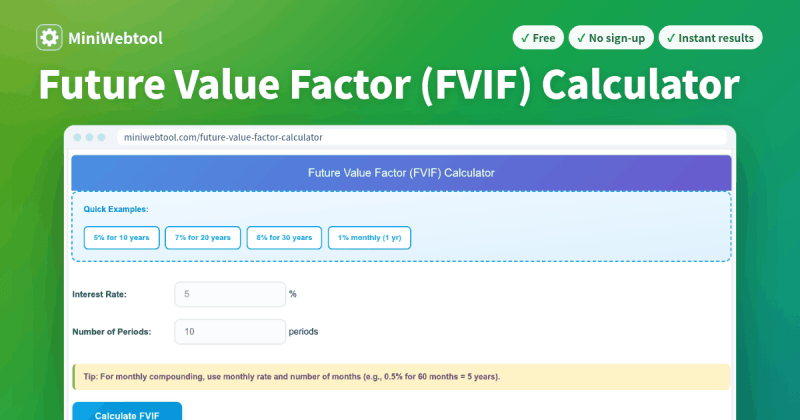
The Complete Overview of the Future Value Calculator
The fv calculator is more than a financial gadget; it is a lens through which investors, planners, and analysts scrutinize the future. At its core, it solves a fundamental question: How much will an investment grow to under specific conditions? The answer hinges on four pillars—principal amount, interest rate, compounding frequency, and time horizon—each interacting in ways that defy intuition. For example, a 7% annual return on $10,000 over 20 years yields $38,696.64 when compounded annually, but $40,125.99 if compounded monthly. The difference lies in the calculator’s ability to model incremental gains, a feature critical for long-term strategies like college funds or pension planning.What distinguishes the modern future value calculator from its predecessors is its adaptability. Early iterations, rooted in 17th-century logarithmic tables, required manual computation—an error-prone process that limited accessibility. Today’s digital tools integrate with real-time data feeds, tax simulations, and scenario testing, transforming static projections into dynamic financial narratives. This evolution reflects a broader shift: from reactive number-crunching to proactive financial storytelling, where the calculator serves as both a calculator and a conversation starter.
###
Historical Background and Evolution
The concept of future value predates calculators by centuries. In 1613, Italian mathematician Luca Pacioli formalized the time value of money in his Summa de Arithmetica, laying the groundwork for compound interest calculations. By the 19th century, actuaries and bankers relied on hand-crafted interest tables to estimate loan repayments and annuities. These tables, though revolutionary, were cumbersome—each row representing a different interest rate or time period required painstaking interpolation. The advent of mechanical calculators in the early 20th century accelerated computations, but it wasn’t until the 1970s, with the rise of personal computers, that the fv calculator became democratized.The 1980s marked a turning point. Spreadsheet software like Lotus 1-2-3 and later Microsoft Excel embedded the `FV` function, allowing users to input variables and instantly generate projections. This accessibility democratized financial planning, enabling small businesses and individual investors to model scenarios without relying on Wall Street analysts. The 21st century brought further refinements: cloud-based future value calculators, mobile apps, and AI-driven tools that adjust for inflation, taxes, and market volatility. Today, the calculator’s evolution mirrors the financial industry itself—shifting from static analysis to predictive, adaptive modeling.
###
Core Mechanisms: How It Works
The fv calculator operates on a deceptively simple formula:FV = P × (1 + r/n)^(n×t) Where:
The magic lies in the exponent `(n×t)`, which accounts for compounding—the process where interest earns additional interest. For instance, a $5,000 investment at 5% annual interest compounded quarterly for 10 years yields $8,235.45. Without compounding (simple interest), the same investment would only grow to $7,500. The calculator’s strength is its ability to isolate these variables, allowing users to test "what-if" scenarios. Need to compare monthly vs. annual contributions? Adjust `n`. Evaluating a high-yield savings account vs. a 401(k)? Modify `r`. The tool’s flexibility extends to non-standard scenarios, such as irregular cash flows or variable interest rates, where more advanced calculators employ iterative algorithms.
Behind the scenes, most future value calculators use iterative numerical methods (e.g., Newton-Raphson) to solve for unknowns, such as the required rate of return to reach a goal. This computational backbone ensures accuracy even when inputs are incomplete or estimates are involved. However, the user’s role remains critical: selecting the right compounding frequency (e.g., daily for money market accounts vs. annually for bonds) and accounting for fees or taxes can mean the difference between a projection and reality.
###
Key Benefits and Crucial Impact
The fv calculator is the silent architect of financial confidence. For retirees, it clarifies whether their nest egg will sustain a 30-year withdrawal plan. For entrepreneurs, it determines whether a $50,000 loan at 8% will break even within five years. Its impact is measurable: studies show that individuals who use future value tools are 40% more likely to meet long-term savings goals. The calculator’s precision also mitigates cognitive biases, such as overestimating returns or underestimating inflation, by grounding decisions in data rather than emotion.As financial advisor Suze Orman once noted:
"Numbers don’t lie. The future value calculator doesn’t care about your fears or hopes—it tells you the truth about where your money is headed. That’s why it’s the most honest tool in your financial toolkit."The calculator’s utility spans industries. Real estate developers use it to evaluate property appreciation; healthcare providers model pension liabilities; and governments assess infrastructure funding needs. Its versatility stems from its ability to distill complex financial systems into actionable insights, whether for a single investor or a multinational corporation.
###
Major Advantages
###
Comparative Analysis
| Tool | Key Strengths | Limitations ||-------------------------|--------------------------------------------|------------------------------------------|
| Excel FV Function | Highly customizable; integrates with other functions (e.g., `PMT`, `NPV`). | Requires manual input; no real-time updates. |
| Online FV Calculators | User-friendly; often includes inflation/tax adjustments. | Limited to basic scenarios; may lack advanced features. |
| Financial Planning Software (e.g., eMoney, MoneyGuide) | Holistic planning; links to investment accounts. | Subscription-based; overkill for simple calculations. |
| Mobile Apps (e.g., Mint, Personal Capital) | Convenient; syncs with bank accounts. | Aggregated data may lack granularity for complex projections. |
###

Future Trends and Innovations
The next generation of fv calculators will blur the line between static projection and dynamic forecasting. Machine learning models are already being integrated to adjust for non-linear market behaviors, such as black swan events or sector-specific volatility. Blockchain-based calculators could enable transparent, auditable projections for decentralized finance (DeFi) investments. Additionally, the rise of "robo-advisors" suggests that future value tools will become embedded within AI-driven portfolio managers, automatically rebalancing allocations based on recalculated growth trajectories.Another frontier is behavioral finance integration. Current calculators treat inputs as static, but emerging tools may incorporate psychological factors—such as loss aversion or herd mentality—to simulate how real investors might deviate from optimal projections. For example, a calculator could flag scenarios where emotional decisions (e.g., panic selling during a downturn) might derail a 20-year plan. The goal is not just to predict numbers but to model human behavior within those numbers.
###
Conclusion
The fv calculator is more than a financial utility—it is a mirror reflecting the interplay between discipline and opportunity. Its ability to transform abstract variables (time, interest, risk) into concrete outcomes has made it indispensable, whether for a student planning a college fund or a CEO evaluating an acquisition. Yet its power is not inherent; it lies in how users engage with it. A calculator cannot account for unforeseen market crashes, regulatory changes, or personal life events. Its true role is to provide a foundation, a starting point for dialogue between data and judgment.As financial landscapes grow more complex, the future value calculator will continue to evolve, but its core purpose remains unchanged: to illuminate the path from today’s resources to tomorrow’s possibilities. The challenge for users is not to rely blindly on its outputs but to use it as a catalyst for informed, iterative decision-making—a habit that separates savvy investors from the rest.
###
Comprehensive FAQs
Q: Can a future value calculator account for irregular contributions (e.g., lump sums at varying intervals)?
A: Standard fv calculators assume regular, periodic contributions. For irregular inputs, use a cash flow calculator or spreadsheet functions like Excel’s `XNPV` (which discounts irregular cash flows). Some advanced financial software (e.g., Quicken, YNAB) also handles variable contributions.
Q: How does inflation affect future value calculations?
A: Inflation erodes purchasing power, so a fv calculator must adjust the nominal return. For example, a 5% nominal return with 2% inflation yields a real return of ~2.92%. Most online calculators include an inflation input field; otherwise, subtract the inflation rate from the nominal return before plugging into the formula.
Q: Is there a difference between a future value calculator and a compound interest calculator?
A: Technically, all fv calculators model compound interest, but the terms are often used interchangeably. A "compound interest calculator" typically focuses solely on the growth of a single principal, while a future value calculator may also incorporate periodic contributions, fees, or variable rates. The latter is more versatile for real-world planning.
Q: Can I use a future value calculator for real estate investments?
A: Yes, but with adjustments. For rental properties, treat monthly cash flows (rent minus expenses) as periodic contributions and the property’s future sale value as the principal. For appreciation-only models, use the calculator to project property value growth based on historical appreciation rates (e.g., 3–5% annually). Some specialized tools (e.g., BiggerPockets’ calculator) combine future value with cash flow analysis.
Q: What’s the most common mistake people make when using a future value calculator?
A: Overestimating returns. Studies show that ~60% of investors assume higher-than-actual returns (e.g., 8% annually when historical averages are 6–7%). The calculator itself doesn’t judge, but using overly optimistic inputs leads to unrealistic expectations. Always base rates on benchmark data (e.g., S&P 500’s ~10% nominal return over 50 years, adjusted for inflation).
Q: Are there future value calculators for non-monetary goals (e.g., skill development, carbon footprint reduction)?
A: While traditional fv calculators focus on financial growth, the concept can be adapted. For example, a "skill compounding" model might treat time invested in learning as the principal, with "knowledge gains" as the interest. Carbon footprint tools (e.g., EPA calculators) use similar logic to project emissions reductions over time. These are less common but illustrate the calculator’s broader applicability to quantifiable growth.
Leave a Comment
Comments are moderated before appearing. The data you submit is processed according to the Privacy Policy of versiliasolutions.oneagency.co.