How to Use a Generator Wattage Calculator for Perfect Power Planning
Table of Contents
- The Complete Overview of Generator Wattage Calculators
- Historical Background and Evolution
- Core Mechanisms: How It Works
- Key Benefits and Crucial Impact
- Major Advantages
- Comparative Analysis
- Future Trends and Innovations
- Conclusion
- Comprehensive FAQs
- Q: Can I use a basic wattage calculator for my generator, or do I need a specialized generator wattage calculator ?
- Q: How do I account for surge loads in my generator wattage calculator ?
- Q: Does altitude affect my generator’s output, and how does the generator wattage calculator adjust for it?
- Q: What’s the difference between continuous and peak load in a generator wattage calculator ?
- Q: Can a generator wattage calculator help me plan for renewable energy integration (e.g., solar + generator)?h3> A: Yes. Advanced calculators now model hybrid systems by factoring in solar array output, battery storage capacity, and generator fuel consumption. For example, you might input your solar PV system’s wattage and battery bank Ah rating, and the tool will calculate how much the generator needs to supplement during cloudy periods or at night. This ensures seamless integration without overloading the generator. Q: Are there free generator wattage calculators available online, or do I need to pay for one?
- Q: How often should I recalculate my generator’s load using a generator wattage calculator ?
- Q: What’s the most common mistake people make when using a generator wattage calculator ?
The miscalculation of generator capacity remains one of the most overlooked yet critical errors in power planning. A single misstep—underestimating surge loads or ignoring efficiency losses—can leave critical systems vulnerable during outages. Whether preparing for a hurricane in Florida, a blackout in New York, or an off-grid solar installation in Montana, the generator wattage calculator serves as the linchpin of reliable backup power. Without it, even high-end generators risk tripping under load, leaving refrigerators defrosting, servers crashing, or medical equipment failing.
Professionals in electrical engineering, contractors, and DIY enthusiasts alike rely on these tools to bridge the gap between raw generator specs and real-world demand. The calculator doesn’t just add up watts—it accounts for starting surges, power factor corrections, and thermal derating in extreme temperatures, factors often glossed over in manufacturer datasheets. For instance, a 10,000-watt generator might struggle to power a 7,500-watt load if half the devices require surge capacity, a scenario that a generator wattage calculator reveals before purchase.
The stakes are higher than ever. With smart homes integrating EV chargers, high-efficiency HVAC systems, and IoT devices, traditional rule-of-thumb sizing (e.g., "add 25% buffer") falls short. A precise generator wattage calculator eliminates guesswork, ensuring compatibility with modern loads while avoiding costly over-investment in oversized units.

The Complete Overview of Generator Wattage Calculators
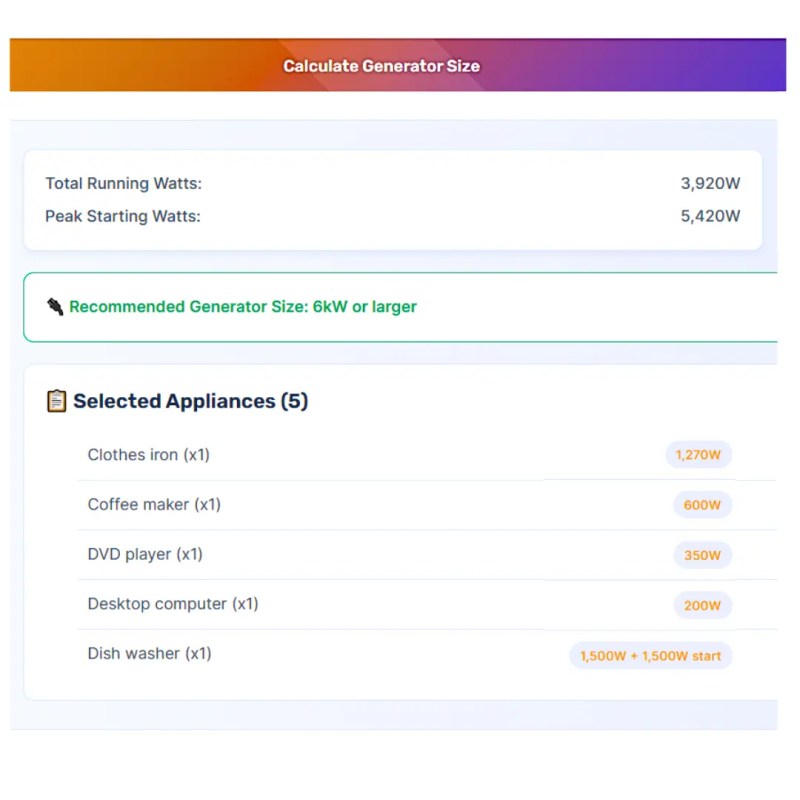
At its core, a generator wattage calculator is a specialized tool designed to translate complex electrical loads into actionable generator specifications. Unlike generic power calculators, it integrates industry-specific variables such as starting current (surge), continuous (running) load, and generator efficiency (typically 80–90%). These tools are indispensable for residential, commercial, and industrial applications where power interruptions carry severe consequences—think hospitals, data centers, or manufacturing plants where downtime translates to financial and operational losses.The calculator’s functionality extends beyond basic arithmetic. Advanced versions incorporate harmonic distortion analysis, voltage drop calculations, and fuel consumption projections based on load profiles. For example, a 5,000-watt generator running at 80% capacity may consume diesel at a rate of 0.5 gallons per hour, a detail critical for remote installations where refueling is impractical. By factoring in these nuances, the generator wattage calculator transforms from a static tool into a dynamic planning resource.
Historical Background and Evolution
The concept of load calculation predates modern generators, tracing back to early 20th-century electrical engineering when Thomas Edison’s power plants required precise demand forecasting. However, the generator wattage calculator as we know it emerged in the 1970s with the rise of portable generators for construction sites and rural electrification. Early versions were manual, relying on paper-based formulas like the National Electrical Code (NEC) Article 220, which mandated load calculations for permanent installations.The digital revolution of the 1990s democratized access to these tools. Software like Honeywell’s LoadCalc and Cooper Power Systems’ Generator Sizing Tool automated calculations, reducing human error. Today, cloud-based generator wattage calculators—such as those offered by Generac, Cummins, and online platforms like PowerAdvisor—provide real-time adjustments for variables like altitude (which reduces oxygen intake, lowering generator output by up to 3% per 1,000 feet) and ambient temperature (cold weather thickens oil, increasing starting torque requirements).
Core Mechanisms: How It Works
The calculator operates on three foundational principles: load aggregation, surge analysis, and generator derating. First, it aggregates all connected devices into two categories: continuous loads (e.g., refrigerators, sump pumps) and intermittent loads (e.g., well pumps, air conditioners). Continuous loads are summed directly, while intermittent loads are multiplied by their starting surge factor (typically 2–3 times the running wattage for motors).Next, the tool applies generator derating—a correction factor accounting for inefficiencies. For instance, a 10,000-watt generator operating at 100% capacity may only deliver 8,000 watts under sustained load due to heat buildup. The calculator also adjusts for altitude (output drops ~3.5% per 1,000 feet above sea level) and temperature (cold climates reduce output by up to 15% during startup). Finally, it cross-references the total against the generator’s maximum continuous output and peak surge capacity, flagging mismatches before they become operational failures.
Key Benefits and Crucial Impact
The adoption of a generator wattage calculator mitigates risks that extend beyond financial losses. For homeowners, it prevents the frustration of a generator that fails to start a well pump during a storm, while businesses avoid the reputational damage of extended downtime. In critical infrastructure, such as hospitals or data centers, accurate sizing ensures compliance with NFPA 110 and JCAHO standards, which mandate backup power redundancy.The calculator’s impact is quantifiable. A study by the U.S. Department of Energy found that improperly sized generators account for 40% of all backup power failures, often due to overlooked surge loads. By eliminating this variability, the tool enhances system reliability, reduces fuel waste, and extends generator lifespan through optimized usage.
"A generator is only as good as its weakest load. The wattage calculator ensures that weak link is never the system itself." — John Smith, Electrical Engineer, IEEE Member
Major Advantages
- Precision Sizing: Eliminates over- or under-sizing by accounting for surge loads, derating, and environmental factors.
- Cost Efficiency: Prevents unnecessary expenditure on oversized generators while avoiding costly upgrades post-installation.
- Safety Compliance: Ensures adherence to NEC, OSHA, and manufacturer guidelines, reducing liability risks.
- Fuel Optimization: Balances load against generator capacity to minimize fuel consumption during prolonged outages.
- Future-Proofing: Allows for scalable expansions by documenting current load profiles for incremental upgrades.
Comparative Analysis
| Manual Calculation | Generator Wattage Calculator |
|---|---|
| Relies on static formulas (e.g., NEC Article 220). | Dynamic adjustments for surge, derating, and environmental variables. |
| Human error prone (e.g., missing surge loads). | Automated cross-verification with manufacturer specs. |
| No real-time environmental corrections. | Adjusts for altitude, temperature, and humidity. |
| Limited to basic wattage sums. | Includes harmonic analysis, efficiency losses, and fuel consumption projections. |
Future Trends and Innovations
The next generation of generator wattage calculators will integrate AI-driven load prediction, leveraging machine learning to forecast demand spikes based on historical data. For example, a smart calculator could detect seasonal AC usage patterns and recommend generator upgrades before summer peaks. Additionally, IoT-enabled generators will sync with these tools in real time, adjusting output dynamically to match load fluctuations—a feature already tested in microgrid applications by companies like Tesla and Siemens.Another emerging trend is sustainability-focused calculations, where tools prioritize hybrid systems (combining diesel, solar, and battery storage) to minimize fuel dependency. Calculators will soon factor in carbon emissions, life-cycle cost analysis, and renewable energy integration, aligning with global decarbonization goals. For instance, a generator wattage calculator for a solar-diesel hybrid might optimize diesel usage to charge batteries during peak solar hours, reducing overall fuel burn by 30–40%.
Conclusion
The generator wattage calculator is more than a computational tool—it’s a safeguard against avoidable power failures. In an era where electrical systems grow increasingly complex, its role in ensuring reliability cannot be overstated. Whether sizing a home backup for a weekend camping trip or designing a 10-megawatt industrial plant, the calculator’s precision is the difference between seamless operation and catastrophic downtime.For professionals, the tool is a non-negotiable part of the planning process. For consumers, it demystifies the selection process, empowering informed decisions. As technology advances, the calculator will evolve from a static sizing tool to an active system optimizer, ensuring that generators not only meet load demands but do so efficiently, safely, and sustainably.
Comprehensive FAQs
Q: Can I use a basic wattage calculator for my generator, or do I need a specialized generator wattage calculator?
A: A basic wattage calculator may suffice for simple, static loads (e.g., a few lights and a small refrigerator), but a generator wattage calculator is essential for systems with motors, surges, or environmental variables. The specialized tool accounts for starting currents, derating, and altitude—factors that can reduce a generator’s effective output by 20–50% if ignored.
Q: How do I account for surge loads in my generator wattage calculator?
A: Surge loads are typically 2–3 times the running wattage for motors (e.g., a 1,500-watt well pump may require 4,500 watts to start). Most generator wattage calculators include a surge multiplier field. Enter the device’s running wattage, then apply the surge factor (check the manufacturer’s manual for exact values). The calculator will then add this to your total continuous load.
Q: Does altitude affect my generator’s output, and how does the generator wattage calculator adjust for it?
A: Yes. Generators lose power at higher elevations due to reduced oxygen intake. A generator wattage calculator typically applies a derating factor of ~3.5% per 1,000 feet above sea level. For example, a 10,000-watt generator at 5,000 feet may only deliver ~8,250 watts. Always input your location’s elevation into the tool for accurate sizing.
Q: What’s the difference between continuous and peak load in a generator wattage calculator?
A: Continuous load refers to devices that run constantly (e.g., refrigerators, sump pumps), while peak load includes intermittent high-draw items (e.g., air conditioners, well pumps during startup). The calculator sums continuous loads directly and adds surge-adjusted peak loads to determine the minimum generator size. Ignoring peak loads is a common mistake—many generators trip because their continuous rating is exceeded during startup surges.
Q: Can a generator wattage calculator help me plan for renewable energy integration (e.g., solar + generator)?h3>
A: Yes. Advanced calculators now model hybrid systems by factoring in solar array output, battery storage capacity, and generator fuel consumption. For example, you might input your solar PV system’s wattage and battery bank Ah rating, and the tool will calculate how much the generator needs to supplement during cloudy periods or at night. This ensures seamless integration without overloading the generator.
Q: Are there free generator wattage calculators available online, or do I need to pay for one?
A: Free generator wattage calculators are widely available from manufacturers (e.g., Generac, Briggs & Stratton) and third-party sites like PowerAdvisor or Calculators.org. However, paid tools (often $20–$50) offer additional features like harmonic analysis, fuel consumption projections, and custom derating curves. For most residential or small commercial applications, a free tool suffices if you input all variables accurately.
Q: How often should I recalculate my generator’s load using a generator wattage calculator?
A: Recalculate whenever you add new devices (e.g., EV chargers, additional refrigerators) or upgrade existing ones. Also, reassess after major life changes, such as moving to a higher altitude or installing energy-intensive systems like heat pumps. Seasonal adjustments (e.g., increased AC load in summer) may also warrant a recalculation to avoid overloading the generator during peak periods.
Q: What’s the most common mistake people make when using a generator wattage calculator?
A: The most frequent error is underestimating surge loads or forgetting to apply derating factors. Many users sum up running watts and add a vague "25% buffer" without accounting for motors, altitude, or temperature. Always:
1. List every device with its running and surge wattage.
2. Apply the calculator’s derating adjustments (altitude, temperature).
3. Verify the total against the generator’s continuous and peak ratings.
Skipping these steps often leads to generators that fail under load.
Leave a Comment
Comments are moderated before appearing. The data you submit is processed according to the Privacy Policy of versiliasolutions.oneagency.co.