The Definitive Lease vs. Buy Analysis: Weighing Financial & Lifestyle Tradeoffs
Table of Contents
- The Complete Overview of Lease vs. Buy Analysis
- Historical Background and Evolution
- Core Mechanisms: How It Works
- Key Benefits and Crucial Impact
- Major Advantages
- Comparative Analysis
- Future Trends and Innovations
- Conclusion
- Comprehensive FAQs
- Q: How do I calculate the break-even point in a lease vs. buy scenario?
- Q: Are there tax advantages to leasing a car for personal use?
- Q: Can leasing ever be better than buying for long-term wealth building?
- Q: How does inflation affect the lease vs. buy decision?
- Q: What are the hidden costs of buying that aren’t always factored into a lease vs. buy analysis?
The decision to lease or buy isn’t just a financial calculation—it’s a lifestyle pivot. For professionals navigating career transitions, investors assessing portfolio diversification, or families weighing long-term stability, the choice between leasing and purchasing assets (whether real estate, vehicles, or equipment) dictates cash flow, tax liability, and even personal freedom. The traditional "lease versus buy analysis" has evolved beyond spreadsheet comparisons; today, it demands an understanding of macroeconomic shifts, alternative financing models, and the intangible costs of ownership.
Consider the tech executive relocating to a new market. Leasing a luxury apartment in a prime district might offer flexibility for a two-year contract, while buying a suburban home locks in equity but requires maintenance costs and property taxes. Meanwhile, a freelance designer might lease high-end equipment to avoid depreciation risks, only to realize later that ownership would have yielded tax deductions. These scenarios underscore why a static "lease versus buy analysis" fails—context matters. The right choice hinges on time horizons, risk tolerance, and whether the asset’s utility aligns with your financial narrative.
The financial press often oversimplifies the debate, framing leasing as "renting" and buying as "investing." But leasing can be a strategic lever—think of it as a hedge against inflation or a tool to preserve liquidity. Conversely, buying isn’t always a wealth-building play; for some, it’s a liability disguised as an asset. The modern "lease versus buy analysis" must account for these nuances, blending quantitative metrics with qualitative tradeoffs. Below, we dissect the mechanics, benefits, and future of this enduring dilemma.

The Complete Overview of Lease vs. Buy Analysis
At its core, the "lease versus buy analysis" is a decision framework that balances upfront costs, long-term obligations, and opportunity costs. While leasing transfers ownership risks to a third party, buying embeds the purchaser in a cycle of maintenance, depreciation, and market volatility. The distinction isn’t binary—it’s a spectrum where hybrid models (e.g., lease-to-own, shared equity) blur the lines. For instance, a 2023 study by the Federal Reserve found that 35% of U.S. households with incomes over $200K opt for leasing in high-cost urban centers, prioritizing flexibility over forced appreciation.The analysis extends beyond tangible assets. In commercial real estate, a "lease versus buy analysis" might weigh the tax advantages of a 1031 exchange against the operational burdens of property management. For consumers, it’s about aligning asset ownership with personal goals: Does the asset’s depreciation curve justify the purchase price? Can leasing free up capital for higher-yield investments? The answers depend on whether you’re optimizing for liquidity, tax efficiency, or lifestyle resilience.
Historical Background and Evolution
The modern "lease versus buy analysis" traces its roots to post-World War II America, when the GI Bill incentivized homeownership as a patriotic and economic policy. Before then, leasing was the default for the middle class, with ownership reserved for the elite. The 1970s oil crisis and subsequent inflationary periods forced a reckoning: leasing became a hedge against asset deflation, while buying offered inflation protection. By the 1990s, the rise of subprime lending and adjustable-rate mortgages distorted the calculus, leading to the 2008 financial crisis—a cautionary tale about overleveraging in a "buy at all costs" mindset.Today, the "lease versus buy analysis" is more dynamic. The gig economy’s rise has made leasing appealing to those without stable incomes, while remote work has shifted demand toward secondary markets where buying may offer better long-term value. Even in real estate, co-living models and fractional ownership platforms have introduced new variables. The analysis now incorporates environmental factors: leasing reduces carbon footprints (no construction emissions), while buying may align with sustainability goals if the property is energy-efficient. This evolution reflects a broader shift—from ownership as a status symbol to ownership as a calculated financial instrument.
Core Mechanisms: How It Works
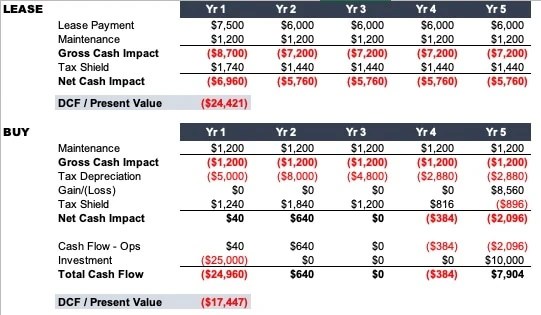
The mechanics of a "lease versus buy analysis" revolve around three pillars: cash flow, tax implications, and opportunity cost. Leasing typically involves fixed monthly payments, often including maintenance and insurance, while buying requires a down payment, closing costs, and variable expenses (property taxes, repairs). The break-even point—the moment when total lease payments exceed the net cost of ownership—varies by asset class. For example, leasing a $50K vehicle over 36 months might cost $45K, while buying and financing it could total $60K after interest and depreciation, but the buyer gains equity.Tax treatment is another critical lever. In many jurisdictions, lease payments are fully deductible for businesses, while buyers benefit from depreciation deductions (Section 179 in the U.S.) and mortgage interest deductions. However, the 2017 Tax Cuts and Jobs Act reduced the incentive for homeownership by capping mortgage interest deductions at $750K. Meanwhile, leasing can offer off-balance-sheet financing, improving a company’s debt-to-equity ratio. The analysis must also factor in residual value: a leased asset’s worth at the end of the term may offset initial costs, whereas a purchased asset’s depreciation erodes its book value over time.
Key Benefits and Crucial Impact
The "lease versus buy analysis" isn’t just about numbers—it’s about aligning financial strategy with personal or professional objectives. For entrepreneurs, leasing equipment might preserve cash for growth, while buying real estate could stabilize operations. High-net-worth individuals often use leasing to diversify holdings without diluting equity. The impact extends to risk management: leasing shields against obsolescence (e.g., tech hardware), while buying locks in asset appreciation (e.g., vintage wine or classic cars).The psychological dimension is often overlooked. Ownership confers pride and stability, but it also imposes responsibility. A leased asset offers freedom—relocate, upgrade, or exit without penalty. This flexibility is invaluable in volatile markets or uncertain career phases. Conversely, buying builds equity and forces disciplined savings, which can be a virtue in low-interest-rate environments.
"Leasing is the art of temporary possession; buying is the science of permanent obligation. The choice isn’t about which is better—it’s about which fits your story."
— David Bach, Financial Planner and Author
Major Advantages
- Liquidity Preservation: Leasing avoids large upfront capital outlays, freeing cash for investments or emergencies. Buyers may need to liquidate other assets or take on debt.
- Tax Optimization: Lease payments are often 100% deductible for businesses, while buyers benefit from depreciation and interest deductions (subject to local laws).
- Flexibility and Scalability: Leasing allows for easy upgrades or downsizing without selling an asset. Ideal for dynamic industries (e.g., tech, healthcare) where needs evolve rapidly.
- Risk Mitigation: Leasing transfers depreciation and maintenance risks to the lessor. Buyers assume these costs, which can be unpredictable (e.g., a $20K annual repair bill for an old property).
- Market Timing: Buying locks in current prices, which may be advantageous in rising markets. Leasing lets you wait for better deals or avoid market downturns.
Comparative Analysis
| Factor | Leasing | Buying |
|---|---|---|
| Upfront Cost | Low (security deposit, first month’s rent). | High (down payment, closing costs, renovations). |
| Long-Term Cost | Fixed payments; no residual equity. | Variable (mortgage, taxes, maintenance); builds equity. |
| Tax Benefits | Deductible for businesses; personal leases offer no direct tax relief. | Depreciation, mortgage interest deductions (if applicable). |
| Flexibility | High (end lease, upgrade, or relocate easily). | Low (selling requires market timing; tied to location). |
Future Trends and Innovations
The "lease versus buy analysis" is being redefined by fintech and alternative financing. Peer-to-peer leasing platforms (e.g., Arrived Homes) allow fractional ownership of real estate, blending leasing and investing. Meanwhile, subscription models for cars (e.g., Mercedes-AMG Drive) and even homes (e.g., WeLive) eliminate traditional lease terms, offering month-to-month flexibility. Blockchain-based smart contracts are automating lease agreements, reducing disputes and lowering administrative costs.Environmental and social governance (ESG) factors are also reshaping decisions. Sustainable leasing—where lessors invest in green buildings—may soon offer tax incentives, making it a win-win for tenants and landlords. Conversely, buying energy-efficient properties could yield higher resale values and lower utility costs. The future of the "lease versus buy analysis" will likely integrate these trends, with AI-driven tools personalizing recommendations based on real-time data (e.g., local rental yields, inflation forecasts).
Conclusion
The "lease versus buy analysis" is less about choosing a single path and more about designing a strategy that evolves with your life. What makes sense for a 25-year-old professional may not suit a 45-year-old parent or a 60-year-old retiree. The key is to treat the decision as a dynamic process—reassess every 2–3 years or when major life changes occur (marriage, career shifts, market downturns).Ultimately, the "lease versus buy analysis" reveals deeper truths about priorities. Are you optimizing for cash flow or equity? Stability or adaptability? The answer isn’t in the numbers alone but in how those numbers align with your vision of success. For some, leasing is the smarter play; for others, buying is the only path to wealth. The art lies in knowing which.
Comprehensive FAQs
Q: How do I calculate the break-even point in a lease vs. buy scenario?
The break-even point is the duration at which total lease payments equal the net cost of ownership (purchase price + financing costs + maintenance - resale value). Use this formula:
Break-even (years) = (Purchase Price + Financing Costs + Maintenance) / Annual Lease Payment
For example, if buying costs $300K (including fees) and leasing costs $20K/year, the break-even is ~15 years. However, factor in tax benefits, depreciation, and opportunity costs for accuracy.
Q: Are there tax advantages to leasing a car for personal use?
No, personal car leases offer no direct tax benefits in most jurisdictions. However, business leases are 100% deductible (up to IRS limits). Some regions offer sales tax exemptions on leased vehicles, but consult a tax advisor to explore local incentives.
Q: Can leasing ever be better than buying for long-term wealth building?
Yes, if the leased funds are invested elsewhere at a higher return. For instance, leasing a $1M property for $120K/year and investing that capital at 8% annual return could yield $1.2M in 10 years—more than the property’s appreciated value. This strategy works best for high-net-worth individuals with strong alternative investment options.
Q: How does inflation affect the lease vs. buy decision?
Inflation favors buying over time, as fixed-rate mortgages lock in payments while rents and asset values rise. However, if inflation is volatile, leasing provides a hedge against unexpected price spikes. Historical data shows that homeowners outperform renters in high-inflation decades (e.g., 1970s), but leasing can be strategic in low-inflation or recessionary periods.
Q: What are the hidden costs of buying that aren’t always factored into a lease vs. buy analysis?
Commonly overlooked costs include:
- Property taxes and insurance (often rising faster than inflation).
- Maintenance and repairs (1–4% of home value annually).
- Opportunity cost of tied-up capital (could earn 5–10% invested elsewhere).
- Transaction costs (realtor fees, closing costs, capital gains taxes when selling).
- Depreciation (especially for vehicles or tech equipment).
Leave a Comment
Comments are moderated before appearing. The data you submit is processed according to the Privacy Policy of versiliasolutions.oneagency.co.