Nitrogen Facts: Unraveling the Periodic Table’s 7th Element & Its Atomic Mass Secrets
Table of Contents
- The Complete Overview of Nitrogen’s Atomic and Periodic Table Profile
- Historical Background and Evolution
- Core Mechanisms: How It Works
- Key Benefits and Crucial Impact
- Major Advantages
- Comparative Analysis
- Future Trends and Innovations
- Conclusion
- Comprehensive FAQs
- Q: Why is nitrogen’s atomic mass listed as 14.007 u instead of 14 u?
- Q: How does nitrogen’s triple bond (N≡N) compare to carbon’s double bond (C=C)?
- Q: Can nitrogen exist in forms other than N₂ gas?
- Q: Why is nitrogen fixation so energy-intensive?
- Q: How does nitrogen’s atomic mass affect its role in the nitrogen cycle?
- Q: What are the risks of nitrogen pollution?
- Q: Is nitrogen used in medical treatments beyond nitric oxide?
- Q: How might quantum computing change nitrogen research?
- Q: Why isn’t nitrogen more reactive, given its lone electrons?
Nitrogen isn’t just the 7th element on the periodic table—it’s the silent architect of life as we know it. Comprising 78% of Earth’s atmosphere, this colorless, odorless gas is a cornerstone of proteins, DNA, and even explosives. Yet its atomic mass (14.007 u) and precise placement in Group 15 (the pnictogens) reveal a molecule far more complex than its inert reputation suggests. From the nitrogen cycle’s ecological balance to its critical role in ammonia synthesis, understanding nitrogen facts periodic table nitrogen atomic mass bridges chemistry, biology, and industry in ways few elements can match.
The story of nitrogen begins not with a single discovery but with a series of scientific puzzles. Early chemists mistook it for "azote" (Greek for lifeless), unaware of its fertility-enhancing properties in soil. By the late 18th century, scientists like Joseph Priestley and Daniel Rutherford isolated it, only to later realize its atomic mass (14.007 u) was the key to unlocking its reactivity. This revelation reshaped agriculture, medicine, and even warfare—from Haber-Bosch’s ammonia revolution to the nitrogen-filled balloons of the First World War. Today, nitrogen facts periodic table nitrogen atomic mass remain a linchpin in fields ranging from cryogenics to astrobiology.
What makes nitrogen uniquely fascinating is its duality: an atmospheric giant yet a molecular chameleon. Its atomic mass (14.007 u) stems from seven protons and seven neutrons, but its electron configuration (2s² 2p³) enables covalent bonds that power everything from fertilizers to pharmaceuticals. The element’s stability in N₂ gas contrasts sharply with its explosive potential when combined with hydrogen or oxygen. This tension—between ubiquity and volatility—defines its role in both natural systems and human innovation.
The Complete Overview of Nitrogen’s Atomic and Periodic Table Profile
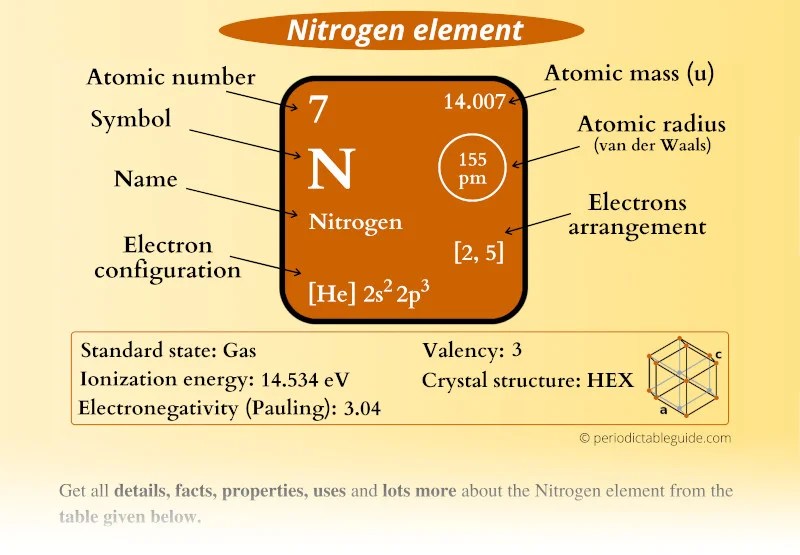
Nitrogen’s position on the periodic table (atomic number 7, Group 15, Period 2) is more than a numerical designation—it’s a blueprint for its chemical behavior. With an atomic mass of 14.007 u, it sits between carbon (6) and oxygen (8), reflecting its intermediate reactivity. Its electron configuration (2s² 2p³) leaves it one electron short of a full octet, driving its tendency to form triple bonds (as in N₂) or participate in redox reactions. This atomic structure underpins its dual role as both a biological essential and an industrial workhorse, whether in the nitrogen cycle or synthetic ammonia production.The element’s isotopic composition further complicates its profile. While ^14N dominates (99.634%), trace amounts of ^15N (0.366%) are critical for radiometric dating and metabolic studies. These isotopes, combined with nitrogen’s atomic mass (14.007 u), create a toolkit for scientists tracking everything from ancient soils to extraterrestrial atmospheres. Even its allotropes—ranging from diatomic N₂ to the high-energy azides—highlight the depth of nitrogen facts periodic table nitrogen atomic mass in modern research.
Historical Background and Evolution
Nitrogen’s journey from obscurity to indispensability began in 1772, when Daniel Rutherford identified it as a component of air distinct from oxygen. His work, though initially overlooked, laid the groundwork for Antoine Lavoisier’s later classification of nitrogen as an element. The breakthrough came in 1909, when Fritz Haber and Carl Bosch developed a method to synthesize ammonia (NH₃) from atmospheric nitrogen—a process that won Bosch the Nobel Prize in 1931 and fed a global population. This innovation, rooted in understanding nitrogen facts periodic table nitrogen atomic mass, transformed agriculture by making nitrogen fertilizers accessible.The 20th century cemented nitrogen’s industrial dominance. From the Haber-Bosch process to the development of nitrogen-based explosives (e.g., TNT), its atomic mass (14.007 u) became a metric for both progress and destruction. Meanwhile, environmental scientists grappled with nitrogen’s darker side: runoff from fertilizers triggering dead zones in oceans. These dual legacies—life-sustaining yet ecologically disruptive—stem directly from the element’s atomic properties and periodic table positioning.
Core Mechanisms: How It Works
Nitrogen’s chemical behavior hinges on its atomic mass (14.007 u) and electron configuration. The triple bond in N₂ (N≡N) is one of the strongest in nature, requiring 945 kJ/mol to break—a stability that explains its abundance in Earth’s atmosphere. However, this inertness is relative. Under high pressure or with catalysts (like the iron in the Haber-Bosch process), nitrogen reacts with hydrogen to form ammonia, a reaction critical for fertilizer production. The process’s energy demands (450–600°C, 200–400 atm) reflect the challenges of overcoming N₂’s bond strength, a direct consequence of its atomic structure.At the biological level, nitrogen’s atomic mass enables its incorporation into amino acids and nucleotides. Enzymes like nitrogenase reduce N₂ to ammonia in legumes, while nitrifying bacteria oxidize it to nitrates in the soil. These transformations, governed by the element’s electron affinity and atomic mass (14.007 u), form the nitrogen cycle—a closed loop that sustains ecosystems. Even in human metabolism, nitrogen’s role in proteins and DNA underscores its foundational place in life’s chemistry.
Key Benefits and Crucial Impact
Nitrogen’s influence spans disciplines, from sustaining crops to powering rocket fuel. Its atomic mass (14.007 u) and periodic table placement make it a versatile reactant, while its abundance in air ensures it’s a renewable resource. In industry, nitrogen’s inert form (N₂) is used as a coolant in cryogenics, a shielding gas in welding, and a preservative for food and pharmaceuticals. Meanwhile, its reactive forms—like nitric oxide (NO) and nitrogen dioxide (NO₂)—play roles in atmospheric chemistry and medical treatments (e.g., NO as a vasodilator). The element’s duality is a testament to how nitrogen facts periodic table nitrogen atomic mass translate into tangible applications.The ecological stakes of nitrogen are equally profound. While fertilizers boost agricultural yields, excess nitrogen leads to eutrophication, where algal blooms deplete oxygen in waterways. This paradox—between necessity and harm—highlights the need for precise management of nitrogen’s atomic and molecular forms. Understanding its atomic mass (14.007 u) and periodic table behavior is essential for balancing these competing demands.
"Nitrogen is the difference between famine and feast, between life and death in the soil—and yet, we’ve only begun to harness its full potential." — Dr. Rachel Carson, environmental scientist (adapted)
Major Advantages
- Biological Essentiality: Nitrogen is a building block of proteins, DNA, and chlorophyll, making it indispensable for all known life forms. Its atomic mass (14.007 u) allows it to form stable covalent bonds critical for these molecules.
- Industrial Versatility: From ammonia synthesis to inert gas applications, nitrogen’s atomic structure enables diverse industrial processes, including food preservation, electronics manufacturing, and aerospace.
- Environmental Regulation: The nitrogen cycle, governed by its atomic properties, maintains soil fertility and atmospheric balance. However, human activities disrupt this cycle, underscoring the need for sustainable nitrogen management.
- Energy Applications: Liquid nitrogen (cooled to -196°C) is used in fuel tanks, superconductors, and even as a propellant in rockets, leveraging its atomic mass (14.007 u) for high-energy density.
- Medical and Pharmaceutical Uses: Nitrogen’s isotopes (^14N, ^15N) are tools in medical imaging and drug development, while nitric oxide (NO) regulates blood pressure and immune responses.
Comparative Analysis
| Property | Nitrogen (N) | Phosphorus (P) | Arsenic (As) |
|---|---|---|---|
| Atomic Number | 7 | 15 | 33 |
| Atomic Mass (u) | 14.007 | 30.974 | 74.922 |
| Group (Periodic Table) | 15 (Pnictogen) | 15 (Pnictogen) | 15 (Pnictogen) |
| Key Bonding | Triple bond (N≡N), covalent | Single/multiple bonds, reactive | Covalent, toxic in organic forms |
| Biological Role | Amino acids, DNA, proteins | ATP, phospholipids, bone mineralization | Toxic in most life forms (except some bacteria) |

Future Trends and Innovations
The next frontier for nitrogen research lies in atomic-level precision. Advances in quantum chemistry may unlock new catalysts to reduce N₂ to ammonia at ambient conditions, slashing the energy costs of the Haber-Bosch process. Meanwhile, isotopic labeling with ^15N is poised to revolutionize personalized medicine, tracking metabolic pathways in real time. In environmental science, nitrogen capture technologies—like biochar or engineered bacteria—could mitigate runoff, addressing the element’s ecological footprint.Astrobiology offers another horizon. NASA’s search for life on Mars hinges on detecting nitrogen compounds in soil and atmosphere, as they’re biomarkers for past or present biology. Understanding nitrogen facts periodic table nitrogen atomic mass in extraterrestrial contexts could redefine our place in the universe. Even on Earth, nitrogen’s role in climate change—through nitrous oxide (N₂O), a potent greenhouse gas—demands innovative solutions to balance its benefits and risks.
Conclusion
Nitrogen’s atomic mass (14.007 u) and periodic table positioning are more than scientific curiosities—they’re the foundation of modern life. From the nitrogen cycle’s ecological ballet to the Haber-Bosch process’s agricultural revolution, this element’s properties have shaped civilizations. Yet its challenges—environmental degradation, energy-intensive synthesis—remind us that even the most abundant resources require stewardship. As research pushes into quantum catalysis and astrobiology, nitrogen’s story is far from over. The key to unlocking its full potential lies in deeper exploration of nitrogen facts periodic table nitrogen atomic mass, bridging chemistry, biology, and sustainability.The element’s legacy is a testament to how atomic structure dictates destiny. Whether in a farmer’s field or a lab on Mars, nitrogen’s influence is inescapable—a silent partner in the drama of science and survival.
Comprehensive FAQs
Q: Why is nitrogen’s atomic mass listed as 14.007 u instead of 14 u?
A: Nitrogen’s atomic mass (14.007 u) accounts for its natural isotopic distribution: 99.634% ^14N and 0.366% ^15N. The decimal reflects the weighted average, incorporating the slight mass difference between isotopes. This precision is critical for applications like mass spectrometry and nuclear physics.
Q: How does nitrogen’s triple bond (N≡N) compare to carbon’s double bond (C=C)?
A: Nitrogen’s triple bond (N≡N) is stronger (945 kJ/mol) than carbon’s double bond (C=C, ~614 kJ/mol) due to its smaller atomic size and higher electron density. This stability explains why N₂ is inert at room temperature, while C=C bonds are more reactive, enabling organic chemistry’s diversity.
Q: Can nitrogen exist in forms other than N₂ gas?
A: Yes. Nitrogen forms include liquid nitrogen (cryogenic), solid nitrogen (below -210°C), and reactive allotropes like nitrogen monoxide (NO) and dinitrogen pentoxide (N₂O₅). Even high-energy compounds like azides (e.g., NaN₃) exploit nitrogen’s atomic structure for explosive or propellant applications.
Q: Why is nitrogen fixation so energy-intensive?
A: Breaking N₂’s triple bond requires overcoming its high bond dissociation energy (945 kJ/mol). The Haber-Bosch process uses iron catalysts and extreme conditions (450–600°C, 200–400 atm) to force nitrogen and hydrogen into ammonia (NH₃). Biological fixation, via nitrogenase enzymes, achieves this at ambient temperatures but with lower yields.
Q: How does nitrogen’s atomic mass affect its role in the nitrogen cycle?
A: The atomic mass (14.007 u) influences nitrogen’s reactivity and isotopic fractionation. Lighter ^14N is preferentially used in biological processes, leaving heavier ^15N enriched in residual compounds. This isotopic shift helps scientists trace nitrogen’s movement through ecosystems, from soil microbes to atmospheric deposition.
Q: What are the risks of nitrogen pollution?
A: Excess nitrogen from fertilizers or industrial emissions leads to eutrophication (oxygen-depleted dead zones), acid rain (via NOₓ), and greenhouse gas emissions (N₂O). These issues stem from nitrogen’s atomic properties—its high solubility and reactivity in oxidized forms (NO₃⁻, NO₂⁻)—which, when unchecked, disrupt natural cycles.
Q: Is nitrogen used in medical treatments beyond nitric oxide?
A: Yes. ^15N isotopes are used in PET scans to track metabolic processes, while nitrogen mustard (a chemotherapeutic) exploits nitrogen’s reactivity to damage DNA in cancer cells. Liquid nitrogen is also used in cryopreservation of tissues and vaccines.
Q: How might quantum computing change nitrogen research?
A: Quantum simulations could model nitrogen’s electron interactions with unprecedented accuracy, potentially designing catalysts that mimic nitrogenase enzymes. This could revolutionize ammonia synthesis, reducing energy demands and environmental impact tied to nitrogen facts periodic table nitrogen atomic mass.
Q: Why isn’t nitrogen more reactive, given its lone electrons?
A: Nitrogen’s lone electrons are tightly held due to its small atomic size and high electronegativity. The triple bond in N₂ further stabilizes the molecule, requiring significant energy to disrupt. This inertness is why N₂ dominates Earth’s atmosphere—without it, reactive nitrogen species would deplete ozone and alter climate dynamics.
Leave a Comment
Comments are moderated before appearing. The data you submit is processed according to the Privacy Policy of versiliasolutions.oneagency.co.