The Hidden Battle: How Rural Internet Options Are Changing Lives
Table of Contents
- The Complete Overview of Rural Internet Options
- Historical Background and Evolution
- Core Mechanisms: How It Works
- Key Benefits and Crucial Impact
- Major Advantages
- Comparative Analysis
- Future Trends and Innovations
- Conclusion
- Comprehensive FAQs
- Q: Can I get high-speed internet in my rural area if no provider advertises service?
- Q: How do I know if fixed wireless is right for my home?
- Q: Are satellite internet data caps really a problem for rural users?
- Q: What’s the best rural internet option for a small business?
- Q: How can I lower the cost of rural internet?
- Q: Will 5G solve rural internet problems?
For decades, rural America has been an afterthought in the digital revolution. While urban centers boast fiber-optic speeds and seamless streaming, residents in remote towns and countryside areas have struggled with spotty connections, exorbitant costs, or outright neglect from major providers. The gap isn’t just about convenience—it’s about access to healthcare, education, and economic opportunity. Yet, the narrative is shifting. Innovations in rural internet options are no longer a pipe dream but a reality, offering viable alternatives to traditional infrastructure. From low-orbit satellites to mesh networks, the tools exist—but choosing the right one requires understanding the trade-offs, limitations, and hidden advantages of each.
The problem isn’t a lack of demand. Rural communities depend on reliable rural internet options as much as city dwellers, if not more. Farmers need real-time market data to sell crops at peak prices; telemedicine requires stable connections for remote consultations; and students in one-room schoolhouses must submit assignments without buffering interruptions. Yet, the economics of laying fiber in sparsely populated areas have long deterred investment. The result? A patchwork of solutions—some cutting-edge, others decades old—that cater to different needs, budgets, and geographic challenges. The question isn’t whether rural internet options work; it’s which one will work for you.
What’s changed in the last five years isn’t just the technology, but the urgency. Government incentives, private sector competition, and grassroots advocacy have forced providers to innovate. Satellite internet has shed its reputation for lag and data caps, while fixed wireless and even experimental solutions like TV white space are gaining traction. The catch? No single solution fits all. A rancher in Montana needs different rural internet options than a retiree in the Appalachian foothills. The key is separating hype from reality—and knowing when to hold out for better, or settle for what’s available now.
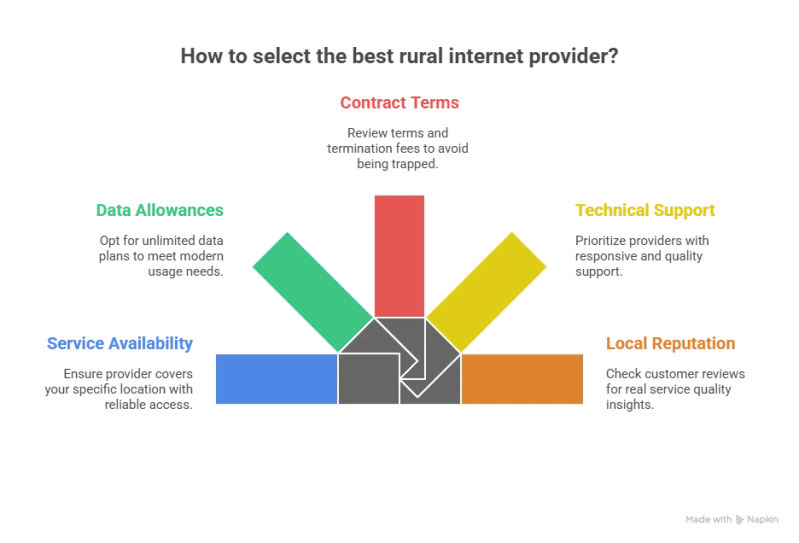
The Complete Overview of Rural Internet Options
The term "rural internet options" encompasses a broad spectrum of technologies, each with distinct strengths, weaknesses, and ideal use cases. Broadly, these fall into three categories: satellite-based solutions, terrestrial (ground-based) networks, and emerging or hybrid models. Satellite internet, once synonymous with high latency and unpredictable performance, has undergone a renaissance with the launch of constellations like Starlink and Viasat’s Exede. These systems beam signals from space, bypassing the need for physical infrastructure—but at the cost of weather sensitivity and potential congestion during peak usage. On the ground, fixed wireless and DSL remain the workhorses of rural connectivity, though their reliability hinges on proximity to cell towers or phone lines. Meanwhile, niche players are experimenting with TV white space (using unused broadcast frequencies) and even power line communications, though these are still in early adoption phases.What unites these rural internet options is their shared mission: to deliver service where fiber is uneconomical. The trade-offs are stark. Satellite offers broad coverage but can suffer from latency (a delay of 20–50ms compared to 10ms for fiber). Fixed wireless is faster than satellite but limited by line-of-sight constraints—trees, hills, or even a neighbor’s barn can disrupt signals. DSL, the oldest player, is slow and dependent on copper lines that degrade over time. The challenge for rural users isn’t just choosing a provider; it’s aligning their needs with the inherent limitations of the technology. A data-heavy household might prioritize satellite’s unlimited data plans, while a small business could demand the low latency of a local fixed wireless network. The landscape is complex, but the options are no longer scarce.
Historical Background and Evolution
The digital divide in rural America traces back to the 1990s, when broadband was first introduced as a luxury rather than a necessity. Major internet service providers (ISPs) prioritized dense urban areas, where high subscriber counts justified the cost of fiber or cable infrastructure. Rural communities, with their scattered populations and rugged terrain, were left with dial-up or, at best, dial-up speeds disguised as "broadband." The Federal Communications Commission’s (FCC) definition of broadband—once as low as 200 Kbps—only exacerbated the problem by classifying slower services as "adequate," even as urban users enjoyed gigabit connections. It wasn’t until the 2010s, with the rise of smart agriculture, telehealth, and remote work, that the stakes became undeniable.The turning point came with legislative pushes like the 2018 Farm Bill, which allocated $600 million to expand broadband in rural areas, and the 2021 Infrastructure Investment and Jobs Act, which earmarked $48 billion for rural internet options. Simultaneously, private companies saw opportunity. SpaceX’s Starlink, launched in 2018, promised to democratize high-speed internet by deploying thousands of satellites. Competitors like Viasat and HughesNet followed, refining satellite tech to reduce latency and increase reliability. On the ground, regional ISPs and cooperatives—often nonprofits—began deploying fixed wireless and fiber-to-the-home (FTTH) in pockets where it made sense. The evolution hasn’t been linear, but the trajectory is clear: rural internet options are no longer a charity case but a competitive market.
Core Mechanisms: How It Works
At their core, rural internet options rely on three fundamental mechanisms: signal transmission, bandwidth allocation, and last-mile delivery. Satellite internet, for example, uses geostationary or low-Earth orbit (LEO) satellites to relay data between a user’s dish and a ground station. The signal travels up to space and back down, introducing latency—though Starlink’s LEO satellites cut this delay to roughly 20–50ms by operating closer to Earth. Fixed wireless, by contrast, transmits data via radio waves between a user’s antenna and a local tower, eliminating the need for satellites. The catch? Obstructions like hills or buildings can weaken the signal, requiring careful placement of equipment. DSL piggybacks on existing phone lines, using copper wires to carry data alongside voice calls, but its speed is throttled by distance from the central office—often rendering it useless beyond 10,000 feet.Bandwidth allocation varies widely. Satellite providers like Starlink offer symmetric upload/download speeds (e.g., 50–150 Mbps), while DSL and some fixed wireless plans prioritize download speeds, leaving uploads sluggish—a critical limitation for video calls or cloud backups. Data caps, another contentious issue, are more common with satellite services, though some providers now offer uncapped plans for a premium. The last-mile challenge—how the signal reaches the user’s home—is where most rural internet options hit their limits. Fiber is ideal but prohibitively expensive to deploy in low-density areas; copper and wireless alternatives require creative workarounds, from mesh networks to solar-powered repeaters in off-grid locations.
Key Benefits and Crucial Impact
The impact of rural internet options extends beyond mere connectivity—it’s a catalyst for economic resilience, educational equity, and public safety. Consider the farmer who can monitor soil moisture in real time, adjusting irrigation to save water and crops. Or the nurse in a remote clinic who uses telemedicine to consult specialists without transporting patients. Even basic tasks, like filing taxes or applying for jobs online, become feasible where they once were impossible. The social cost of poor connectivity is measurable: rural unemployment rates are higher in areas with limited broadband, and students in low-connectivity zones score lower on standardized tests. The COVID-19 pandemic laid bare these disparities, as rural children fell behind in virtual learning while urban peers thrived.Yet, the benefits aren’t just quantitative. Reliable rural internet options restore a sense of agency to communities that have long felt overlooked. Take the case of a rural school district in North Dakota that swapped dial-up for Starlink, enabling students to participate in global science competitions via video conferencing. Or the elderly resident in West Virginia who now attends virtual church services without missing a word. The technology isn’t just about speed; it’s about inclusion. As one rural ISP executive put it:
"Broadband isn’t a luxury—it’s the modern equivalent of electricity. You don’t get to choose whether you need it; you only get to choose how you’ll get it." — Mark Wigfield, CEO of Mountain Broadband CooperativeThe crux of the matter is that rural internet options aren’t just filling a gap; they’re redefining what’s possible in areas once written off as technologically backward.
Major Advantages
The advantages of modern rural internet options can be distilled into five key areas:- Coverage Where Fiber Fails: Satellite and fixed wireless reach areas deemed "uneconomical" for traditional ISPs, often with minimal infrastructure investment.
- Scalability for Sparse Populations: Unlike fiber, which requires extensive trenching, wireless and satellite solutions can scale to a single home or a hundred without proportional cost increases.
- Reduced Latency Improvements: Newer satellite constellations (e.g., Starlink) have slashed latency to near-wireless levels, making gaming and video calls viable.
- Competitive Pricing: While costs vary, many rural internet options now offer plans comparable to urban rates, especially with government subsidies and regional ISP discounts.
- Resilience to Natural Disasters: Wireless and satellite networks are less vulnerable to power outages or physical line damage (e.g., storms, floods) than copper-based DSL.
Comparative Analysis
Choosing among rural internet options requires weighing speed, cost, and reliability. Below is a side-by-side comparison of the leading solutions:| Factor | Satellite (Starlink/Viasat) | Fixed Wireless (Local ISPs) | DSL (Traditional ISPs) |
|---|---|---|---|
| Typical Speed | 50–150 Mbps (download), 10–25 Mbps (upload) | 25–100 Mbps (download), 5–10 Mbps (upload) | 1–25 Mbps (download), 0.5–3 Mbps (upload) |
| Latency | 20–50ms (LEO), 600–700ms (geostationary) | 10–30ms (comparable to fiber) | 30–100ms (varies by distance) |
| Data Caps | Unlimited (Starlink) or 50–100TB (Viasat) | Often unlimited, but throttling after heavy use | Common caps (5–50GB/month) |
| Installation Cost | $599–$999 (equipment + activation) | $50–$200 (antenna + setup) | $0–$150 (modem rental) |

Future Trends and Innovations
The next frontier in rural internet options lies in three disruptive areas: orbital megaconstellations, terrestrial wireless advancements, and government-driven infrastructure. SpaceX’s Starlink is just the beginning—Amazon’s Project Kuiper and OneWeb aim to deploy tens of thousands of satellites, increasing coverage and reducing congestion. On the ground, 5G and its rural variants promise to extend cellular networks into areas once deemed impractical, though rollout will depend on spectrum allocation and tower placement. Meanwhile, experimental technologies like TV white space (using unused UHF/VHF frequencies) and Li-Fi (light-based internet) are inching closer to viability, though adoption remains niche.The biggest wildcard is federal policy. The FCC’s recent reclassification of broadband as a "telecommunications service" (rather than an "information service") could open doors for more competitive pricing and infrastructure investment. State-level initiatives, such as California’s $1.5 billion broadband expansion fund, are also accelerating change. The long-term vision? A hybrid model where satellite handles remote areas, fixed wireless covers suburban fringes, and fiber serves high-density zones—all underpinned by smart regulation and private-public partnerships.
Conclusion
The story of rural internet options is one of persistence against odds. What began as a technical afterthought has become a cornerstone of rural revitalization, proving that innovation doesn’t require density—just determination. The solutions available today are better than ever, but the journey isn’t over. Latency remains an issue for satellite users, fixed wireless struggles with weather, and DSL clings to obsolescence. Yet, the pace of change is accelerating, with each new satellite launch or wireless tower bringing communities one step closer to parity with urban counterparts.For rural residents, the message is clear: the options exist, but they demand research and advocacy. Not every rural internet option will be perfect, but the right choice—whether it’s Starlink’s speed, a local cooperative’s fixed wireless, or a DSL upgrade—can transform daily life. The digital divide isn’t insurmountable; it’s a challenge being met with creativity, capital, and an unshakable belief that connectivity is a right, not a privilege.
Comprehensive FAQs
Q: Can I get high-speed internet in my rural area if no provider advertises service?
A: Yes, but it may require creative solutions. Start by checking the FCC’s broadband map for reported providers, then reach out to regional ISPs or cooperatives—many offer service even if not widely advertised. Satellite options like Starlink or Viasat can fill gaps, though installation may be limited by local regulations. If all else fails, consider mesh networks or community-driven initiatives, such as shared towers or nonprofit broadband projects.
Q: How do I know if fixed wireless is right for my home?
A: Fixed wireless relies on a clear line of sight to a tower, so obstructions like trees, hills, or buildings can disrupt service. Use a satellite view to assess your property’s visibility to the nearest tower. Contact local ISPs for a site survey—they can test signal strength and recommend equipment placement. If your home has multiple floors or dense foliage, you may need a higher-gain antenna or a repeater.
Q: Are satellite internet data caps really a problem for rural users?
A: It depends on usage. Starlink offers unlimited data, but older satellite providers like Viasat impose strict caps (e.g., 50GB/month), which can be hit by streaming, large downloads, or smart home devices. Rural users with high-bandwidth needs (e.g., 4K streaming, cloud backups) should prioritize uncapped plans or monitor usage closely. Some providers offer overage fees or throttling after exceeding limits, so read the fine print.
Q: What’s the best rural internet option for a small business?
A: Symmetric speed (equal upload/download) and low latency are critical for businesses. Starlink or fixed wireless from a local ISP are top choices, as they offer speeds of 50+ Mbps in both directions—ideal for video conferencing, cloud services, or e-commerce. Avoid DSL for business use due to poor upload speeds and data caps. If your business relies on constant uptime, ask providers about service-level agreements (SLAs) and backup options, such as cellular failovers.
Q: How can I lower the cost of rural internet?
A: Look for government subsidies (e.g., USDA ReConnect Program), non-profit ISPs, or regional promotions. Bundling with TV or phone services can reduce monthly fees, and some providers offer rural discounts. Hardware costs can be mitigated by leasing equipment or checking for promotions (e.g., Starlink’s $99/month plan includes a free dish). Community partnerships—such as shared towers or cooperative models—can also spread costs across multiple users.
Q: Will 5G solve rural internet problems?
A: 5G has potential, but its rural impact depends on infrastructure. While 5G can deliver faster speeds over longer distances than 4G, it still requires cell towers—often spaced 5–10 miles apart in rural areas. Carriers like Verizon and T-Mobile have launched rural 5G initiatives, but coverage remains spotty. For now, 5G is best suited as a backup (e.g., hotspot failover) rather than a primary solution. Keep an eye on FCC spectrum auctions, as more bandwidth could expand rural 5G in the coming years.
Leave a Comment
Comments are moderated before appearing. The data you submit is processed according to the Privacy Policy of versiliasolutions.oneagency.co.