Cracking the Code: Select All Expressions Equivalent to `0.4x` in Math, Finance, and Tech
Table of Contents
- The Complete Overview of Equivalent Expressions for `0.4x`
- Historical Background and Evolution
- Core Mechanisms: How It Works
- Key Benefits and Crucial Impact
- Major Advantages
- Comparative Analysis
- Future Trends and Innovations
- Conclusion
- Comprehensive FAQs
- Q: Is `0.4x` the same as `x 0.4`?
- Q: Can `0.4x` be represented as a ratio?
- Q: How does `0.4x` differ from `40% of x`?
- Q: Is `0.4x` equivalent to `x - 0.6x`?
- Q: What if `x` is a function (e.g., `x(t)`)? Does `0.4x(t)` still hold?
- Q: Are there non-linear equivalents to `0.4x`?
- Q: How can I verify if two expressions are equivalent to `0.4x`?
- Q: Why does finance use `0.4x` for discounts but `1.4x` for markups?
- Q: Can `0.4x` appear in logarithmic or exponential forms?
- Q: What’s the most common mistake when identifying `0.4x` equivalents?
Mathematics, finance, and technical fields often demand precision—especially when translating abstract coefficients like `0.4x` into functional equivalents. Whether you’re optimizing a budget, scaling a tech algorithm, or solving an equation, recognizing all forms of `0.4x` is non-negotiable. The challenge? Not all representations are immediately obvious. A decimal might disguise itself as a fraction, a percentage, or even a logarithmic ratio, yet they all resolve to the same multiplicative force. This oversight can lead to miscalculations, financial losses, or flawed models. The solution? A systematic breakdown of every expression that mirrors `0.4x`—from its simplest fractional form to its most complex real-world applications.
The phrase “select all the expressions that are equivalent to `0.4x`” isn’t just about rote memorization; it’s about understanding the underlying patterns. A 40% markup in retail, a 0.4 scaling factor in machine learning, or a 2:5 ratio in chemistry all share the same mathematical essence. The key lies in recognizing how these forms interconnect—whether through division, percentage conversion, or unit transformations. Without this lens, professionals risk misinterpreting data, underestimating risks, or missing optimization opportunities. This article dismantles the ambiguity, providing a definitive guide to identifying and leveraging every equivalent of `0.4x` across disciplines.
Consider this: A data scientist adjusting a neural network’s learning rate might encounter `0.4 x`, while a procurement manager negotiating a 40% discount on bulk orders faces the same coefficient in disguise. The disconnect? One operates in floating-point arithmetic, the other in percentage-based contracts. Bridging this gap requires more than calculation—it demands an awareness of how `0.4x` manifests in different contexts. From algebraic identities to financial leverage, the expressions equivalent to `0.4x` are everywhere. The question is no longer if you’ll encounter them, but when—and whether you’ll recognize them instantly.

The Complete Overview of Equivalent Expressions for `0.4x`
The expression `0.4x` is deceptively simple: a decimal multiplier applied to a variable `x`. Yet its equivalents span algebraic fractions, percentage-based notations, and even logarithmic or exponential forms in advanced applications. The core principle is invariance—regardless of representation, the operation remains the same. For example, `0.4x` is identical to `2x/5` because `0.4` and `2/5` are numerically equivalent. This equivalence extends to percentages (40% of `x`), ratios (4:10), and even scientific notations (4 × 10⁻¹ × `x`). The challenge arises when these forms are embedded in complex equations, unit conversions, or real-world scenarios where `x` isn’t a pure variable but a composite function or dataset.
Mastering the art of identifying these equivalents hinges on two skills: dimensional analysis (ensuring units align) and form normalization (converting all expressions to a common base). For instance, a 40% increase in revenue (`1.4x` of original) isn’t equivalent to `0.4x`—but a 40% reduction (`0.6x`) is. The distinction between additive and multiplicative changes is critical. Similarly, in coding, a scaling factor of `0.4x` might appear as `x 0.4` in Python or `0.4 x` in MATLAB, yet the mathematical core remains unchanged. The goal here is to eliminate ambiguity by exposing every possible guise of `0.4x`, from the most straightforward to the most obscured.
Historical Background and Evolution
The concept of equivalent expressions traces back to ancient mathematics, where fractions like `2/5` were used interchangeably with decimals as computational tools evolved. By the 17th century, European merchants and scientists standardized percentage notation (per centum, or "per hundred"), solidifying `0.4x` as a shorthand for "40 parts per hundred of `x`." The Industrial Revolution further cemented this practice, as engineers and economists relied on scaling factors to optimize production and trade. In the 20th century, the rise of computing introduced floating-point arithmetic, where `0.4x` became a fundamental operation in algorithms—yet the underlying equivalence rules remained unchanged.
Modern applications have expanded the scope of `0.4x` equivalents. In finance, the term "leverage" often disguises multiplicative factors; a 4:1 leverage ratio implies `0.4x` of equity relative to debt. In machine learning, hyperparameters like learning rates (`0.4 gradient`) directly mirror the original expression. Even in biology, a 40% enzyme efficiency might translate to `0.4x` of a baseline reaction rate. The historical thread is clear: what began as a fractional convenience has become a universal language for scaling, optimization, and proportional reasoning.
Core Mechanisms: How It Works
At its core, `0.4x` represents a linear transformation where `x` is multiplied by 0.4. The equivalence arises because any representation that yields the same product for a given `x` is mathematically identical. For example:
- `0.4x` (decimal form)
- `(2/5)x` (fractional form)
- `40% of x` (percentage form)
- `x / 2.5` (reciprocal form)
In practical scenarios, however, `x` may not be a simple variable. For instance, in physics, `0.4x` could represent a damping factor where `x` is a velocity function. Here, equivalence must account for the function’s domain and range. Similarly, in economics, `0.4x` might scale a GDP growth rate, requiring adjustments for inflation or currency fluctuations. The universal rule persists: if two expressions produce the same output for every valid input `x`, they are equivalent. The complexity lies in verifying this across different contexts.
Key Benefits and Crucial Impact
Understanding the equivalents of `0.4x` isn’t merely academic—it’s a competitive advantage. In finance, misinterpreting a 40% discount as `0.4x` (when it’s actually `0.6x` after taxes) can lead to budget overruns. In software, a misapplied scaling factor in a deep learning model can degrade performance by 40% or more. The precision afforded by recognizing these equivalents reduces errors, accelerates decision-making, and enhances reproducibility. Whether you’re negotiating a contract, debugging code, or analyzing data, the ability to select all the expressions that are equivalent to `0.4x` ensures consistency across disciplines.
The impact extends to interdisciplinary collaboration. A biologist describing a 40% reduction in enzyme activity (`0.6x` remaining) must align with an engineer modeling the same process using `0.4x` as the decay rate. Without a shared framework for equivalence, communication breaks down. This article serves as that framework, providing a taxonomy of `0.4x` representations to bridge gaps between fields. The result? Faster innovation, fewer miscalculations, and clearer strategic alignment.
"Mathematics is the language in which God has written the universe." —Galileo Galilei
Yet even God’s language has dialects. The ability to translate between them—whether `0.4x`, `40%`, or `2/5`—is what separates intuition from precision.
Major Advantages
- Error Reduction: Eliminates misinterpretations of scaling factors in contracts, algorithms, or experiments by standardizing representations.
- Cross-Disciplinary Clarity: Enables seamless communication between finance, engineering, and science by aligning on equivalent forms of `0.4x`.
- Optimization: Identifies hidden opportunities in data, such as recognizing that a 40% efficiency gain (`1.4x`) can be reframed as a `0.4x` loss in another context.
- Automation: Simplifies coding and formula design by allowing interchangeable use of decimal, fractional, or percentage forms of `0.4x`.
- Risk Mitigation: Prevents costly oversights, such as confusing `0.4x` (a reduction) with `1.4x` (an increase) in financial projections.
Comparative Analysis
| Expression Form | Equivalent to `0.4x`? |
|---|---|
| `(2/5)x` | Yes (exact fractional equivalent) |
| `40% of x` | Yes (percentage conversion) |
| `x / 2.5` | Yes (reciprocal form) |
| `1.4x - x` | No (equals `0.4x`, but not equivalent in context; implies additive change) |
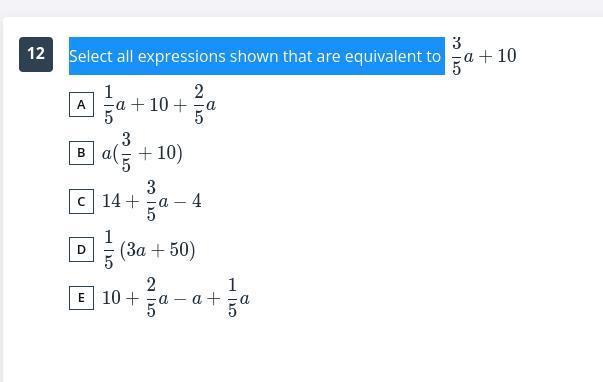
Future Trends and Innovations
As artificial intelligence and quantitative fields advance, the demand for precise scaling will intensify. Machine learning models, for instance, increasingly rely on dynamic scaling factors—where `0.4x` might adapt based on real-time data. Future innovations in symbolic AI could automate the detection of equivalent expressions, reducing human error in complex systems. Meanwhile, blockchain and smart contracts will require ironclad equivalence checks to prevent exploits, such as misrepresented percentages in tokenomics. The ability to select all the expressions that are equivalent to `0.4x` will thus evolve from a mathematical skill to a critical safeguard in automated systems.
In education, the focus will shift from rote memorization to contextual application. Students will need to recognize `0.4x` not just as a decimal but as a template for proportional reasoning across domains. Tools like AI-assisted calculators may emerge to flag non-equivalent forms in real time, further blurring the line between manual and automated verification. The overarching trend? A world where equivalence is not just understood but actively enforced—by algorithms, contracts, and collaborative frameworks.
Conclusion
The expression `0.4x` is a gateway to precision, but only if you know its many faces. From the simplicity of `2/5` to the complexity of logarithmic scaling in advanced models, the equivalents are infinite in form but unified in purpose. The key takeaway? Equivalence isn’t about memorization; it’s about recognizing patterns. A procurement officer, a data scientist, and a chemist all share the same mathematical language when they select all the expressions that are equivalent to `0.4x`. The difference lies in how they apply it—whether to negotiate a deal, train a model, or design a molecule.
As fields converge, the ability to navigate these equivalences will define expertise. The future belongs to those who don’t just calculate but understand—who see beyond the decimal to the universal principle it represents. This article is your map. Use it to ensure that every `0.4x` you encounter is not just recognized, but mastered.
Comprehensive FAQs
Q: Is `0.4x` the same as `x 0.4`?
Yes. The commutative property of multiplication ensures that `0.4x` and `x 0.4` are identical. The order of operands does not affect the result in standard arithmetic.
Q: Can `0.4x` be represented as a ratio?
Absolutely. `0.4x` is equivalent to the ratio `4:10` or simplified, `2:5`. This means for every 5 units of `x`, the result is 2 units.
Q: How does `0.4x` differ from `40% of x`?
They are mathematically identical. `40% of x` is calculated as `(40/100) x = 0.4x`. The percentage form is simply a scaled representation of the same multiplication.
Q: Is `0.4x` equivalent to `x - 0.6x`?
No. While `x - 0.6x` simplifies to `0.4x`, the expressions are not equivalent in context. The latter implies an additive subtraction, which may carry different implications (e.g., tax deductions vs. direct scaling).
Q: What if `x` is a function (e.g., `x(t)`)? Does `0.4x(t)` still hold?
Yes, but with caveats. If `x(t)` is a continuous function, `0.4x(t)` scales every output of `x(t)` by 0.4. However, equivalence must account for the function’s domain—e.g., if `x(t)` has constraints, the scaled version may not preserve those properties.
Q: Are there non-linear equivalents to `0.4x`?
Not in standard arithmetic. Non-linear transformations (e.g., `0.4^x` or `ln(0.4x)`) produce fundamentally different behaviors. True equivalence requires linear proportionality.
Q: How can I verify if two expressions are equivalent to `0.4x`?
Test with a specific value of `x`. For example, if `x = 10`, both expressions should yield `4`. If they do for multiple `x` values, they are likely equivalent (assuming no hidden constraints).
Q: Why does finance use `0.4x` for discounts but `1.4x` for markups?
Finance distinguishes between multiplicative and additive changes. A 40% discount reduces the original by `0.4x`, leaving `0.6x`. A 40% markup increases the original by `0.4x`, resulting in `1.4x`. The key is whether the operation is subtractive or additive relative to the base.
Q: Can `0.4x` appear in logarithmic or exponential forms?
Not directly. Logarithmic/exponential forms (e.g., `e^(0.4x)`) are non-linear and cannot be simplified to `0.4x` without additional context. True equivalence requires linear relationships.
Q: What’s the most common mistake when identifying `0.4x` equivalents?
Confusing additive and multiplicative changes. For example, interpreting a 40% increase as `0.4x` (when it’s `1.4x`) or a 40% decrease as `1.4x` (when it’s `0.6x`). Always verify the operation’s direction.
Leave a Comment
Comments are moderated before appearing. The data you submit is processed according to the Privacy Policy of versiliasolutions.oneagency.co.