How Standard Operating Procedures Shape Modern Business: The Art of SOP Development
Table of Contents
- The Complete Overview of SOP Development
- Historical Background and Evolution
- Core Mechanisms: How It Works
- Key Benefits and Crucial Impact
- Major Advantages
- Comparative Analysis
- Future Trends and Innovations
- Conclusion
- Comprehensive FAQs
- Q: How long does SOP development typically take?
- Q: Can SOPs be too detailed?
- Q: How do we ensure employees follow SOPs?
- Q: What’s the difference between an SOP and a workflow?
- Q: How do we measure the success of SOP development?
Standard Operating Procedures (SOPs) are the invisible architecture of high-performance organizations. They don’t just document processes—they embed institutional memory, mitigate risk, and create repeatable excellence. Yet, the term "SOP development" often conjures images of rigid manuals buried in filing cabinets, not the dynamic frameworks that power agile corporations. The reality is far more nuanced: modern SOP development is a synthesis of behavioral science, data analytics, and adaptive governance, where every procedure is a balance between consistency and innovation.
Consider the pharmaceutical industry, where a single deviation in manufacturing can invalidate years of clinical trials. Or the fintech sector, where fraud detection hinges on SOPs that evolve faster than cyber threats. These aren’t static documents; they’re living systems, refined through iterative testing and real-world feedback. The shift from "compliance checkboxes" to "strategic enablers" marks the difference between organizations that react to crises and those that anticipate them.
What remains underexplored is the artistry behind effective SOP development—the ability to distill complex workflows into actionable steps without stifling creativity. The best SOPs aren’t just instructions; they’re narratives that align teams around shared goals. This article dissects the discipline, from its industrial origins to its current role in shaping corporate resilience.
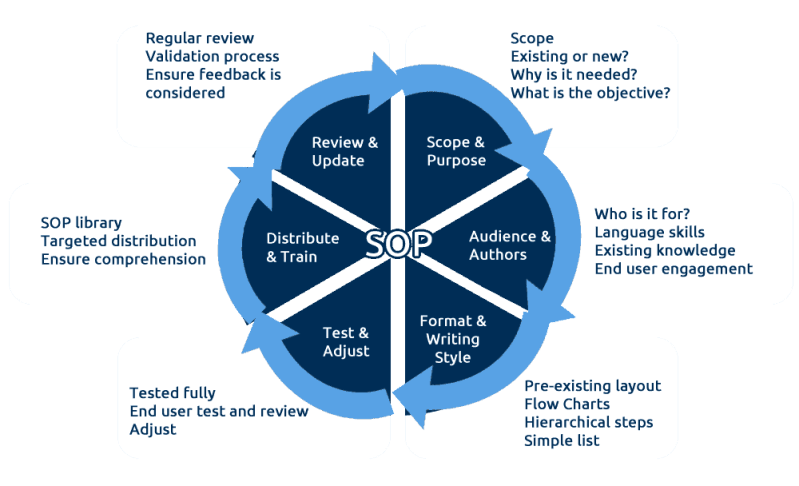
The Complete Overview of SOP Development
SOP development is the process of designing, documenting, and implementing standardized workflows to ensure consistency, accountability, and scalability across an organization. At its core, it’s about translating best practices into repeatable actions—whether in manufacturing, healthcare, or digital services. The term "SOP development" encompasses not just the creation of procedures but also their continuous refinement through performance metrics, employee feedback, and technological integration.
What distinguishes exceptional SOP development is its dual focus: operational rigor and human adaptability. A well-crafted SOP doesn’t eliminate variability; it channels it. For example, a call-center script (an SOP) allows agents to handle customer complaints efficiently while leaving room for empathy—a critical differentiator in service industries. The challenge lies in striking this balance: too prescriptive, and innovation suffocates; too vague, and quality erodes. The most effective frameworks treat SOPs as living documents, updated through data-driven insights rather than top-down edicts.
Historical Background and Evolution
The origins of SOP development trace back to the early 20th century, when Frederick Winslow Taylor’s scientific management principles sought to optimize factory workflows. Taylor’s "one best way" approach laid the groundwork for standardized procedures, but it was World War II that accelerated their adoption. The U.S. military’s "Standard Operating Procedures" ensured that pilots, engineers, and logistics teams could operate seamlessly under pressure—a model later adopted by industries from aerospace to hospitality.
By the 1980s, the rise of quality management systems (like ISO 9000) formalized SOP development as a compliance requirement. However, the digital revolution of the 2000s transformed SOPs from static PDFs to interactive platforms. Cloud-based tools like Confluence and Notion now enable real-time collaboration, while AI-driven analytics identify inefficiencies in workflows. Today, SOP development is less about rigid documentation and more about dynamic process orchestration—where machine learning predicts bottlenecks before they occur.
Core Mechanisms: How It Works
Effective SOP development follows a structured lifecycle: analysis, design, implementation, and optimization. The first phase involves mapping existing processes to identify gaps, redundancies, or compliance risks. Tools like process mining (e.g., Celonis) automate this by analyzing transactional data to reveal hidden inefficiencies. For instance, a retail chain might discover that 30% of in-store returns stem from unclear packaging instructions—a problem solvable through targeted SOP revisions.
The design phase shifts from "what we do" to "how we do it better." Here, behavioral psychology plays a critical role. Studies show that employees adhere to SOPs 40% more when they’re co-created with frontline staff. Techniques like "storyboarding" (visual workflows) or "role-playing" (simulating scenarios) ensure procedures are intuitive. Implementation requires change management—training, incentives, and feedback loops—to prevent resistance. The final stage, optimization, leverages metrics like cycle time, error rates, and employee satisfaction to refine SOPs iteratively.
Key Benefits and Crucial Impact
Organizations that master SOP development gain a competitive edge through reduced variability, lower costs, and higher compliance rates. A 2022 McKinsey study found that companies with standardized workflows achieve 20–30% faster decision-making in regulated industries. Yet the impact extends beyond metrics: SOPs foster psychological safety by clarifying expectations, reducing ambiguity, and empowering employees to focus on value-added tasks rather than ad-hoc problem-solving.
Consider the case of Tesla’s Gigafactories, where SOPs for battery assembly integrate robotics with human oversight. The result? A 50% reduction in defect rates and a 30% increase in output. This isn’t just about efficiency—it’s about scalability. As companies expand globally, SOPs ensure consistency across cultures and time zones, from a Tokyo call center to a Mumbai warehouse.
"Standardization is the enemy of progress" is a myth perpetuated by those who confuse control with creativity. The truth? The best SOPs are the ones that free people from repetitive tasks so they can innovate within defined boundaries.
— Elon Musk, discussing Tesla’s operational philosophy
Major Advantages
- Risk Mitigation: SOPs reduce human error by standardizing critical tasks (e.g., medical procedures, financial audits). The FDA cites SOPs as a key factor in 60% of successful drug approvals.
- Scalability: Franchises like McDonald’s use SOPs to replicate quality across 40,000+ locations. A single procedure manual ensures a Big Mac in Tokyo tastes identical to one in Toronto.
- Compliance Assurance: Industries like aviation (FAA) and pharmaceuticals (GMP) mandate SOPs to meet regulatory standards. Non-compliance can result in fines or shutdowns.
- Employee Empowerment: Clear SOPs reduce workplace anxiety by defining roles and expectations. Google’s "Psychological Safety" studies show that teams with documented processes are 25% more innovative.
- Data-Driven Improvement: Digital SOPs (e.g., integrated with ERP systems) track performance in real time, enabling continuous optimization. For example, Amazon uses SOPs to adjust warehouse picking routes based on peak-hour data.
Comparative Analysis
| Aspect | Traditional SOP Development | Modern (AI/Automated) SOP Development |
|---|---|---|
| Documentation Format | Static PDFs, Word files | Interactive platforms (Notion, Airtable) with version control |
| Update Frequency | Annual reviews (manual) | Real-time adjustments via AI (e.g., process mining) |
| Employee Adoption | Top-down enforcement | Gamified training (e.g., Duolingo-style quizzes) |
| Compliance Tracking | Manual audits | Automated alerts (e.g., SAP Ariba for procurement SOPs) |

Future Trends and Innovations
The next frontier in SOP development lies at the intersection of AI and human collaboration. Generative AI tools like GitHub Copilot are already drafting initial SOP drafts based on existing workflows, while natural language processing (NLP) extracts insights from unstructured data (e.g., customer service transcripts) to refine procedures. The goal isn’t to replace human judgment but to augment it—imagine an SOP for cybersecurity that updates in real time as new threats emerge.
Another trend is modular SOPs, where procedures are designed as interchangeable components. For example, a healthcare SOP for patient intake might include plug-and-play modules for telemedicine, in-person visits, or emergency protocols. Blockchain is also entering the picture, enabling tamper-proof audit trails for SOPs in supply chains or clinical trials. As remote work becomes permanent, SOPs will increasingly focus on asynchronous collaboration, with AI acting as a "virtual supervisor" to flag deviations in distributed teams.
Conclusion
SOP development is far from a relic of industrial-era bureaucracy. It’s a dynamic discipline that blends engineering precision with human-centric design. The organizations that thrive in the next decade will be those that treat SOPs not as constraints but as enablers—tools to amplify creativity, mitigate risk, and scale operations without losing sight of the human element.
Yet the journey doesn’t end with implementation. The most successful SOPs are those that evolve alongside the business. As technology advances, the art of SOP development will shift from documentation to orchestration—where procedures are not just followed but co-created by machines and people alike. The question for leaders isn’t whether to invest in SOP development, but how to make it an engine of innovation rather than a brake on progress.
Comprehensive FAQs
Q: How long does SOP development typically take?
A: The timeline varies by complexity. A simple 5-step procedure (e.g., email approval workflow) may take 2–4 weeks, while a multi-departmental SOP (e.g., ISO 9001 certification) can span 6–12 months. Key factors include stakeholder buy-in, data collection, and iterative testing.
Q: Can SOPs be too detailed?
A: Yes. Overly granular SOPs (e.g., specifying "click the mouse at a 45-degree angle") create rigidity and employee burnout. The rule of thumb: document what must happen, not how it happens—unless critical to safety or compliance. Leave room for contextual judgment.
Q: How do we ensure employees follow SOPs?
A: Enforcement alone fails. Effective strategies include:
- Gamification (e.g., badges for SOP compliance in training modules)
- Leadership modeling (executives adhering to SOPs first)
- Feedback loops (anonymous surveys to identify pain points)
- Integration with tools (e.g., SOPs embedded in CRM systems)
Q: What’s the difference between an SOP and a workflow?
A: An SOP is a documented procedure (e.g., "Steps to process a refund"), while a workflow is the dynamic execution of that procedure (e.g., a digital form routing refund requests). Workflows often automate SOPs (e.g., using RPA tools like UiPath), but the SOP remains the authoritative source.
Q: How do we measure the success of SOP development?
A: Success metrics depend on the goal:
- Efficiency: Cycle time reduction, error rates
- Compliance: Audit findings, regulatory violations
- Adoption: Employee usage data, training completion rates
- Scalability: Ability to replicate processes in new markets
Leave a Comment
Comments are moderated before appearing. The data you submit is processed according to the Privacy Policy of versiliasolutions.oneagency.co.