
Is 4 weeks a month right? The Truth Behind Time’s Most Misunderstood Unit
The confusion stems from two competing systems: the solar calendar (365 days) and the lunar calendar (354 days), each dictating how months are structured...
Tag
The confusion stems from two competing systems: the solar calendar (365 days) and the lunar calendar (354 days), each dictating how months are structured...

Its influence extends beyond mere dates. The civil calendar underpins legal deadlines, fiscal years, and even cultural traditions, creating a shared temporal...

The first recorded day calculation predates recorded history. Long before digital calendars or atomic clocks, our ancestors measured the sun’s arc across the...

The concept of measuring time in such increments isn’t arbitrary. It’s a product of human ingenuity, from ancient calendars to modern digital timestamps. Ten...

What makes this duration particularly intriguing is its role in scenarios where standard units (like years) introduce fractional inconsistencies. For instance...

The discrepancy grows when you consider that some months span 28, 30, or 31 days, while leap years add an extra day to February. A naive calculation (41 ÷ 12 ≈...

What makes "a winkle in time pdf" intriguing is its duality: it’s both a literal artifact (a PDF containing time-sensitive information) and a philosophical...

Precision in timekeeping isn’t just a niche skill—it’s a fundamental requirement in business, science, and daily life. Whether you’re tracking project...

Time is a currency no one can hoard, yet its measurement—especially the span between two dates—remains a fundamental skill across professions. A project...

The human obsession with time is ancient, yet the act of calculating dates from days remains a modern necessity—whether you're reconstructing a historical...
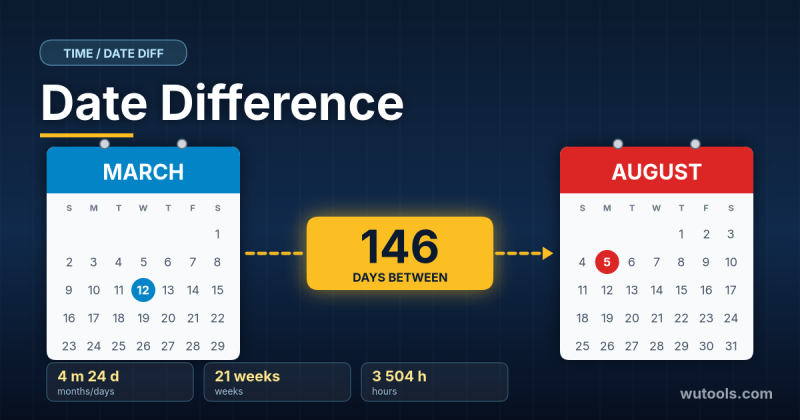
At its core, this calculation bridges two temporal points with mathematical rigor. The challenge lies in accounting for irregularities—like February’s 28 or 29...
The first time you realize a date calculator can pinpoint the exact days between two moments—whether it’s the gap since a childhood memory or the countdown to...

At its core, the calculation of eras blends astronomy with human convention. The Julian and Gregorian calendars, for instance, adjust for Earth’s axial...

This discrepancy isn’t mere trivia. It underpins legal contracts, financial cycles, and even how we commemorate history. A century in the Chinese lunar...

Consider this: The 1960s began with the Bay of Pigs invasion and ended with Woodstock. The 2010s started with the iPad’s debut and closed with a pandemic. Both...

What’s more striking is how this seemingly abstract unit governs real-world decisions. Governments use millennium benchmarks to plan infrastructure (e.g., the...