How the Traditional Marketing Funnel Still Shapes Modern Buyer Journeys
Table of Contents
- The Complete Overview of the Traditional Marketing Funnel
- Historical Background and Evolution
- Core Mechanisms: How It Works
- Key Benefits and Crucial Impact
- Major Advantages
- Comparative Analysis
- Future Trends and Innovations
- Conclusion
- Comprehensive FAQs
- Q: Is the traditional marketing funnel still relevant in 2024?
- Q: How does the traditional marketing funnel differ from the flywheel model?
- Q: Can small businesses effectively use the traditional marketing funnel?
- Q: What’s the biggest mistake brands make with the traditional marketing funnel?
- Q: How can I optimize my funnel for higher conversions?
The traditional marketing funnel remains the bedrock of customer acquisition strategies, even as digital channels have reshaped how brands engage audiences. At its core, this framework—often referred to as the traditional marketing funnel—maps the linear progression from brand awareness to conversion, offering a structured approach to nurturing leads. Its simplicity belies its power: by segmenting prospects into distinct stages (awareness, consideration, decision), businesses align messaging with buyer psychology, ensuring relevance at every touchpoint.
Yet, the traditional marketing funnel is frequently misunderstood as a rigid, one-size-fits-all model. In reality, its adaptability lies in its ability to integrate with modern tactics—whether through personalized email sequences, retargeting ads, or data-driven segmentation. The funnel’s strength persists because it mirrors the natural cognitive journey of consumers: from passive interest to active purchase. Ignoring this framework risks misaligned campaigns, wasted ad spend, and missed opportunities to guide prospects toward conversion.
Critics argue that today’s fragmented digital landscape demands non-linear models. But the traditional marketing funnel thrives precisely because it’s not about linearity—it’s about probability. High-intent users may skip stages, while others linger in consideration. The funnel’s value lies in its flexibility to accommodate these variations while maintaining a clear path to revenue.

The Complete Overview of the Traditional Marketing Funnel
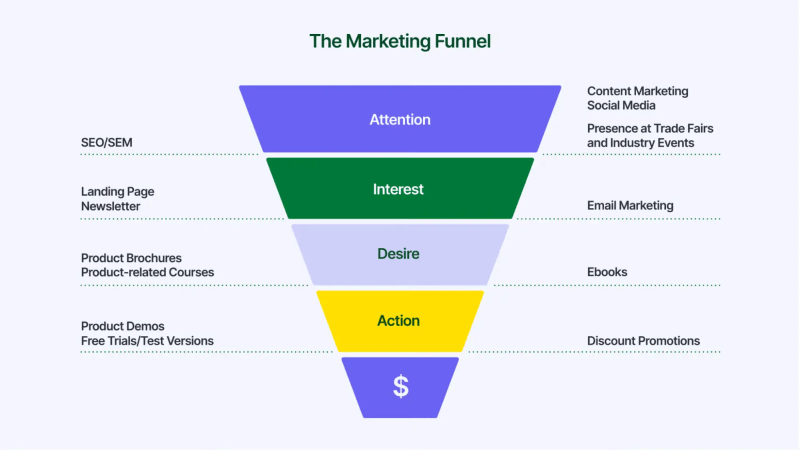
The traditional marketing funnel is a hierarchical model that categorizes consumers into four primary stages: awareness, interest, decision, and action. Each stage serves a distinct purpose—from capturing attention to driving conversion—while progressively narrowing the audience pool. This structure isn’t just a theoretical construct; it’s a tactical blueprint that aligns marketing efforts with measurable outcomes, such as lead generation, engagement metrics, and sales closure rates.What sets the traditional marketing funnel apart is its focus on funnel optimization. Brands don’t merely push traffic through stages; they refine each phase to reduce dropout rates. For example, a high-performing awareness campaign might use SEO and social media to cast a wide net, while decision-stage tactics—like limited-time offers or case studies—narrow focus to high-intent buyers. The funnel’s effectiveness hinges on this balance: broad reach meets targeted precision.
Historical Background and Evolution
The origins of the traditional marketing funnel trace back to the early 20th century, when economists like E. St. Elmo Lewis popularized the "AIDA" model (Attention, Interest, Desire, Action). This framework laid the groundwork for understanding consumer behavior in a pre-digital era, where mass media dominated. As television and print advertising emerged, brands refined the funnel to reflect the linear progression of buyer decisions—from passive exposure to active purchase.The digital revolution in the 1990s and 2000s forced a reevaluation of the traditional marketing funnel. With the rise of search engines, social media, and programmatic advertising, the funnel expanded into a multi-touchpoint ecosystem. However, rather than rendering the original model obsolete, it evolved into a hybrid approach: the core stages remained, but the tactics within each stage diversified. For instance, the "awareness" phase now includes influencer marketing and native ads, while "decision" stages leverage dynamic retargeting and chatbot interactions. The funnel’s adaptability ensures its relevance across eras.
Core Mechanisms: How It Works
The traditional marketing funnel operates on two key principles: attribution and progression. Attribution assigns value to each stage by tracking how many prospects enter and exit, identifying leaky points where conversions stall. Progression, meanwhile, ensures that messaging evolves with the buyer’s intent—educational content for awareness, comparative analysis for consideration, and urgency-driven offers for decision-making.A critical component is the funnel width: the broader the top (awareness), the more prospects filter through to the bottom (action). Brands must optimize this width by investing in scalable awareness tactics (e.g., content marketing, paid social) while refining conversion tactics (e.g., A/B testing landing pages, optimizing checkout flows). The funnel’s mechanics are data-driven; without analytics to measure drop-off rates, brands risk blind spots that erode ROI.
Key Benefits and Crucial Impact
The traditional marketing funnel delivers measurable outcomes that align with business objectives. By segmenting the buyer journey, it allows marketers to allocate budgets efficiently—focusing resources where prospects are most receptive. This precision reduces wasted spend on broad, untargeted campaigns and instead directs efforts toward high-converting stages. The funnel’s structure also fosters accountability: each stage’s performance can be isolated and improved, whether through better ad creatives or retargeting strategies.Beyond efficiency, the traditional marketing funnel enhances customer experience. When prospects receive tailored content at each stage—from exploratory blog posts to case studies—they perceive the brand as attuned to their needs. This alignment builds trust, increasing the likelihood of conversion. The funnel’s impact extends to sales teams, which gain insights into prospect readiness, enabling more effective outreach.
"The traditional marketing funnel isn’t a relic—it’s a living framework that adapts to new tools while preserving its core: understanding the buyer’s mind." — David Meerman Scott, Marketing Strategist
Major Advantages
- Clear Measurement: Each stage provides KPIs (e.g., click-through rates for awareness, conversion rates for action), enabling data-driven adjustments.
- Resource Optimization: Budgets are allocated based on where prospects spend the most time, reducing inefficiencies.
- Scalability: The funnel accommodates both B2B (longer sales cycles) and B2C (faster decisions) with stage-specific tactics.
- Competitive Insight: Analyzing drop-off points reveals gaps competitors may exploit, informing strategy shifts.
- Cross-Channel Integration: From email nurturing to paid ads, the funnel unifies disparate tactics under a unified goal.
Comparative Analysis
| Traditional Marketing Funnel | Modern Customer Journey |
|---|---|
| Linear, stage-based progression | Non-linear, multi-touchpoint interactions |
| Focuses on broad-to-narrow audience filtering | Prioritizes personalized, context-driven engagement |
| Measures success via conversion rates per stage | Tracks micro-conversions (e.g., time on page, social shares) |
| Relies on historical data and averages | Leverages real-time behavioral data and AI predictions |
Future Trends and Innovations
The traditional marketing funnel will continue evolving alongside AI and predictive analytics. Future iterations may incorporate dynamic funnel adjustments, where stages expand or contract based on real-time prospect behavior. For example, a prospect who repeatedly engages with decision-stage content might bypass consideration entirely, triggering a personalized offer. Additionally, voice search and conversational AI will redefine the "awareness" stage, requiring brands to optimize for natural language queries.Another trend is the fusion of the funnel with account-based marketing (ABM), where B2B brands tailor stages to high-value accounts. The funnel’s adaptability ensures it remains relevant, even as tools like chatbots and predictive lead scoring reshape execution. The core principle—guiding prospects toward conversion—will persist, but the tactics will grow more sophisticated.
Conclusion
The traditional marketing funnel endures because it distills complex buyer behavior into actionable stages. While digital marketing has introduced non-linear paths, the funnel’s foundational logic remains: prospects move through phases of intent, and brands must meet them where they are. Its greatest strength is not rigidity but flexibility—whether integrated with AI, ABM, or omnichannel strategies, the funnel provides a roadmap for growth.For businesses, the takeaway is clear: master the traditional marketing funnel, then innovate within it. The stages may evolve, but the principle of guiding prospects from awareness to action will always define successful marketing.
Comprehensive FAQs
Q: Is the traditional marketing funnel still relevant in 2024?
A: Absolutely. While modern models like the flywheel emphasize retention, the funnel’s stage-based approach remains essential for lead nurturing, budget allocation, and measuring conversion efficiency. Brands use it as a foundation, adapting tactics (e.g., AI-driven personalization) within each stage.
Q: How does the traditional marketing funnel differ from the flywheel model?
A: The funnel is linear and conversion-focused, while the flywheel prioritizes customer retention and ongoing engagement. The funnel asks, "How do we acquire?"; the flywheel asks, "How do we keep?" Many brands use both: the funnel for acquisition, the flywheel for loyalty.
Q: Can small businesses effectively use the traditional marketing funnel?
A: Yes. The funnel’s scalability makes it ideal for small businesses. Start with one stage (e.g., awareness via social media), then expand as resources allow. Tools like CRM software and email automation simplify tracking and optimization.
Q: What’s the biggest mistake brands make with the traditional marketing funnel?
A: Assuming all prospects follow the same path. Brands often overlook that some users skip stages (e.g., direct purchases) or loop back (e.g., post-purchase referrals). The solution is dynamic segmentation and multi-touch attribution to account for non-linear journeys.
Q: How can I optimize my funnel for higher conversions?
A: Focus on three areas:
1. Awareness: Improve SEO and content to capture organic traffic.
2. Consideration: Use retargeting ads and gated content (e.g., whitepapers) to nurture leads.
3. Decision: Simplify checkout flows and offer limited-time incentives.
Analyze drop-off points in each stage to refine tactics.
Leave a Comment
Comments are moderated before appearing. The data you submit is processed according to the Privacy Policy of versiliasolutions.oneagency.co.