Unlocking the Geometry: Mastering the Types of Trapezoid
Table of Contents
- The Complete Overview of Types of Trapezoid
- Historical Background and Evolution
- Core Mechanisms: How It Works
- Key Benefits and Crucial Impact
- Major Advantages
- Comparative Analysis
- Future Trends and Innovations
- Conclusion
- Comprehensive FAQs
- Q: How do I distinguish between a trapezoid and a parallelogram?
- Q: Can a trapezoid have all sides equal?
- Q: Why are right trapezoids used in stair design?
- Q: What’s the difference between an isosceles and a scalene trapezoid?
- Q: How do cyclic trapezoids improve optical systems?
- Q: Are trapezoids used in nature?
The trapezoid is often dismissed as a mere "four-sided shape with one pair of parallel sides," but its subtleties reveal a far richer structure. Hidden within its angles and sides lie classifications that dictate everything from structural stability in bridges to the aesthetic symmetry of stained-glass windows. While some types of trapezoid are intuitive—like the isosceles variety with its mirror-image sides—others, such as the scalene or right trapezoid, challenge even seasoned mathematicians to reconsider their assumptions about parallelism and symmetry.
At first glance, the trapezoid’s simplicity belies its versatility. Architects leverage its sloped sides to create dynamic facades, engineers exploit its stability for load-bearing designs, and artists use its proportions to evoke balance or tension. Yet, without a clear taxonomy of types of trapezoid, these applications risk miscalculation. The distinction between a trapezoid and a parallelogram, for instance, hinges on a single pair of parallel sides—a nuance that separates functional design from structural failure.
The confusion often stems from regional definitions. In the U.S., a trapezoid is any quadrilateral with one pair of parallel sides, while in the UK, it must have exactly one pair (excluding parallelograms). This ambiguity forces practitioners to adopt a global standard: types of trapezoid must be defined by their defining properties, not geography.
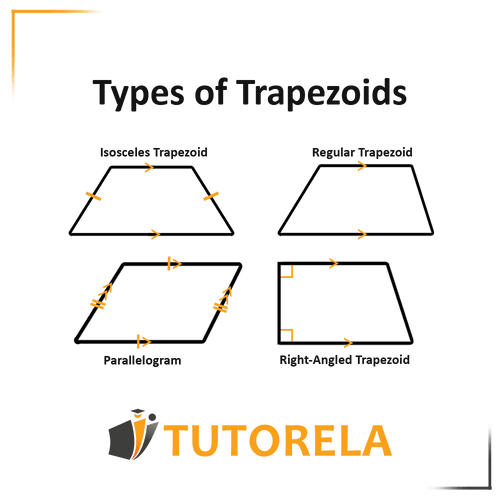
The Complete Overview of Types of Trapezoid
The study of types of trapezoid begins with their defining trait: a quadrilateral with at least one pair of parallel sides. This singular property spawns a spectrum of variations, each with unique geometric behaviors. From the rigid symmetry of the isosceles trapezoid to the asymmetrical scalene, these shapes serve distinct roles in mathematics, physics, and applied sciences. Their classification isn’t arbitrary—it reflects how forces distribute across their sides, how angles interact under stress, and how they integrate into larger systems.Understanding these types of trapezoid requires dissecting their internal structures. The parallel sides (bases) determine stability, while the non-parallel sides (legs) influence flexibility. A trapezoid’s height—measured perpendicular to the bases—dictates area calculations, a critical factor in everything from roofing to fluid dynamics. Even the angles between legs and bases reveal whether a shape will resist deformation or collapse under load. Without this framework, engineers might misapply a trapezoid’s properties, leading to costly errors in real-world structures.
Historical Background and Evolution
Trapezoids emerged from ancient geometric inquiries, where scholars like Euclid categorized quadrilaterals based on side relationships. The term itself traces back to the Greek trapeza (table) and eidos (form), reflecting early observations of trapezoidal tables or altars. However, it wasn’t until the 17th century that mathematicians formalized their classification, distinguishing them from parallelograms—a debate that persists today due to regional terminological divides.The evolution of types of trapezoid mirrors broader advances in geometry. Renaissance artists, such as Leonardo da Vinci, used trapezoidal proportions in perspective drawings, while 19th-century engineers applied them to railway tracks and suspension bridges. Each application demanded precision: a right trapezoid’s perpendicular legs, for example, became essential in designing staircases or ramps, where vertical and horizontal alignment were non-negotiable.
Core Mechanisms: How It Works
The functionality of types of trapezoid hinges on their side-length relationships and angular properties. Take the isosceles trapezoid: its equal non-parallel sides create symmetry, allowing forces to distribute evenly when used in load-bearing structures. Conversely, a scalene trapezoid’s unequal sides introduce instability, making it unsuitable for static applications unless reinforced. The right trapezoid, with one leg perpendicular to the bases, excels in scenarios requiring vertical alignment, such as drafting tables or architectural trusses.Mathematically, the area of any trapezoid is calculated using the formula:
A = (a + b) × h / 2,
where a and b are the lengths of the parallel sides, and h is the height. This formula underscores why trapezoids are favored in fluid containment (e.g., canals) or land surveying—their predictable area ensures consistent volume or space allocation. The interplay of these variables also explains why some types of trapezoid dominate specific fields: a cyclic trapezoid (inscribed in a circle) is prized in optical designs for its reflective properties.
Key Benefits and Crucial Impact
The practical advantages of types of trapezoid extend beyond theoretical geometry. In civil engineering, their sloped sides reduce material waste in construction, while their stability under lateral forces makes them ideal for retaining walls. Architects exploit their visual dynamism to create illusions of depth or movement, as seen in modernist buildings like Le Corbusier’s Villa Savoye, where trapezoidal windows manipulate light and perspective. Even in computer graphics, trapezoids simplify 3D rendering by approximating curved surfaces with flat polygons.Their impact isn’t limited to physical structures. In physics, trapezoidal cross-sections optimize airflow in ducts, and in robotics, their adjustable angles allow for modular designs. The versatility of types of trapezoid stems from their adaptability: whether as a static support beam or a dynamic component in kinetic art, their geometry solves problems that circles or rectangles cannot.
"A trapezoid is not just a shape—it’s a problem-solver. Its ability to bridge parallel and non-parallel worlds makes it indispensable in both art and industry." — Dr. Elena Vasquez, Geometric Structures Specialist
Major Advantages
- Structural Efficiency: Trapezoidal trusses distribute weight evenly, reducing material use in bridges and roofs by up to 30% compared to rectangular frameworks.
- Optical Precision: Cyclic trapezoids (inscribed in circles) create distortion-free reflections, used in telescopes and periscopes.
- Adaptive Design: Right trapezoids enable seamless integration into right-angled systems (e.g., staircases, ramps) without additional supports.
- Cost-Effective Manufacturing: Their simple side relationships allow for easier fabrication via CNC machining or 3D printing.
- Mathematical Simplicity: Area and perimeter calculations require minimal data, making them ideal for quick field assessments in surveying.
Comparative Analysis
| Type of Trapezoid | Key Characteristics & Applications |
|---|---|
| Isosceles Trapezoid | Non-parallel sides equal; used in symmetric structures (e.g., tables, bridges). Angles adjacent to each base are supplementary. |
| Scalene Trapezoid | All sides and angles unequal; common in irregular terrain stabilization (e.g., retaining walls). Requires reinforcement for stability. |
| Right Trapezoid | At least one leg perpendicular to the bases; essential in drafting, stair design, and right-angled frameworks. |
| Cyclic Trapezoid | Can be inscribed in a circle; used in optical instruments and curved architectural elements. |

Future Trends and Innovations
The future of types of trapezoid lies in their intersection with digital fabrication and smart materials. As 3D printing advances, trapezoidal lattice structures will enable lighter, stronger components in aerospace and automotive industries. Meanwhile, adaptive trapezoids—shapes that alter their angles in response to external forces—could revolutionize wearable tech, where flexibility meets structural integrity.In architecture, parametric design software will allow for trapezoidal facades that dynamically adjust to environmental conditions, such as solar exposure or wind loads. The key innovation? Self-optimizing trapezoids, where algorithms calculate the ideal side lengths and angles for a given function in real time. This shift from static to responsive geometry will redefine how we interact with built environments.
Conclusion
The types of trapezoid are more than academic curiosities—they are the unsung heroes of modern design and engineering. Their ability to balance simplicity with adaptability makes them a cornerstone of functional and aesthetic innovation. Whether in the rigid symmetry of an isosceles trapezoid or the asymmetrical resilience of a scalene, each variation offers solutions tailored to specific challenges.As technology evolves, so too will our understanding of these shapes. The trapezoid’s journey from ancient tables to smart structures underscores a fundamental truth: geometry isn’t just about lines and angles—it’s about solving problems. And in that pursuit, the trapezoid remains indispensable.
Comprehensive FAQs
Q: How do I distinguish between a trapezoid and a parallelogram?
A trapezoid has exactly one pair of parallel sides, while a parallelogram has two pairs. If both pairs of opposite sides are parallel, it’s a parallelogram (e.g., rectangle, rhombus); if only one pair is parallel, it’s a trapezoid.
Q: Can a trapezoid have all sides equal?
No. A quadrilateral with all sides equal is a rhombus (a type of parallelogram), which requires two pairs of parallel sides. A trapezoid cannot satisfy this condition by definition.Q: Why are right trapezoids used in stair design?
Right trapezoids provide a natural transition between vertical and horizontal planes, ensuring stairs align perfectly with floors and ceilings. Their perpendicular legs also simplify calculations for tread depth and riser height.Q: What’s the difference between an isosceles and a scalene trapezoid?
An isosceles trapezoid has equal non-parallel sides and base angles, creating symmetry. A scalene trapezoid has all sides and angles unequal, making it asymmetrical and less stable without support.Q: How do cyclic trapezoids improve optical systems?
Cyclic trapezoids can be inscribed in a circle, ensuring light or sound waves reflect or refract without distortion. This property is critical in telescopes, periscopes, and acoustic panels.Q: Are trapezoids used in nature?
Yes. Trapezoidal patterns appear in honeycomb cells (when viewed obliquely), certain crystal structures, and the cross-sections of some plant stems. Their efficiency in load distribution mirrors human-engineered designs.
Leave a Comment
Comments are moderated before appearing. The data you submit is processed according to the Privacy Policy of versiliasolutions.oneagency.co.