How to Calculate Pay After Taxes: The Exact Formula for Your Take-Home Salary
Table of Contents
- The Complete Overview of Calculating Pay After Taxes
- Historical Background and Evolution
- Core Mechanisms: How It Works
- Key Benefits and Crucial Impact
- Major Advantages
- Comparative Analysis
- Future Trends and Innovations
- Conclusion
- Comprehensive FAQs
- Q: How do I calculate my pay after taxes manually?
- Q: Why does my paycheck change even though my salary stayed the same?
- Q: Can I get a refund if my employer withheld too much tax?
- Q: How do state taxes affect my net pay if I work remotely?
- Q: What’s the difference between gross pay and net pay?
- Q: How can I maximize my take-home pay legally?
- Q: What happens if I forget to report side income on my W-4?
- Q: Are payroll calculators 100% accurate?
- Q: How do bonuses affect my tax withholding?
Understanding how to calculate pay after taxes isn’t just about plugging numbers into a payroll calculator—it’s about grasping the intricate interplay between federal, state, and local tax systems, each with its own rules and exceptions. A single miscalculation can leave you overpaying or, worse, underestimating your true take-home pay. For instance, a software engineer in California earning $120,000 annually might see their net pay shrink by nearly 30% due to state taxes, while their counterpart in Texas could retain a significantly larger portion. The discrepancy stems from progressive tax brackets, standard deduction adjustments, and regional tax policies that evolve yearly. Without precise calculations, even high earners risk financial missteps—like under-saving for retirement or missing deductions that could lower their taxable income.
The process of determining your net pay extends beyond simple percentage deductions. It involves decoding complex tax tables, accounting for pre-tax benefits (like 401(k) contributions), and navigating credits that might reduce your liability. For example, the Child Tax Credit or Earned Income Tax Credit can drastically alter your final figure, yet many employees overlook them when estimating their paychecks. Even small variations—such as switching from biweekly to semi-monthly payroll—can shift your withholding amounts, leading to unexpected surpluses or shortfalls at tax time. The stakes are higher than ever, given the IRS’s push for accuracy in W-4 filings post-2020 reforms, which now require employees to input allowances based on total annual income rather than per-paycheck estimates.
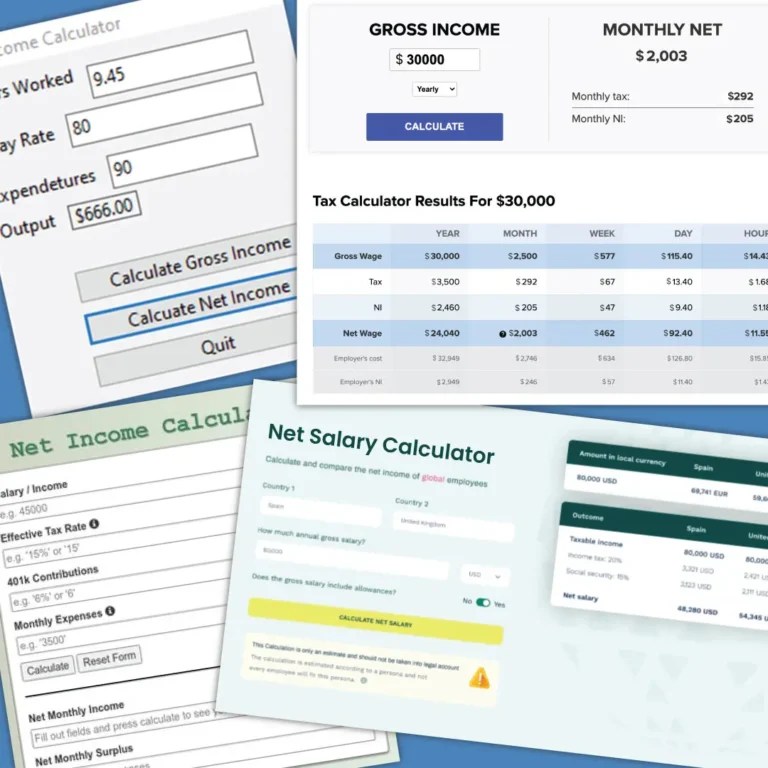
While payroll software and online calculators simplify the process, they often rely on generalized assumptions that may not apply to your specific situation. A freelancer with variable income, a dual-income household, or someone claiming dependents faces unique challenges in calculating their after-tax pay. The solution lies in mastering the foundational mechanics—from federal income tax brackets to Social Security contributions—while adapting for personal circumstances. This guide cuts through the ambiguity, providing a step-by-step framework to ensure your paycheck reflects what you’re truly owed.
The Complete Overview of Calculating Pay After Taxes
The core of calculating pay after taxes revolves around three primary components: withholding taxes (federal, state, and local), payroll taxes (Social Security and Medicare), and voluntary deductions (retirement contributions, health insurance). Federal income tax is assessed based on your filing status (single, married, etc.) and income bracket, with rates ranging from 10% to 37%. Meanwhile, FICA taxes—7.65% of your gross pay (6.2% for Social Security and 1.45% for Medicare)—are non-negotiable for most employees. State and local taxes add another layer, with some states (like Washington) imposing no income tax, while others (like New York) apply rates up to 10.9%. The interplay between these factors means a $5,000 paycheck in New York City could yield $3,700 after taxes, whereas the same paycheck in Florida might net $4,200.Beyond the baseline deductions, calculating your net pay requires accounting for pre-tax benefits, such as contributions to a 401(k) or health savings account (HSA), which reduce your taxable income. For example, deferring $1,000 monthly into a 401(k) could lower your taxable income by $12,000 annually, potentially dropping you into a lower tax bracket. Additionally, tax credits—like the Saver’s Credit for retirement contributions or the Lifetime Learning Credit—can further offset your liability. The complexity escalates for those with side income, investments, or self-employment earnings, which may trigger additional taxes (e.g., self-employment tax at 15.3%). Ignoring these nuances can result in over-withholding, tying up cash that could be used for investments or debt repayment.
Historical Background and Evolution
The modern system for calculating pay after taxes traces back to the Revenue Act of 1913, which introduced federal income taxation in the U.S. Initially, taxes were flat and minimal, but the progression to graduated rates in 1918 laid the groundwork for today’s bracket system. The Social Security Act of 1935 added payroll taxes, initially set at 1% for employers and employees, later rising to the current 6.2% and 1.45% respectively. These taxes were designed to fund retirement and disability benefits, but their structure—capped at $168,600 in 2024—means high earners pay less as a percentage of their income, creating a regressive element in the system.The evolution of tax withholding reflects broader economic shifts. The W-4 form, introduced in 1943, was simplified in 2020 to reduce errors and ensure employees paid closer to their actual tax liability. Meanwhile, state tax policies have diverged significantly; some states abolished income taxes entirely (e.g., Texas, Florida), while others adopted progressive rates to fund public services. The Affordable Care Act (2010) further complicated calculations by introducing the Net Investment Income Tax (3.8%) for high earners. These historical layers explain why calculating your take-home pay today demands an understanding of both legacy systems and modern adjustments—from the flat tax era to the digital age of real-time payroll processing.
Core Mechanisms: How It Works
At its core, calculating pay after taxes follows a structured formula:1. Gross Income: Your total earnings before deductions.
2. Pre-Tax Deductions: Amounts withheld before tax calculation (e.g., 401(k) contributions).
3. Adjusted Gross Income (AGI): Gross income minus pre-tax deductions.
4. Taxable Income: AGI minus standard or itemized deductions (e.g., $14,600 for single filers in 2024).
5. Tax Liability: Applied to taxable income using IRS brackets.
6. Payroll Taxes: FICA (7.65%) applied to gross income (capped for Social Security).
7. State/Local Taxes: Varies by jurisdiction (e.g., 4% flat rate in Pennsylvania).
8. Post-Tax Deductions: Voluntary contributions (e.g., health insurance premiums).
For example, a $3,500 biweekly paycheck in Illinois (6.25% state tax) with $500 in 401(k) contributions would:
The precision of this calculation hinges on accurate W-4 inputs and awareness of regional variations.
Key Benefits and Crucial Impact
Accurately calculating your after-tax pay isn’t just about budgeting—it’s a financial safeguard. For employees, it prevents over-withholding, which can be refunded but costs you interest-free use of your money. Conversely, under-withholding may trigger penalties or a tax bill at year-end. For employers, it ensures compliance with labor laws and avoids IRS audits. The ripple effects extend to retirement planning; knowing your net pay helps determine how much to allocate to savings without sacrificing lifestyle needs. Even small adjustments—like optimizing W-4 allowances—can free up hundreds monthly for investments or debt repayment.The psychological impact is equally significant. Financial stress often stems from uncertainty about take-home pay, especially for gig workers or those with irregular incomes. A clear understanding of how to calculate pay after taxes empowers individuals to negotiate salaries, claim credits, or adjust deductions proactively. For instance, a parent claiming the Child Tax Credit might reduce their taxable income by up to $2,000 per child, directly boosting their net pay. The same principle applies to education-related credits or energy-efficient home improvements. By demystifying the process, you regain control over your financial narrative.
"Taxes are what we pay for a civilized society." — Oliver Wendell Holmes Jr.
While this quote underscores the societal purpose of taxation, the practical reality is that calculating your pay after taxes should work for you—not against you. The difference between a well-optimized paycheck and one drained by avoidable deductions can mean the gap between financial security and constant catch-up.
Major Advantages
- Financial Clarity: Eliminates guesswork in budgeting by providing an exact net pay figure, including state-specific adjustments.
- Tax Optimization: Identifies deductions, credits, and pre-tax benefits to legally minimize taxable income, increasing take-home pay.
- Retirement Planning: Accurate net pay calculations help determine optimal 401(k) or IRA contributions without sacrificing daily expenses.
- Avoidance of Penalties: Prevents under-withholding errors that could trigger IRS interest or quarterly estimated tax payments.
- Negotiation Leverage: Knowledge of true take-home pay strengthens salary discussions, as employers often quote gross figures.
Comparative Analysis
| Factor | High-Tax State (e.g., California) | No-Income-Tax State (e.g., Texas) |
|---|---|---|
| State Tax Rate | Up to 13.3% (progressive) | 0% |
| Local Taxes (if applicable) | Up to 1.25% (e.g., Los Angeles) | Up to 2% (e.g., Houston) |
| Net Pay Impact on $60K Salary | ~$4,500 less annually vs. Texas | Base federal + FICA only |
| Key Deduction Strategy | Maximize 401(k) contributions; claim education credits | Prioritize HSA if eligible; itemize deductions |

Future Trends and Innovations
The landscape of calculating pay after taxes is poised for disruption, driven by automation and policy shifts. Real-time payroll systems, already adopted by companies like ADP and Gusto, will further reduce manual errors by syncing with tax databases to adjust withholdings dynamically. Blockchain-based payroll could enable transparent, immutable records of tax deductions, simplifying audits and credit claims. Meanwhile, the IRS’s push for digital tax filings (via Free File or direct deposit refunds) will streamline refunds and payments, making net pay calculations more immediate.Legislative changes may also reshape the equation. Proposals to cap Social Security taxes at higher income thresholds or expand tax credits for green energy investments could alter net pay outcomes. Remote work trends may lead to hybrid tax systems, where employees split residency between states with differing rates—a scenario already tested in "snowbird" states like Florida and Arizona. As AI tools like tax-optimization chatbots mature, individuals may soon receive personalized after-tax pay estimates tailored to their lifestyle, dependents, and investment goals. The future of payroll accuracy lies in blending human expertise with real-time, adaptive technology.
Conclusion
Calculating your pay after taxes is more than arithmetic—it’s a financial strategy that demands attention to detail and an understanding of how taxes interact with your income. Whether you’re a salaried employee, freelancer, or business owner, the principles remain constant: gross income minus deductions, credits, and taxes equals your net take-home. The key to mastery lies in leveraging tools (like payroll calculators), staying updated on tax law changes, and optimizing deductions without overcomplicating your finances. Small adjustments—such as tweaking your W-4 or contributing to a Health Savings Account—can yield significant savings over time.The ultimate goal isn’t just to survive tax season but to thrive by aligning your paycheck with your financial priorities. By demystifying the process, you transform passive income into active wealth-building. Start with the basics, refine as your circumstances evolve, and always verify calculations with official sources like the IRS or state revenue agencies. In an era where financial literacy is a competitive advantage, knowing how to calculate your after-tax pay is one of the most practical skills you can develop.
Comprehensive FAQs
Q: How do I calculate my pay after taxes manually?
A: Use this step-by-step method:
1. Subtract pre-tax deductions (e.g., 401(k)) from gross pay to get taxable income.
2. Apply your federal tax bracket (e.g., 22% for $44,726–$95,375 in 2024).
3. Add FICA (7.65% of gross pay).
4. Subtract state/local taxes (check your state’s rates).
5. Deduct post-tax items (e.g., health insurance).
Tools like the IRS Tax Withholding Estimator can automate this.
Q: Why does my paycheck change even though my salary stayed the same?
A: Paycheck fluctuations occur due to:
Q: Can I get a refund if my employer withheld too much tax?
A: Yes, but it’s not ideal. Over-withholding means you’re loaning the government interest-free cash. To adjust:
1. Update your W-4 with the IRS’s Tax Withholding Estimator.
2. Claim credits (e.g., EITC) to reduce future liability.
3. Consider biweekly payroll if you’re under-withholding (more frequent adjustments).
Q: How do state taxes affect my net pay if I work remotely?
A: Remote work complicates calculating pay after taxes if you split time between states. Rules vary:
Q: What’s the difference between gross pay and net pay?
A: Gross pay is your total earnings before any deductions. Net pay (or take-home pay) is what remains after:
Q: How can I maximize my take-home pay legally?
A: Optimize using these strategies:
1. Increase pre-tax contributions (401(k), HSA, FSA).
2. Claim all eligible credits (Child Tax Credit, EITC, education credits).
3. Adjust W-4 allowances (use the IRS estimator to match your tax liability).
4. Choose tax-efficient investments (e.g., municipal bonds for state tax-free income).
5. Monitor state-specific deductions (e.g., California’s mortgage interest deductions).
Avoid aggressive tactics like misclassifying income—accuracy is key.
Q: What happens if I forget to report side income on my W-4?
A: Unreported side income (e.g., freelance, gig work) can lead to:
Q: Are payroll calculators 100% accurate?
A: No, but they’re highly reliable for estimates. Limitations include:
Q: How do bonuses affect my tax withholding?
A: Bonuses are taxed differently because they’re often paid in lump sums. Employers typically withhold:
Leave a Comment
Comments are moderated before appearing. The data you submit is processed according to the Privacy Policy of versiliasolutions.oneagency.co.