How to Calculate the Radius of a Circle Through Three Points: Geometry’s Hidden Precision
Table of Contents
- The Complete Overview of Calculating the Radius of a Circle Through Three Points
- Historical Background and Evolution
- Core Mechanisms: How It Works
- Key Benefits and Crucial Impact
- Major Advantages
- Comparative Analysis
- Future Trends and Innovations
- Conclusion
- Comprehensive FAQs
- Q: What happens if the three points are collinear?
- Q: Can this method be extended to three-dimensional space?
- Q: How does the circumradius formula \( R = \frac{abc}{4K} \) relate to the coordinate method?
- Q: Are there numerical stability issues when solving for the circumcenter?
- Q: How is this problem solved in computer graphics for rendering circles?
- Q: What role does this play in GPS or satellite navigation?
The problem of calculating the radius of the circle passing through three given planar points is a cornerstone of Euclidean geometry, bridging abstract theory with practical application. Whether you’re reconstructing a lost architectural blueprint, optimizing a drone’s flight path, or validating a simulation in physics, the ability to derive this radius from three arbitrary points is indispensable. The solution isn’t merely about plugging numbers into a formula—it’s about understanding the underlying symmetry of the plane, where three non-collinear points uniquely define a circle. This precision demands more than memorization; it requires grasping how perpendicular bisectors intersect at the circumcenter, the geometric pivot around which the radius pivots.
At its core, the challenge lies in the tension between simplicity and rigor. A child sketching a circle freehand might approximate the center by eye, but engineers and mathematicians need exactitude. The method hinges on the perpendicular bisector theorem, a principle so elegant it was known to the ancient Greeks yet remains the bedrock of modern CAD software. Yet, even today, students and professionals alike stumble when translating this theorem into algebraic steps—confusing the midpoint formula with the slope of the bisector, or misapplying the distance formula to the circumradius. The stakes are higher in fields like robotics, where a miscalculation could mean the difference between a smooth trajectory and a catastrophic collision.
The journey from three points to a radius is a microcosm of mathematical storytelling: each step—from identifying collinearity to solving a system of equations—reveals deeper layers of logic. What follows is not just a step-by-step manual, but an exploration of how geometry’s most fundamental problems persist across millennia, adapting to new tools while retaining their timeless essence.
The Complete Overview of Calculating the Radius of a Circle Through Three Points
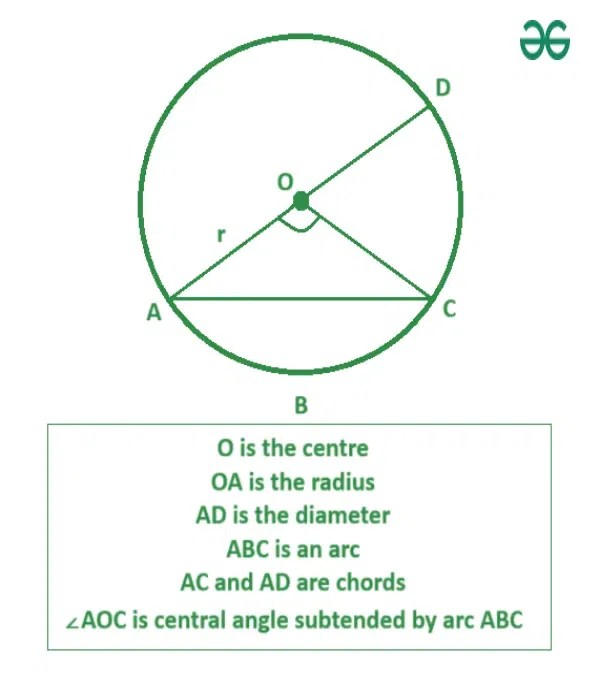
The process of determining the radius of a circle passing through three given planar points is a synthesis of coordinate geometry and pure Euclidean reasoning. Given three non-collinear points \( A(x_1, y_1) \), \( B(x_2, y_2) \), and \( C(x_3, y_3) \), the solution hinges on two critical insights: first, that the center of the circle (the circumcenter) lies at the intersection of the perpendicular bisectors of any two sides of the triangle formed by the points; second, that the radius is the distance from this center to any of the three points. The algebraic translation of these geometric principles yields a formula that, while straightforward, masks the depth of its derivation—from the midpoint calculations to the quadratic solutions that emerge when equating distances.What often confuses learners is the transition from visual intuition to symbolic manipulation. A diagram might show the perpendicular bisectors converging neatly, but the algebra—solving for the intersection point \((h, k)\) of two linear equations—can feel like an arbitrary exercise. The key lies in recognizing that these equations are not arbitrary; they encode the geometric constraint that the center must be equidistant to all three points. This duality between visual and algebraic representations is why the problem serves as a gateway to understanding more advanced topics, such as inversion geometry or least-squares fitting in data science.
Historical Background and Evolution
The quest to calculate the radius of a circle through three points traces back to the 4th century BCE, when Euclid formalized the concept of the circumcircle in Elements, Book IV. His proof relied on constructing the perpendicular bisectors of a triangle’s sides, demonstrating that their intersection—the circumcenter—equally distanced all three vertices. This was revolutionary: it turned a seemingly arbitrary construction into a rigorous geometric truth, laying the foundation for centuries of mathematical inquiry. Later, in the 17th century, René Descartes and Pierre de Fermat expanded these ideas into analytic geometry, where coordinates replaced compass-and-straightedge constructions, making the problem accessible to a broader audience.The 19th century brought further refinements with the rise of projective geometry and the development of algebraic methods. Mathematicians like Carl Friedrich Gauss and Arthur Cayley recognized that the circumradius could be expressed not just as a geometric distance but as a determinant in a system of linear equations—a bridge between pure and applied mathematics. Today, the problem is as relevant in computer graphics (where circles are rendered via parametric equations) as it is in astrophysics (modeling planetary orbits). The evolution reflects a broader truth: geometry is not static; it adapts to the tools of each era while preserving its core principles.
Core Mechanisms: How It Works
The modern approach to determining the radius of a circle passing through three planar points begins with the perpendicular bisector method, which can be broken into three phases:1. Midpoint Calculation: For sides \( AB \) and \( AC \), compute the midpoints \( M \) and \( N \). These points anchor the bisectors.
2. Slope Determination: The slope of \( AB \) (or \( AC \)) is inverted and negated to find the slope of its perpendicular bisector. This step ensures the bisector is truly perpendicular.
3. Equation Solving: The equations of the two bisectors are solved simultaneously to find the circumcenter \((h, k)\). The radius is then the Euclidean distance from \((h, k)\) to any of the original points.
The algebraic heavy lifting occurs in the third phase, where the system of equations derived from the bisectors may yield a unique solution (if the points are non-collinear) or no solution (if they lie on a straight line). The formula for the circumradius \( R \) can also be expressed in terms of the triangle’s sides \( a, b, c \) and area \( K \):
\[ R = \frac{abc}{4K} \]
This variant, known as the circumradius formula, is particularly useful in surveying and engineering, where side lengths are often measured directly.
Key Benefits and Crucial Impact
The ability to calculate the radius of a circle through three points transcends academic exercises, offering tangible advantages in fields as diverse as architecture, aerospace, and machine learning. In computer-aided design (CAD), for instance, this calculation underpins tools that generate smooth curves from discrete points, ensuring precision in everything from car body panels to medical implants. Similarly, in robotics, path-planning algorithms use circumradius computations to optimize trajectories, reducing energy consumption and wear on mechanical systems. The impact extends to data analysis, where circles fitted to scattered points help identify trends or anomalies in datasets.At a fundamental level, mastering this technique sharpens spatial reasoning—a skill critical for problem-solving in any discipline. The process of translating geometric intuition into algebraic steps mirrors the cognitive challenges of debugging code or designing experiments, fostering a mindset that values both creativity and rigor. As one mathematician once noted:
"Geometry is the silent language of the universe; to speak it is to unlock patterns invisible to the untrained eye." — Adapted from the works of David Hilbert
Major Advantages
- Universal Applicability: Works in any Cartesian coordinate system, from 2D plane geometry to 3D space (extending to spheres).
- Precision in Design: Eliminates approximation errors in manufacturing and construction, where tolerances are measured in micrometers.
- Algorithmic Efficiency: The solution can be computed in constant time \( O(1) \), making it ideal for real-time applications like collision detection in games.
- Educational Foundation: Serves as a gateway to advanced topics like inversion geometry, complex numbers, and even general relativity.
- Cross-Disciplinary Utility: Used in astronomy (orbit calculations), biology (protein structure modeling), and economics (optimization of resource distribution).
Comparative Analysis
| Method | Advantages |
|---|---|
| Perpendicular Bisector Method | Intuitive, geometrically transparent; works with any three non-collinear points. |
| Circumradius Formula (\( R = \frac{abc}{4K} \)) | Efficient when side lengths and area are known; avoids coordinate calculations. |
| Determinant-Based Approach | Lends itself to matrix operations; useful in computational geometry libraries. |
| Parametric Optimization | Adaptable to noisy data (e.g., least-squares fitting in sensor networks). |

Future Trends and Innovations
As computational geometry continues to intersect with artificial intelligence, the methods for calculating the radius of a circle through three points are evolving beyond classical Euclidean constraints. Machine learning models now "learn" geometric properties from data, including circle-fitting algorithms that generalize to higher dimensions or irregular point distributions. In quantum computing, similar principles are being explored to optimize qubit arrangements, where the "circle" might represent a spherical constraint in a multi-dimensional Hilbert space.Another frontier lies in topological data analysis, where circles (or their higher-dimensional analogs, spheres) are used to detect patterns in complex datasets. Here, the circumradius becomes a feature in itself, helping classify shapes or predict behaviors in fields like climatology or genomics. The future of this problem is not in solving it anew, but in embedding its logic into systems that redefine what "points" and "circles" can represent.
Conclusion
The problem of determining the radius of a circle passing through three planar points is more than a textbook exercise—it’s a lens through which to view the interplay between abstraction and application. From the chalkboards of ancient Athens to the silicon chips of modern supercomputers, its solutions have remained constant in essence while adapting to new tools. The takeaway for practitioners is clear: geometry is not a relic of the past but a living discipline, its principles as vital today as they were to the architects of the Parthenon or the engineers of the Apollo missions.For those who seek to wield this knowledge, the path forward lies in balancing theoretical understanding with practical experimentation. Whether you’re writing code to animate a 3D scene or measuring the curvature of a galaxy’s edge, the ability to calculate a circumradius is a testament to the enduring power of mathematical thought.
Comprehensive FAQs
Q: What happens if the three points are collinear?
A: If the points lie on a straight line, the perpendicular bisectors will be parallel and never intersect, meaning no finite circle passes through them. The "radius" tends to infinity, representing a degenerate case where the circle becomes a straight line.
Q: Can this method be extended to three-dimensional space?
A: Yes. In 3D, three non-collinear points define a unique circle (lying on a plane), and the radius is calculated similarly. However, four non-coplanar points are needed to define a sphere. The process involves finding the circumcenter of the triangle formed by the points and then computing the distance to any vertex.
Q: How does the circumradius formula \( R = \frac{abc}{4K} \) relate to the coordinate method?
A: Both methods derive the same radius but use different inputs. The coordinate method relies on the points’ Cartesian coordinates, while the formula uses the triangle’s side lengths (\( a, b, c \)) and area (\( K \)). They are equivalent because the area and side lengths can be computed from the coordinates via the shoelace formula and distance formula, respectively.
Q: Are there numerical stability issues when solving for the circumcenter?
A: Yes. When points are nearly collinear or very close together, the perpendicular bisectors may intersect at a point far from the data, leading to large radius values and potential floating-point errors. Robust implementations use techniques like least-squares fitting or symbolic computation to mitigate these issues.
Q: How is this problem solved in computer graphics for rendering circles?
A: In graphics, circles are often approximated using parametric equations (e.g., \( x = h + r \cos \theta \), \( y = k + r \sin \theta \)) after computing the circumcenter \((h, k)\) and radius \( r \). For anti-aliased rendering, additional points are sampled around the circumference to smooth jagged edges. Libraries like OpenGL or DirectX handle these calculations efficiently using optimized matrix operations.
Q: What role does this play in GPS or satellite navigation?
A: Satellite triangulation relies on similar principles. A receiver calculates its position by determining the intersection of circles (or spheres) centered at known satellite positions with radii equal to the signal travel time multiplied by the speed of light. The circumradius concept helps refine these calculations, especially in urban canyons where signal reflections introduce noise.
Leave a Comment
Comments are moderated before appearing. The data you submit is processed according to the Privacy Policy of versiliasolutions.oneagency.co.