How Database Marketing Transforms Customer Engagement
Table of Contents
- The Complete Overview of Database Marketing
- Historical Background and Evolution
- Core Mechanisms: How It Works
- Key Benefits and Crucial Impact
- Major Advantages
- Comparative Analysis
- Future Trends and Innovations
- Conclusion
- Comprehensive FAQs
- Q: What’s the difference between database marketing and CRM?
- Q: How do I start implementing database marketing?
- Q: Is database marketing only for large enterprises?
- Q: How does database marketing handle privacy regulations like GDPR?
- Q: Can database marketing improve customer retention?
- Q: What metrics should I track to measure success?
Database marketing isn’t just a tactic—it’s the backbone of modern customer-centric strategies. By systematically collecting, analyzing, and deploying consumer data, businesses turn raw insights into actionable campaigns. The shift from broad-brush advertising to hyper-targeted messaging began decades ago, but today’s database marketing systems integrate AI, real-time analytics, and behavioral triggers to create seamless, personalized experiences.
Yet, its power lies in precision. Unlike traditional marketing, which relies on demographics or guesswork, database-driven marketing uses transaction histories, browsing behavior, and even social signals to predict needs before they arise. This isn’t just about sending emails—it’s about anticipating churn, optimizing cross-sell opportunities, and building loyalty through relevance.
The challenge? Balancing scale with granularity. A poorly managed customer database becomes a liability—fragmented, outdated, or riddled with compliance gaps. The most effective programs treat data as a living asset, continuously refined through feedback loops and ethical governance. That’s where the difference between database marketing and generic data collection becomes clear: it’s not about hoarding information, but orchestrating it into strategies that resonate.
The Complete Overview of Database Marketing
Database marketing refers to the strategic use of structured customer data to inform, automate, and optimize marketing efforts. At its core, it’s a fusion of technology and psychology: technology to capture and process data at scale, and psychology to interpret human behavior patterns. The goal is to move beyond one-size-fits-all messaging and deliver experiences that align with individual preferences, purchase cycles, and lifecycle stages.
Modern implementations often rely on customer data platforms (CDPs), which aggregate data from CRM systems, e-commerce platforms, social media, and IoT devices. These platforms don’t just store data—they activate it, enabling marketers to trigger personalized emails, dynamic website content, or even in-store promotions based on real-time triggers. The result? Higher conversion rates, reduced customer acquisition costs, and stronger brand affinity.
Historical Background and Evolution
The roots of database marketing trace back to the 1970s, when direct mail companies began using simple punch-card systems to track customer responses. The real breakthrough came in the 1990s with the rise of relational databases and the ability to segment audiences dynamically. Early adopters like catalog retailers used RFM (Recency, Frequency, Monetary) analysis to identify high-value customers, laying the groundwork for what would become data-driven marketing strategies.
By the 2000s, the internet democratized data collection, but also introduced fragmentation. Customers interacted across channels—email, websites, mobile apps—each leaving siloed data. Enter the era of customer relationship management (CRM) systems, which consolidated interactions but often lacked the agility of modern database marketing tools. Today, the integration of AI and machine learning has transformed static databases into predictive engines, enabling marketers to anticipate needs with near-real-time accuracy.
Core Mechanisms: How It Works
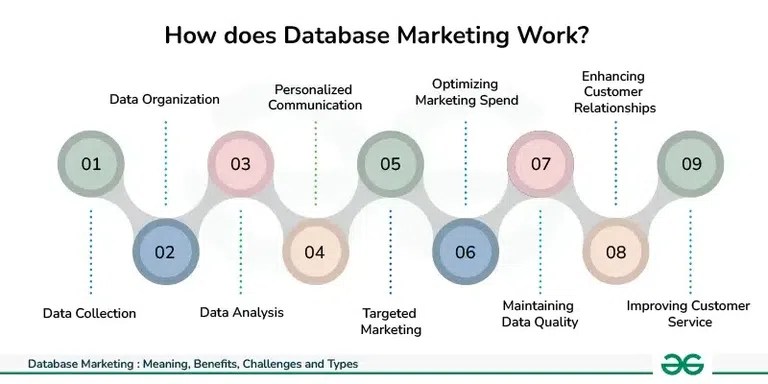
The engine of database marketing is a feedback loop: data collection → analysis → segmentation → activation → measurement → refinement. The process begins with data unification, where disparate sources (e.g., purchase history, browsing behavior, support tickets) are cleaned, deduplicated, and enriched. Tools like CDPs or data warehouses then apply algorithms to identify patterns—such as churn risk scores or lifetime value (LTV) predictions.
Activation happens through automated workflows. For example, a customer who abandons a cart might receive a personalized discount via email, while a high-LTV segment could trigger a VIP invitation to an exclusive event. The loop closes with performance analytics, where marketers assess whether the campaign met KPIs (e.g., open rates, sales lift) and adjust future strategies. The most advanced systems use predictive modeling to simulate outcomes before execution, minimizing trial-and-error costs.
Key Benefits and Crucial Impact
Database marketing delivers quantifiable results, but its true value lies in its ability to redefine customer relationships. Businesses that leverage it effectively see a 20–40% increase in customer retention and a 15–30% boost in revenue per customer, according to industry benchmarks. The impact isn’t just financial—it’s experiential. When customers feel understood, engagement metrics improve across the board: higher email open rates, longer session durations, and reduced customer service costs.
The competitive edge comes from contextual relevance. A retail brand using database-driven marketing might recommend products based on past purchases, while a SaaS company could tailor onboarding sequences to user behavior. The key is moving from reactive marketing (responding to actions) to proactive marketing (predicting and shaping actions). This shift requires not just technology, but a cultural commitment to data literacy across teams.
— "The companies that win in the next decade will be those that turn data into empathy." — Forrester Research
Major Advantages
- Hyper-Personalization: Algorithms tailor messages, offers, and content to individual preferences, increasing relevance and reducing bounce rates.
- Cost Efficiency: By targeting high-intent audiences, businesses reduce wasted spend on broad campaigns, with ROI improvements of 30%+ in many cases.
- Customer Retention: Proactive engagement (e.g., win-back campaigns for lapsed users) extends lifecycle value by 15–25% on average.
- Data-Driven Decision Making: Real-time analytics replace gut instincts, enabling marketers to pivot strategies based on live performance data.
- Compliance and Trust: Ethical data governance (e.g., GDPR alignment) builds customer trust while mitigating legal risks.
Comparative Analysis
| Database Marketing | Traditional Marketing |
|---|---|
| Data-driven, real-time, and personalized | Demographic-based, batch-oriented, and generic |
| Uses CRM, CDPs, and AI for automation | Relies on manual segmentation and static lists |
| Measures individual-level engagement (e.g., open rates, click-throughs) | Tracks aggregate metrics (e.g., impressions, conversions) |
| Adapts to customer behavior dynamically | Follows predefined campaign calendars |

Future Trends and Innovations
The next frontier for database marketing lies in contextual intelligence—where data isn’t just analyzed but interpreted in real-world scenarios. Advances in natural language processing (NLP) will enable marketers to derive insights from unstructured data (e.g., customer reviews, social media sentiment), while edge computing will reduce latency for real-time personalization. Privacy-preserving techniques, like federated learning, will allow businesses to collaborate on insights without compromising individual data.
Another shift is toward predictive orchestration, where AI doesn’t just recommend actions but executes them autonomously. Imagine a system that not only identifies a customer’s likelihood to churn but also triggers a multi-channel retention sequence—including a personalized video message, a discount, and a support outreach—all within hours. The challenge will be balancing automation with human oversight to maintain authenticity in customer interactions.
Conclusion
Database marketing is no longer optional—it’s the standard by which customer-centric businesses are measured. The organizations that thrive will be those that treat data as a strategic asset, not just a tactical tool. This requires investing in the right infrastructure (CDPs, analytics platforms) and fostering a culture where data informs every decision, from product development to customer service.
The future belongs to those who can turn data into stories—stories that resonate on a personal level. As technology evolves, the lines between marketing and customer experience will blur further, demanding marketers who can navigate both the art of storytelling and the science of data. The question isn’t whether to adopt database marketing—it’s how far to push its potential.
Comprehensive FAQs
Q: What’s the difference between database marketing and CRM?
A: While CRM systems manage customer interactions and relationships, database marketing specifically focuses on using structured data to drive targeted campaigns. CRM is the container; database marketing is the engine that powers personalized outreach within it.
Q: How do I start implementing database marketing?
A: Begin by auditing your data sources (CRM, website, email, etc.), then invest in a CDP or data warehouse to unify them. Prioritize cleaning and enriching data before building segmentation rules and automated workflows. Start small—pilot with one high-value segment before scaling.
Q: Is database marketing only for large enterprises?
A: No. Tools like HubSpot or Klaviyo offer scalable database marketing solutions for SMBs, with AI-driven personalization features. The key is starting with accessible data (e.g., email lists, purchase history) and gradually layering in advanced analytics.
Q: How does database marketing handle privacy regulations like GDPR?
A: Ethical database marketing requires explicit consent, data minimization, and anonymization techniques. Many CDPs now include built-in compliance features, such as opt-out management and right-to-erasure workflows. Always consult legal experts to align strategies with regional laws.
Q: Can database marketing improve customer retention?
A: Absolutely. By analyzing behavioral triggers (e.g., reduced purchase frequency), businesses can deploy proactive retention strategies—such as loyalty rewards or personalized support—before customers churn. Studies show database-driven retention can increase LTV by up to 30%.
Q: What metrics should I track to measure success?
A: Focus on individual-level metrics like open rates, click-through rates, and conversion lift per segment. Macro metrics include customer lifetime value (LTV), retention rate, and cost per acquisition (CPA). Compare pre- and post-campaign performance to isolate the impact of database marketing strategies.
Leave a Comment
Comments are moderated before appearing. The data you submit is processed according to the Privacy Policy of versiliasolutions.oneagency.co.