How Database Marketing Services Reshape Customer Engagement in 2024
Table of Contents
- The Complete Overview of Database Marketing Services
- Historical Background and Evolution
- Core Mechanisms: How It Works
- Key Benefits and Crucial Impact
- Major Advantages
- Comparative Analysis
- Future Trends and Innovations
- Conclusion
- Comprehensive FAQs
- Q: What’s the difference between a CRM and a CDP in database marketing?
- Q: How do I ensure my database marketing efforts comply with privacy laws?
- Q: Can small businesses benefit from database marketing services?
- Q: What’s the biggest mistake companies make when implementing database marketing?
- Q: How do I measure the ROI of database marketing services?
- Q: Are there industries where database marketing services are more effective than others?
Data isn’t just a corporate asset—it’s the backbone of modern marketing. Companies that harness database marketing services don’t just collect emails or track clicks; they build dynamic profiles of individual customers, predict behavior, and automate engagement at scale. The difference between a scattershot campaign and a hyper-personalized one often comes down to how well a business integrates data into its strategy.
Yet for all its promise, database-driven marketing remains misunderstood. Many organizations treat customer data as a static ledger rather than a living resource. The most effective brands treat it as a competitive weapon—cross-referencing purchase histories, browsing behavior, and even social signals to craft messages that resonate on a one-to-one level. The result? Higher conversion rates, stronger loyalty, and campaigns that feel tailor-made.
But the technology behind these services has evolved far beyond simple email lists. Today’s database marketing solutions blend AI, real-time analytics, and predictive modeling to turn raw data into strategic advantage. The question isn’t whether businesses should adopt these tools—it’s how to implement them without drowning in complexity or violating privacy standards.

The Complete Overview of Database Marketing Services
Database marketing services refer to the suite of technologies and strategies that organize, analyze, and activate customer data to fuel targeted campaigns. At its core, this discipline bridges the gap between raw data and actionable marketing—whether through CRM platforms, customer data platforms (CDPs), or specialized analytics tools. The goal isn’t just to segment audiences but to create dynamic, adaptive interactions that evolve with customer behavior.
What sets modern database marketing services apart is their ability to unify disparate data sources—transactional records, web activity, social media interactions, and even third-party insights—into a single, actionable view. This isn’t about batch processing; it’s about real-time personalization. For example, an e-commerce brand might use purchase history to trigger a discount on complementary products, while a B2B firm could deploy account-based marketing (ABM) strategies based on firmographic data. The precision of these services depends on the quality of the data ingested and the sophistication of the algorithms applied.
Historical Background and Evolution
The roots of database marketing services trace back to the 1970s, when direct mail companies began using simple segmentation techniques to target households. The real inflection point came in the 1990s with the rise of CRM systems, which allowed businesses to track customer interactions across channels. However, these early platforms were siloed—sales, marketing, and service teams operated on separate databases, leading to fragmented customer views.
The 2000s brought the next leap: the integration of web analytics and the explosion of digital touchpoints. Tools like Google Analytics and early CDPs emerged, enabling marketers to stitch together online behavior with offline data. By the 2010s, the advent of machine learning and predictive analytics transformed database marketing services into proactive engines. Today, platforms like Salesforce CDP, Adobe Real-Time CDP, and Segment don’t just analyze data—they predict churn, recommend next-best actions, and even simulate the impact of campaigns before launch.
Core Mechanisms: How It Works
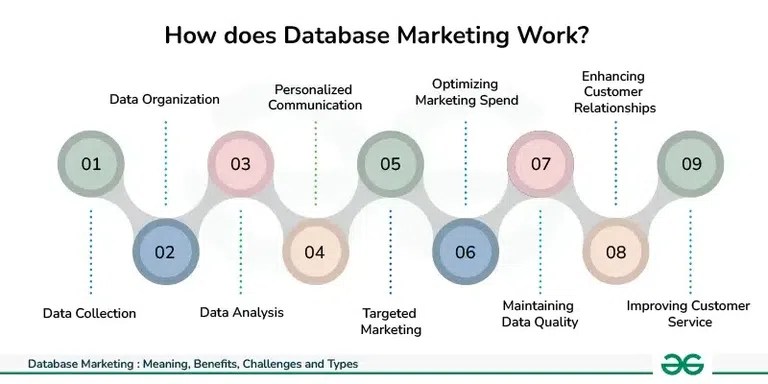
The architecture of database marketing services revolves around three pillars: data ingestion, processing, and activation. Ingestion begins with collecting structured (e.g., CRM records) and unstructured data (e.g., social media posts, chat logs). The system then cleans, enriches, and normalizes this data—removing duplicates, filling gaps with third-party insights, and ensuring consistency across sources. This is where identity resolution becomes critical, as businesses must link a customer’s activity across devices and channels without violating privacy laws like GDPR or CCPA.
Once the data is unified, the real magic happens in the processing layer. Advanced database marketing solutions employ algorithms to segment audiences dynamically, identify patterns (e.g., RFM analysis for recency, frequency, monetary value), and score leads based on propensity models. Activation then distributes these insights to marketing automation tools, ad platforms, or even customer service teams. For instance, a retail brand might use a CDP to trigger a personalized email to a high-value segment while suppressing irrelevant offers to lapsed users. The loop closes when performance data feeds back into the system, refining future predictions.
Key Benefits and Crucial Impact
The value of database marketing services extends beyond vanity metrics like open rates or click-throughs. At its best, it delivers measurable ROI by reducing wasted spend, increasing customer lifetime value (CLV), and improving operational efficiency. Businesses that invest in these services often see a 20–40% lift in conversion rates, thanks to hyper-relevant messaging. Moreover, the ability to predict churn or upsell opportunities translates into direct revenue impact—studies show that companies using predictive analytics see a 10–15% increase in sales.
Yet the benefits aren’t just financial. In an era where 73% of consumers expect personalized experiences, database-driven marketing becomes a differentiator. Brands that leverage these tools can move from interruptive advertising to contextual engagement—offering the right product at the right time via the right channel. This shift aligns with broader consumer trends, where trust and relevance outweigh traditional mass marketing tactics.
— "The future of marketing isn’t about the customer journey; it’s about the customer’s intent journey. Database marketing services are the only way to map that in real time."
— David Raab, Founder of the CDP Institute
Major Advantages
- Precision Targeting: Eliminates guesswork by using behavioral and demographic data to deliver messages tailored to individual preferences, increasing engagement by up to 50%.
- Automation at Scale: Triggers personalized actions (e.g., abandoned cart emails, win-back campaigns) without manual intervention, saving time and reducing human error.
- Unified Customer View: Breaks down silos between departments, ensuring sales, marketing, and service teams access the same up-to-date data for cohesive customer experiences.
- Predictive Insights: Identifies high-value prospects, predicts churn risks, and recommends optimal next steps using machine learning, lifting revenue per customer by 10–30%.
- Compliance and Security: Modern database marketing services incorporate privacy-by-design features, such as anonymization and consent management, to meet regulatory requirements while maintaining trust.
Comparative Analysis
| Traditional CRM Systems | Customer Data Platforms (CDPs) |
|---|---|
| Primarily sales-focused; limited marketing automation. | Marketing-centric; unifies first-, second-, and third-party data. |
| Static segmentation; relies on manual updates. | Dynamic, real-time audience building with AI-driven insights. |
| Lower cost but requires custom integrations for advanced analytics. | Higher upfront investment; native support for omnichannel activation. |
| Best for: Sales teams managing pipelines. | Best for: Marketers needing unified customer profiles and automation. |
Future Trends and Innovations
The next frontier for database marketing services lies in blending data with emerging technologies. AI and generative models will soon enable hyper-personalized content creation—imagine a CDP dynamically generating product descriptions or email copy based on a customer’s past interactions. Meanwhile, the rise of "data cooperatives" may allow consumers to monetize their own data, shifting power dynamics in database-driven marketing. Privacy-preserving techniques like federated learning will also gain traction, enabling collaboration without exposing raw data.
Another critical trend is the convergence of offline and online data. As IoT devices proliferate, businesses will capture contextual signals—such as a customer’s location near a store or their smart-home preferences—to trigger hyper-localized campaigns. Additionally, the metaverse and virtual experiences will introduce new data dimensions, requiring database marketing solutions to adapt to immersive customer journeys. The challenge? Balancing innovation with ethical data use, as consumers grow increasingly wary of surveillance capitalism.
Conclusion
Database marketing services are no longer optional—they’re a necessity for businesses that want to compete in a data-saturated world. The shift from broad-stroke advertising to precision targeting isn’t just a tactical upgrade; it’s a fundamental rethinking of how brands connect with customers. The companies that succeed will be those that treat data as a strategic asset, not just a byproduct of transactions.
Implementation requires more than buying a CDP or CRM. It demands a cultural shift—one where data literacy becomes a core competency and where marketing strategies are built on insights, not assumptions. For businesses ready to make that leap, the payoff is clear: deeper customer relationships, higher efficiency, and a sustainable competitive edge. The question is no longer if to adopt these services, but how to do so without losing sight of the human element at the heart of marketing.
Comprehensive FAQs
Q: What’s the difference between a CRM and a CDP in database marketing?
A: While both handle customer data, CRMs are sales-focused (e.g., pipeline management) and often lack advanced marketing automation. CDPs, however, are built for marketers—they unify first-, second-, and third-party data, enable real-time segmentation, and integrate with multiple channels. Think of a CRM as a sales toolkit and a CDP as a marketing command center.
Q: How do I ensure my database marketing efforts comply with privacy laws?
A: Start by mapping data flows to regulations like GDPR or CCPA. Use anonymization techniques for aggregated analytics, implement consent management platforms (CMPs), and adopt privacy-enhancing technologies (PETs) like differential privacy. Regular audits and employee training on data handling are also critical—many breaches stem from internal oversight.
Q: Can small businesses benefit from database marketing services?
A: Absolutely. While enterprise-grade CDPs may require significant investment, smaller businesses can start with affordable tools like HubSpot, ActiveCampaign, or even Google’s free Data Studio for basic segmentation. The key is to begin with a single data source (e.g., email lists) and scale as revenue grows. Prioritize high-impact use cases, such as retargeting or loyalty programs.
Q: What’s the biggest mistake companies make when implementing database marketing?
A: Treating data as static rather than dynamic. Many businesses load data into a system once and forget about maintenance—leading to stale profiles, inaccurate predictions, and missed opportunities. Successful database marketing services require continuous data hygiene, regular model retraining, and feedback loops to refine strategies based on real-world performance.
Q: How do I measure the ROI of database marketing services?
A: Focus on three metrics: incremental revenue (attributable to personalized campaigns), cost per acquisition (CPA) reduction, and customer lifetime value (CLV) growth. Use A/B testing to isolate the impact of data-driven changes, and track operational efficiency gains (e.g., reduced manual segmentation time). Tools like Google Analytics 4 or Adobe Analytics can help attribute conversions to specific data-driven actions.
Q: Are there industries where database marketing services are more effective than others?
A: While applicable across sectors, database marketing solutions excel in industries with high customer interaction frequency and clear purchase cycles. E-commerce, SaaS, and retail benefit most from real-time personalization, while B2B firms leverage account-based marketing (ABM) for high-value deals. However, even niche markets (e.g., nonprofits or local services) can use data to refine donor segmentation or local SEO strategies.
Leave a Comment
Comments are moderated before appearing. The data you submit is processed according to the Privacy Policy of versiliasolutions.oneagency.co.