How the Difference Between Income and Revenue Shapes Business Success
Table of Contents
- The Complete Overview of the Difference Between Income and Revenue
- Historical Background and Evolution
- Core Mechanisms: How It Works
- Key Benefits and Crucial Impact
- Major Advantages
- Comparative Analysis
- Future Trends and Innovations
- Conclusion
- Comprehensive FAQs
- Q: Can a company have revenue without income?
- Q: Why do some businesses report "gross income" separately?
- Q: How does deferred revenue affect the difference between income and revenue?
- Q: Are there industries where revenue and income are nearly identical?
- Q: What’s the most common mistake businesses make with revenue vs. income?
Every business decision—from hiring to expansion—hinges on a fundamental question: Are you measuring income or revenue? The answer isn’t just semantic; it dictates whether a company survives or thrives. Take the case of a tech startup that reported $10 million in revenue but only $2 million in net income. Investors saw growth; accountants saw a red flag. The difference between income and revenue isn’t just numbers—it’s the difference between illusion and reality.
Public companies spend millions refining their revenue streams, yet many still confuse the two terms in earnings calls, leading to misguided investor confidence. A 2023 SEC report highlighted how 37% of mid-market firms misclassified revenue as income in quarterly filings, costing them an average of $420,000 in regulatory corrections. The stakes are higher than ever, as stakeholders now demand granularity beyond top-line figures.
Even seasoned entrepreneurs often conflate the two, assuming they’re interchangeable. But revenue is the raw fuel; income is what remains after the engine burns it. One fuels growth; the other determines sustainability. The line between them isn’t just financial—it’s strategic.
The Complete Overview of the Difference Between Income and Revenue
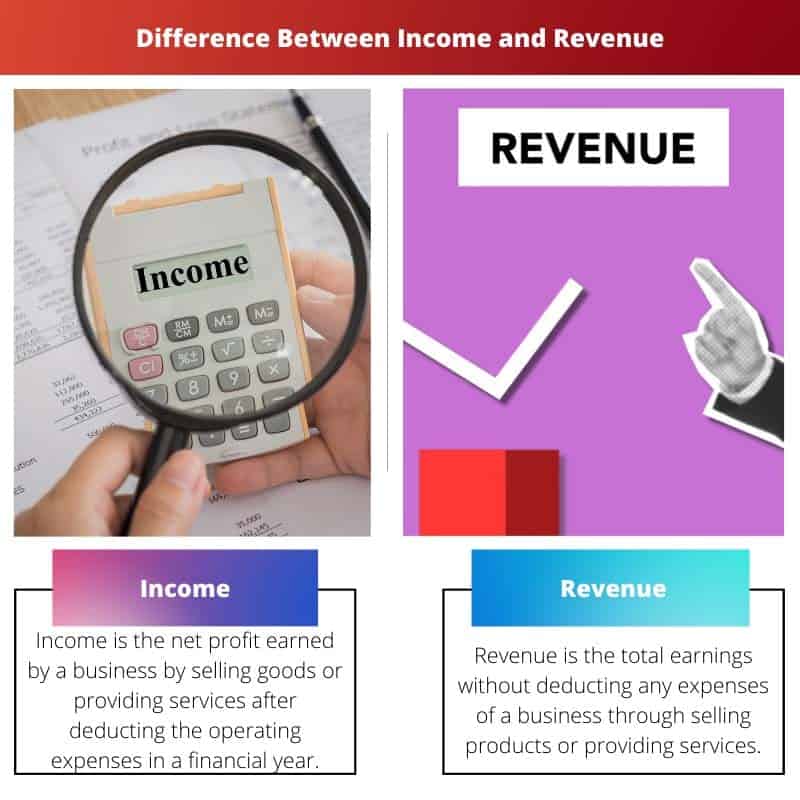
The difference between income and revenue lies in their roles within a company’s financial ecosystem. Revenue represents the total cash or cash-equivalent inflows from business activities—sales, services, subscriptions—before any deductions. It’s the gross figure, unfiltered by expenses. Income, however, is what remains after subtracting all costs: operating expenses, taxes, interest, and other liabilities. While revenue answers how much money came in, income answers how much profit was kept.
This distinction is critical because revenue alone doesn’t reflect profitability. A retail chain might generate $50 million in revenue but lose $10 million after rent, wages, and inventory costs. The same $50 million in revenue for a software firm could translate to $30 million in net income due to lower overhead. The difference between income and revenue isn’t just theoretical—it’s the margin between survival and dominance.
Historical Background and Evolution
The modern separation of revenue and income traces back to 19th-century industrialization, when businesses expanded beyond local markets. Early accountants like Luca Pacioli formalized double-entry bookkeeping, but it wasn’t until the 1930s that the U.S. generally accepted accounting principles (GAAP) codified the distinction. Revenue became the "top line" in income statements, while income (or net profit) occupied the "bottom line"—a visual hierarchy that persists today.
Post-WWII, the rise of multinational corporations demanded even sharper distinctions. The International Accounting Standards Board (IASB) later refined definitions to align with global financial reporting standards (IFRS), emphasizing that revenue must be earned (not just received) and realizable (convertible to cash). Today, the difference between income and revenue is governed by strict frameworks, yet misinterpretations persist, particularly in tech and subscription-based models where recurring revenue is often mislabeled as profit.
Core Mechanisms: How It Works
Revenue is recorded when a business delivers a product or service, regardless of payment timing (accrual accounting). For example, a SaaS company recognizes subscription revenue monthly, even if customers pay annually. Income, however, is calculated only after all expenses—COGS (Cost of Goods Sold), SG&A (Selling, General & Administrative), depreciation, and taxes—are deducted. This two-step process ensures transparency: revenue shows activity; income shows efficiency.
The mechanics differ by industry. A manufacturer’s revenue includes sales of finished goods, but income accounts for raw material costs, labor, and factory overhead. A consultant’s revenue is project fees, while income subtracts software licenses, office rent, and marketing spend. The key takeaway: revenue is the inflow; income is the outflow’s residue. Ignore one, and financial health becomes a gamble.
Key Benefits and Crucial Impact
Mastering the difference between income and revenue isn’t just about compliance—it’s about competitive advantage. Companies that treat revenue as a vanity metric (e.g., "We grew 20%!") while income stagnates risk misallocation of capital. Conversely, those that optimize for net income—like Amazon’s relentless focus on operational efficiency—turn revenue into sustainable growth. The impact extends to investor trust, creditworthiness, and even employee morale when bonuses tie to profitability, not just sales.
Historically, firms that blurred the lines faced catastrophic outcomes. Enron’s infamous revenue recognition schemes masked declining income, leading to its collapse. Today, regulatory bodies like the SEC enforce stricter scrutiny, but the onus remains on businesses to educate stakeholders. The difference between income and revenue is the financial equivalent of a compass: without it, even the most ambitious companies veer off course.
"Revenue is vanity, profit is sanity, and cash is reality." — Unknown (attributed to Warren Buffett’s investment philosophy)
Major Advantages
- Profitability Insight: Revenue shows top-line growth; income reveals true profitability. A $1 million revenue jump with flat income signals cost inflation.
- Investor Confidence: Stakeholders prioritize income over revenue. Tesla’s 2020 revenue surge (+72%) paled compared to its net income volatility, affecting stock valuations.
- Tax Optimization: Income determines taxable liabilities. Misclassifying revenue as income can trigger audits or penalties.
- Strategic Pricing: Understanding the income-revenue gap helps set prices that cover costs. A $100 product with $80 COGS must generate $20+ in net income to justify scaling.
- Risk Management: High revenue but low income indicates exposure to fixed costs. Airlines often report record revenue during crises but negative income due to fuel spikes.
Comparative Analysis
| Revenue | Income (Net Profit) |
|---|---|
| Total sales + other inflows (e.g., interest, investments). | Revenue minus all expenses (COGS, taxes, debt, etc.). |
| Recorded when earned (accrual basis) or received (cash basis). | Calculated at fiscal period-end (e.g., quarterly). |
| Used to assess business activity and growth. | Used to assess financial health and sustainability. |
| Example: Netflix’s $31.6B revenue (2023). | Example: Netflix’s $5.9B net income (2023). |

Future Trends and Innovations
The difference between income and revenue is evolving with digital transformation. Subscription models (e.g., Spotify, Adobe) complicate revenue recognition, as deferred revenue must be allocated over contract periods. Meanwhile, AI-driven financial tools now auto-categorize transactions, reducing manual errors in income calculations. Blockchain is poised to further blur lines by enabling real-time, immutable revenue tracking—but income will still require traditional accounting adjustments for taxes and depreciation.
Regulatory shifts are also reshaping the landscape. The SEC’s 2023 proposed rules on "customer acquisition cost" (CAC) vs. "lifetime value" (LTV) force companies to align revenue recognition with long-term income potential. As remote work persists, hybrid cost structures (office vs. cloud expenses) will demand granular income breakdowns. The future of financial reporting lies in harmonizing revenue’s dynamism with income’s rigor.
Conclusion
The difference between income and revenue is more than semantics—it’s the bedrock of financial literacy. Revenue tells a story of activity; income tells the truth about results. Companies that ignore this distinction risk overvaluing growth while underestimating costs. The lesson is clear: revenue fuels ambition, but income fuels endurance. In an era where stakeholders demand both transparency and performance, mastering this duality isn’t optional—it’s essential.
For leaders, the takeaway is straightforward: Celebrate revenue growth, but obsess over income margins. The gap between them isn’t just a number—it’s the margin between a company’s potential and its reality.
Comprehensive FAQs
Q: Can a company have revenue without income?
A: Absolutely. Revenue is the total inflow, while income is net profit after expenses. A company can generate millions in revenue but lose money if costs exceed sales (e.g., startups in hypergrowth phases).
Q: Why do some businesses report "gross income" separately?
A: Gross income (revenue minus COGS) is a midpoint between revenue and net income. It helps stakeholders assess operational efficiency before accounting for SG&A or taxes. Tech firms often highlight gross income to emphasize product margins.
Q: How does deferred revenue affect the difference between income and revenue?
A: Deferred revenue is prepaid income not yet recognized as revenue. It appears as a liability on balance sheets until services are delivered. This creates a timing discrepancy: revenue is deferred, but income is recognized incrementally, smoothing profit recognition.
Q: Are there industries where revenue and income are nearly identical?
A: Low-cost, high-margin industries (e.g., software, digital media) often see revenue and income converge. For example, a SaaS company with 80% gross margins may report net income close to revenue after minimal overhead.
Q: What’s the most common mistake businesses make with revenue vs. income?
A: Confusing revenue growth with profitability. Many scale aggressively based on revenue metrics (e.g., "We’re growing 30% YoY!") without ensuring income keeps pace, leading to cash flow crises.
Leave a Comment
Comments are moderated before appearing. The data you submit is processed according to the Privacy Policy of versiliasolutions.oneagency.co.