How the Difference Between Revenue and Net Income Shapes Financial Reality
Table of Contents
- The Complete Overview of the Difference Between Revenue and Net Income
- Historical Background and Evolution
- Core Mechanisms: How It Works
- Key Benefits and Crucial Impact
- Major Advantages
- Comparative Analysis
- Future Trends and Innovations
- Conclusion
- Comprehensive FAQs
- Q: Can a company have positive revenue but negative net income?
- Q: Why do some companies report "non-GAAP net income"?
- Q: How does revenue recognition timing affect net income?
- Q: What’s the relationship between gross profit and net income?
- Q: Can net income be higher than revenue?
Financial statements often confuse revenue and net income, yet their distinction is the bedrock of corporate valuation. Revenue—raw sales figures—paints a picture of business activity, while net income reveals what remains after all costs. The gap between them exposes operational efficiency, cost management, and true profitability. Investors scrutinizing earnings reports or executives crafting budgets must grasp this difference, as it separates surface-level performance from sustainable value creation.
Public companies disclose revenue first in their income statements, creating an illusion of success before deducting expenses. Yet net income—the bottom line—often tells a starker truth about whether a company generates actual profit. The discrepancy between these figures can reveal hidden costs, pricing strategies, or even accounting anomalies that influence investor confidence and regulatory compliance.
Accountants and financial analysts treat revenue as the starting point of profitability analysis, but net income is what shareholders ultimately care about. The journey from top-line revenue to bottom-line net income involves subtracting costs, taxes, and other financial obligations—a process that highlights why understanding the difference between revenue and net income is non-negotiable for financial decision-making.

The Complete Overview of the Difference Between Revenue and Net Income
Revenue, also called sales or turnover, represents the total income generated from business operations before any deductions. It is the gross amount earned from selling goods or services, recorded when the transaction occurs, regardless of whether cash has been received. Net income, however, is the residual amount after accounting for all expenses—cost of goods sold (COGS), operating expenses, interest, taxes, and non-recurring items. While revenue measures activity, net income measures true profitability, making it the figure that determines dividends, shareholder returns, and long-term sustainability.The difference between revenue and net income is not just numerical but conceptual. Revenue is an indicator of market demand and sales effectiveness, while net income reflects a company’s ability to convert sales into actual profit. For example, a tech startup might report $100 million in revenue but only $10 million in net income due to high R&D costs, leaving investors questioning whether the business model is scalable. This disparity underscores why financial statements must be read holistically—not just by top-line figures.
Historical Background and Evolution
The distinction between revenue and net income traces back to early accounting principles, where merchants tracked income and expenditures to assess trade viability. By the 19th century, industrialization demanded more rigorous financial reporting, leading to the adoption of accrual accounting—a system where revenue is recognized when earned, not when cash is received. This shift allowed businesses to separate operational performance (revenue) from financial health (net income), a critical evolution for investors evaluating long-term prospects.Modern financial reporting standards, such as GAAP (Generally Accepted Accounting Principles) and IFRS (International Financial Reporting Standards), codify this separation. Revenue is now recorded under specific recognition criteria (e.g., when goods are delivered or services rendered), while net income consolidates all post-revenue deductions. The difference between revenue and net income became a focal point in corporate governance reforms, particularly after high-profile accounting scandals like Enron, where misleading revenue figures obscured true financial performance.
Core Mechanisms: How It Works
Revenue is the first line item in an income statement, calculated as:Total Revenue = Quantity Sold × Price per Unit For a retail chain, this might include sales from stores, e-commerce, and wholesale. However, not all revenue is immediately profitable—some is tied to inventory costs (COGS), which are subtracted to arrive at gross profit. Operating expenses (salaries, rent, marketing) further reduce gross profit to operating income (EBIT), before interest and taxes yield net income.
The difference between revenue and net income is bridged by deductions that reflect a company’s cost structure. A high-tech firm with $500M in revenue but $400M in COGS and operating expenses may report just $50M in net income, signaling thin margins. Conversely, a subscription-based business with lower COGS might convert a similar revenue figure into higher net income. This mechanics-driven gap is why analysts dissect income statements line by line.
Key Benefits and Crucial Impact
Understanding the difference between revenue and net income is essential for stakeholders assessing financial health. Revenue growth alone does not guarantee profitability—companies like WeWork expanded rapidly but collapsed due to unsustainable net losses. Net income, however, reveals whether a business can generate returns after all obligations, directly impacting shareholder value and creditworthiness.This distinction also informs strategic decisions. A company with high revenue but low net income may need to optimize costs, renegotiate supplier contracts, or adjust pricing. Conversely, a business with strong net income margins can reinvest confidently or return capital to investors. The difference between revenue and net income thus serves as a financial compass, guiding everything from M&A evaluations to dividend policies.
"Revenue is vanity, profit is sanity, and cash flow is reality." — Warren Buffett
Major Advantages
- Profitability Insight: Net income exposes true earnings after all costs, while revenue alone masks inefficiencies.
- Investor Confidence: Shareholders prioritize net income for dividend sustainability and growth potential.
- Cost Management: The gap between revenue and net income highlights areas for operational optimization.
- Regulatory Compliance: Accurate reporting of both metrics ensures adherence to GAAP/IFRS standards.
- Strategic Planning: Comparing revenue growth to net income trends reveals whether expansion is profitable.
Comparative Analysis
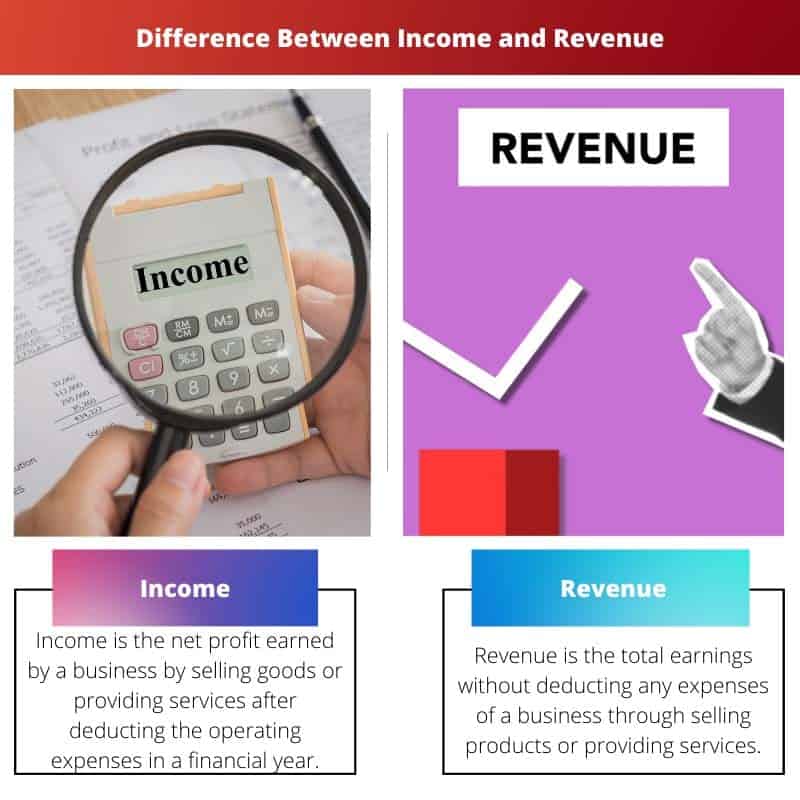
| Revenue | Net Income |
|---|---|
| Total sales before deductions (top-line figure). | Profit after all expenses (bottom-line figure). |
| Recognized when goods/services are delivered (accrual basis). | Calculated after COGS, operating expenses, interest, and taxes. |
| Used to assess market demand and sales performance. | Used to evaluate financial health and shareholder returns. |
| Can be inflated by one-time sales or accounting tricks. | Reflects sustainable profitability over time. |
Future Trends and Innovations
As digital transformation reshapes industries, the difference between revenue and net income will become even more pronounced. Subscription models, for instance, recognize revenue upfront but defer COGS over time, altering traditional net income calculations. Meanwhile, AI-driven cost optimization may shrink the gap between revenue and net income by automating expense management.Regulatory pressures will also evolve, with standards like IFRS 15 (revenue recognition) and CECL (credit loss accounting) redefining how companies report these metrics. Investors will demand deeper transparency into non-GAAP adjustments, forcing businesses to reconcile revenue and net income with operational realities. The future of financial reporting will hinge on closing this gap—not just numerically, but through strategic alignment.
Conclusion
The difference between revenue and net income is more than an accounting distinction; it’s a lens through which to view a company’s economic reality. Revenue tells a story of sales and market presence, while net income reveals whether those sales translate into sustainable value. Ignoring this distinction can lead to misplaced optimism or missed red flags, as seen in high-profile corporate collapses driven by revenue growth without corresponding profitability.For executives, analysts, and investors, mastering this difference is non-negotiable. It separates short-term hype from long-term viability, ensuring that financial decisions are rooted in truth—not just top-line numbers. As businesses navigate an era of volatility and innovation, the gap between revenue and net income will remain the ultimate test of financial acumen.
Comprehensive FAQs
Q: Can a company have positive revenue but negative net income?
A: Yes. A company can generate sales (revenue) but incur higher expenses (COGS, operating costs, losses), resulting in a net loss. This is common in startups or industries with high overhead, like biotech or aerospace.
Q: Why do some companies report "non-GAAP net income"?
A: Non-GAAP net income excludes certain expenses (e.g., stock-based compensation, one-time charges) to provide a clearer view of recurring profitability. However, this can obscure the true difference between revenue and net income under standard accounting.
Q: How does revenue recognition timing affect net income?
A: Under accrual accounting, revenue is recognized when earned, not when cash is received. Delaying revenue recognition (e.g., for long-term contracts) can artificially suppress net income in the short term but may align with economic reality.
Q: What’s the relationship between gross profit and net income?
A: Gross profit (revenue minus COGS) is an intermediate step before operating expenses. Net income subtracts all remaining costs, including taxes and interest, from gross profit. The larger the gap between gross profit and net income, the higher the operating expenses.
Q: Can net income be higher than revenue?
A: No. Net income is always less than or equal to revenue because it represents revenue after subtracting all expenses. However, accounting adjustments (e.g., gains on asset sales) can temporarily inflate net income beyond typical operating revenue.
Leave a Comment
Comments are moderated before appearing. The data you submit is processed according to the Privacy Policy of versiliasolutions.oneagency.co.