The Hidden Truth: How Many Ribs Do Humans Have?
Table of Contents
- The Complete Overview of How Many Ribs Do Humans Have
- Historical Background and Evolution
- Core Mechanisms: How It Works
- Key Benefits and Crucial Impact
- Major Advantages
- Comparative Analysis
- Future Trends and Innovations
- Conclusion
- Comprehensive FAQs
- Q: Can humans have more or fewer than 12 pairs of ribs?
- Q: Why do some people have "floating ribs"?
- Q: Do rib variations affect breathing?
- Q: How do doctors determine rib count in medical imaging?
- Q: Are there cultural or historical myths about rib counts?
- Q: Can rib count change with age?
Humans have spent millennia dissecting the body’s mysteries, yet the question of how many ribs do humans have remains surprisingly misunderstood. Most assume the answer is fixed—a number etched in textbooks—but the truth is far more dynamic. The rib cage, a marvel of structural engineering, isn’t just a static barrier for vital organs; it’s a living framework that varies subtly between individuals, defying oversimplified narratives. Even medical professionals occasionally encounter surprises when probing this question, from anatomical variations to historical misconceptions that persist in modern discourse.
The rib cage’s role extends beyond protection. It’s a scaffold for respiration, a shield for the heart and lungs, and a silent participant in posture and movement. Yet, despite its prominence, the answer to how many ribs do humans have isn’t as straightforward as it seems. Evolutionary pressures, genetic quirks, and even cultural interpretations have shaped our understanding—sometimes inaccurately. For instance, while standard anatomy texts cite a number, real-world scans reveal deviations that challenge the norm, exposing a gap between textbook dogma and biological reality.
This discrepancy isn’t mere trivia. It reflects deeper truths about human diversity, the limits of anatomical generalization, and how science evolves. Whether you’re a student dissecting a cadaver, a fitness enthusiast curious about posture, or simply someone who’s wondered why ribs seem to "disappear" in certain contexts, the answer lies in a blend of history, physiology, and modern medical insight. The rib cage’s story is one of adaptation, not rigidity—a reminder that even the most fundamental aspects of human biology are more complex than they appear.
The Complete Overview of How Many Ribs Do Humans Have
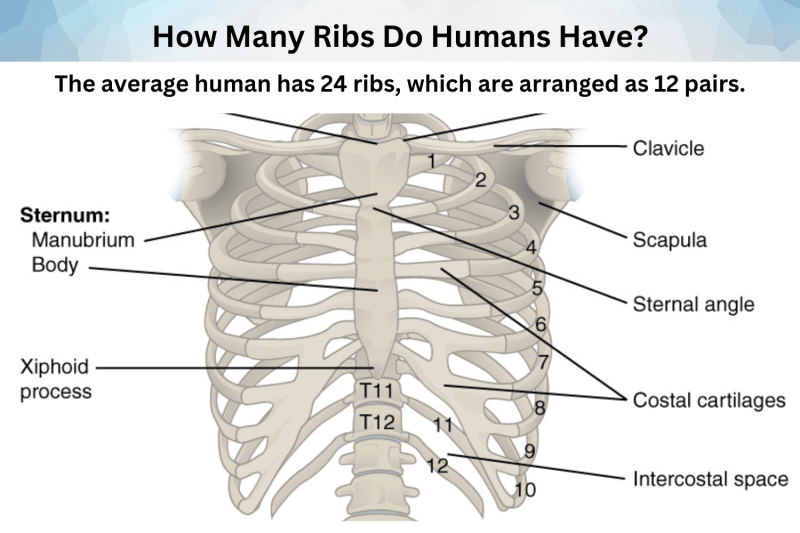
The human rib cage is a masterpiece of functional design, composed of elongated, curved bones that form a protective cage around the thoracic cavity. At its core, the answer to how many ribs do humans have is typically 24—12 pairs, with each pair articulating with the thoracic vertebrae. This symmetry is a hallmark of bilateral symmetry in vertebrates, but the uniformity ends there. While the "standard" count is well-documented, anatomical variations mean that not every individual adheres to this number. Some may have an extra rib (cervical or lumbar), while others might lack one due to congenital conditions or trauma. These variations, though rare, underscore the body’s remarkable adaptability.The rib cage’s structure isn’t just about quantity; its arrangement is critical. The first seven pairs (true ribs) attach directly to the sternum via costal cartilages, while the next three (false ribs) connect indirectly through shared cartilage. The final two pairs (floating ribs) lack sternal attachments entirely, anchoring only to vertebrae. This gradient reflects the rib cage’s dual role: protecting organs while allowing flexibility for breathing and movement. Understanding how many ribs do humans have isn’t just about counting bones—it’s about grasping how this system integrates with the spine, muscles, and diaphragm to sustain life.
Historical Background and Evolution
The question of how many ribs do humans have has roots in ancient anatomy, where early scholars like Galen and Vesalius dissected animals and humans to map the body’s structure. Galen’s work on pigs and other mammals led to early misconceptions, as he extrapolated findings from animals to humans—a common pitfall in pre-modern medicine. It wasn’t until the Renaissance that Andreas Vesalius, through meticulous human dissections, corrected these errors, establishing the 12-pair framework still taught today. Yet, even Vesalius’s observations were limited by the tools of his time, leaving room for later discoveries about anatomical variability.Evolutionarily, ribs trace back to early vertebrates, where they originated as extensions of the vertebral column to support gills and later lungs. In humans, their primary function shifted to protecting thoracic organs and aiding respiration. The number of ribs remained consistent across hominids, but variations—such as the occasional "floating" rib or fused vertebrae—highlight how evolution prioritizes function over uniformity. Modern imaging has further revealed that how many ribs do humans have can deviate slightly, with some individuals possessing 11 or 13 pairs due to genetic or developmental factors. These exceptions aren’t anomalies; they’re proof of nature’s flexibility in optimizing form for survival.
Core Mechanisms: How It Works
The rib cage’s mechanics are a study in biomechanical efficiency. During inhalation, the diaphragm contracts, creating negative pressure that draws air into the lungs. Simultaneously, the external intercostal muscles elevate the ribs, expanding the thoracic cavity. This dual action increases lung volume, a process governed by the rib cage’s curvature and articulation with vertebrae. The ribs’ shape—broad at the back, narrow at the front—distributes stress evenly, preventing collapse under physiological loads. Even the "floating" ribs play a role, stabilizing the lower thoracic region during core movements.The rib cage’s stability isn’t passive; it’s actively maintained by muscles, ligaments, and neural feedback. The serratus anterior and pectoralis minor, for example, anchor the ribs to the scapula and sternum, respectively, ensuring coordinated movement. Disruptions—such as fractures or nerve damage—can impair breathing, illustrating how deeply how many ribs do humans have ties to overall respiratory health. Modern medicine leverages this understanding in treatments for conditions like scoliosis or rib fractures, where structural integrity is paramount.
Key Benefits and Crucial Impact
The rib cage’s design is a testament to evolutionary pragmatism, balancing protection with mobility. Its primary benefit is safeguarding the heart, lungs, and major blood vessels from trauma, while its role in respiration ensures oxygen delivery to tissues. Beyond physiology, the rib cage influences posture, with imbalances (e.g., scoliosis) leading to chronic pain or reduced lung capacity. Athletes, in particular, rely on rib integrity for performance, as restricted movement can limit breathing efficiency. Even in everyday activities—lifting, coughing, or singing—the rib cage’s mechanics are invisible yet indispensable.The question how many ribs do humans have isn’t just anatomical; it’s a gateway to understanding broader health implications. Conditions like rib fractures or congenital anomalies (e.g., pectus excavatum) highlight how deviations from the norm can impact quality of life. Medical imaging has revealed that some individuals with extra ribs may experience compression of nearby structures, while those with fewer ribs might have compensatory adaptations. These insights drive advancements in surgical techniques, such as rib reconstruction or spinal stabilization procedures.
"The rib cage is more than a skeletal framework—it’s a dynamic system where structure and function are inseparable. Variations in rib count aren’t errors; they’re evidence of the body’s ability to adapt." — Dr. Eleanor Carter, Orthopedic Surgeon & Anatomist
Major Advantages
- Organ Protection: The rib cage shields the thoracic cavity from blunt trauma, reducing the risk of organ damage during impacts.
- Respiratory Efficiency: The ribs’ mobility during inhalation/exhalation maximizes lung capacity, critical for endurance and vocal performance.
- Postural Support: A stable rib cage maintains spinal alignment, preventing conditions like kyphosis or chronic back pain.
- Muscle Attachment: Over 20 muscles (e.g., intercostals, pectorals) anchor to the ribs, enabling movement and stability.
- Genetic Resilience: Variations in rib count (e.g., cervical ribs) often cause no symptoms, demonstrating the body’s compensatory mechanisms.
Comparative Analysis
| Feature | Humans (Typical) | Variations |
|---|---|---|
| Rib Count | 24 (12 pairs) | 11–13 pairs (due to genetic or developmental factors) |
| Rib Types | True (7), False (3), Floating (2) | Additional "cervical" ribs (attached to C7) or fused lumbar ribs |
| Functional Role | Protection, respiration, posture | Compensatory adaptations in individuals with missing/fused ribs |
| Medical Relevance | Standard anatomical reference | Diagnostic challenges in imaging (e.g., extra ribs mimicking tumors) |

Future Trends and Innovations
Advances in 3D imaging (CT/MRI) are redefining our understanding of how many ribs do humans have, revealing previously undocumented variations. AI-driven anatomical mapping may soon personalize medical treatments, accounting for individual rib structures in surgical planning. Additionally, regenerative medicine could address rib fractures or deformities using bioengineered scaffolds, restoring function without invasive procedures. As genetic research progresses, we may uncover the genetic basis for rib anomalies, enabling early interventions for conditions like Poland syndrome (rib/pectoral muscle underdevelopment).The future of rib-cage research lies at the intersection of technology and biology. Wearable sensors could monitor rib movement in real-time, aiding athletes or patients with respiratory disorders. Meanwhile, evolutionary studies may explore how rib structure influenced early hominids’ endurance or tool use. One certainty is that the question how many ribs do humans have will continue to evolve, mirroring our deeper grasp of human diversity.
Conclusion
The answer to how many ribs do humans have is rarely a simple one. While 24 ribs (12 pairs) remain the anatomical standard, reality is far more nuanced, with variations that reflect the body’s capacity for adaptation. This complexity isn’t just academic; it has practical implications for medicine, sports, and even forensic science. Recognizing that rib count isn’t fixed challenges us to move beyond textbook definitions and embrace the fluidity of human biology.As research advances, our understanding of the rib cage will deepen, bridging gaps between anatomy and applied science. Whether through imaging, genetics, or biomechanics, the story of how many ribs do humans have is far from over—it’s a living narrative of discovery, resilience, and the endless intricacies of the human form.
Comprehensive FAQs
Q: Can humans have more or fewer than 12 pairs of ribs?
A: Yes. While 12 pairs (24 ribs) are standard, some individuals may have 11 or 13 pairs due to genetic mutations or developmental anomalies. Extra ribs (e.g., cervical ribs) can compress nerves, while missing ribs may lead to compensatory changes in adjacent structures.
Q: Why do some people have "floating ribs"?
A: The last two rib pairs (11th and 12th) are called "floating" because they don’t attach to the sternum. This design provides stability to the lower thoracic cavity while allowing flexibility for core movements. Their presence is consistent across humans, though their length can vary.
Q: Do rib variations affect breathing?
A: Generally, no—most rib variations are asymptomatic. However, conditions like cervical ribs (attached to the 7th cervical vertebra) can compress the brachial plexus, causing pain or numbness in the arm. Severe deformities (e.g., pectus excavatum) may restrict lung expansion, requiring medical intervention.
Q: How do doctors determine rib count in medical imaging?
A: Radiologists use CT scans or X-rays to count ribs, verifying attachments to vertebrae and the sternum. Modern AI tools can now automate this process, reducing human error. Variations are documented in patient records to guide treatment, especially in trauma or congenital cases.
Q: Are there cultural or historical myths about rib counts?
A: Yes. Ancient texts, including biblical references (e.g., Adam’s rib in Genesis), often simplified rib anatomy. Medieval anatomists sometimes confused animal ribs with human structures, leading to enduring misconceptions. Even today, pop culture (e.g., "missing ribs" in horror films) distorts public perception.
Q: Can rib count change with age?
A: Not typically. Rib count is determined at birth, though ribs can fracture or fuse with vertebrae due to trauma or degenerative diseases (e.g., osteoarthritis). Aging may cause rib cartilage to calcify, altering flexibility but not the number of ribs.
Leave a Comment
Comments are moderated before appearing. The data you submit is processed according to the Privacy Policy of versiliasolutions.oneagency.co.