Is nitrogen in the periodic table? The element’s hidden role in science and life
Table of Contents
- The Complete Overview of Nitrogen in the Periodic Table
- Historical Background and Evolution
- Core Mechanisms: How It Works
- Key Benefits and Crucial Impact
- Major Advantages
- Comparative Analysis
- Future Trends and Innovations
- Conclusion
- Comprehensive FAQs
- Q: Why is nitrogen called a "diatomic" element?
- Q: How does nitrogen fixation work in nature?
- Q: What are the environmental risks of excess nitrogen?
- Q: Can humans survive without nitrogen?
- Q: What industries rely most on nitrogen compounds?
- Q: Is nitrogen flammable or explosive?
- Q: How is nitrogen detected in the periodic table?
- Q: What’s the difference between nitrogen gas (N₂) and nitrogen compounds?
The periodic table is the Rosetta Stone of modern science, a meticulously organized grid where each element tells a story of atomic structure, chemical behavior, and cosmic origins. Among its 118 entries, nitrogen stands out—not just for its prevalence in Earth’s atmosphere (comprising 78% of it), but for its paradoxical nature. It is nitrogen in the periodic table, yet its inertness at standard conditions belies its explosive reactivity under pressure, its role in fertilizers that feed billions, and its presence in the building blocks of life. The element’s duality—both a silent majority in the air we breathe and a volatile force in industrial applications—makes it a cornerstone of chemistry, biology, and even warfare.
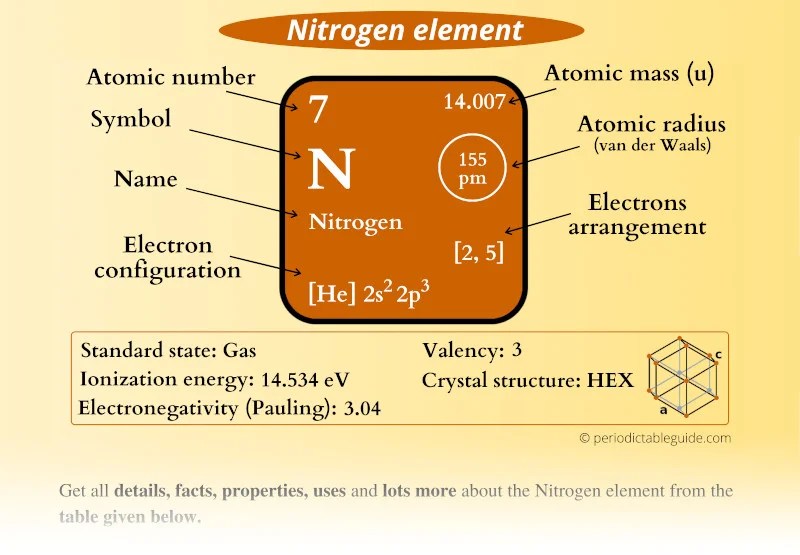
What makes nitrogen particularly fascinating is its position in the periodic table: nestled between carbon and oxygen in Group 15, it bridges the gap between organic and inorganic chemistry. This placement isn’t arbitrary. Nitrogen’s electron configuration (1s² 2s² 2p³) grants it three unpaired electrons in its outer shell, a trait that defines its bonding behavior. Whether forming triple bonds in N₂ gas or participating in the nitrogen cycle that sustains ecosystems, its properties are dictated by its atomic identity—one that scientists have only begun to fully harness. The question is nitrogen in the periodic table? isn’t just about its existence; it’s about understanding how its atomic structure shapes the world.
The element’s journey from an abstract symbol on a chalkboard to a linchpin of modern agriculture and technology is a testament to human curiosity. From the 18th-century discoveries of chemists like Joseph Priestley and Daniel Rutherford to today’s nitrogen-fixing fertilizers and high-energy explosives, nitrogen’s story is one of relentless adaptation. Yet, despite its ubiquity, nitrogen remains misunderstood—often overshadowed by more glamorous elements like gold or carbon. This oversight is a disservice to its critical role: without nitrogen, proteins wouldn’t form, DNA wouldn’t replicate, and the atmosphere would collapse. Its presence in the periodic table isn’t just a fact; it’s a foundation.

The Complete Overview of Nitrogen in the Periodic Table
Nitrogen occupies position 7 on the periodic table, sandwiched between carbon (atomic number 6) and oxygen (8) in Group 15 (formerly known as Group VA). This placement reflects its valence electron count—five in its outermost shell—making it a pnictogen, a category of elements that includes phosphorus and arsenic. Its atomic mass of approximately 14.007 u and its diatomic molecular form (N₂) under standard conditions are defining traits that set it apart. Unlike noble gases, which resist bonding, nitrogen forms strong covalent bonds, particularly the triple bond in N₂, which requires immense energy to break—a feature critical to its stability in the atmosphere.The element’s symbol, N, derives from the Latin nitrogenium, coined in the early 19th century to describe its role in forming nitrates (saltpeter). This nomenclature hints at its historical significance: nitrogen was once thought to be a component of acids (hence the "gen" suffix), a misconception corrected by Antoine Lavoisier’s work in the late 1700s. Today, nitrogen’s position in the periodic table isn’t just a classification—it’s a blueprint for its chemical behavior. Its ability to form up to four bonds (as seen in ammonia, NH₃) and its role in redox reactions (e.g., in nitric acid production) underscore why it is nitrogen in the periodic table that demands attention from chemists, biologists, and engineers alike.
Historical Background and Evolution
The story of nitrogen’s discovery is one of scientific perseverance. In 1772, Daniel Rutherford, a student of Joseph Black, isolated nitrogen by removing oxygen and carbon dioxide from air, though he initially called it "noxious air" due to its lack of support for combustion or respiration. It wasn’t until 1790 that the French chemist Jean-Antoine Chaptal suggested the name azote (from Greek azotos, meaning "lifeless"), reflecting its inert nature. The modern name, nitrogen, was popularized by the French Academy in 1790, consolidating its place in the evolving periodic table. This nomenclature shift mirrored the broader understanding of elements as fundamental substances, not just mixtures or compounds.The 19th century saw nitrogen’s role in agriculture and industry explode. Justus von Liebig’s work on the nitrogen cycle in the 1840s revealed how plants absorb nitrogen through nitrates, laying the groundwork for synthetic fertilizers. By the early 20th century, the Haber-Bosch process—developed by Fritz Haber and Carl Bosch—enabled the mass production of ammonia (NH₃) from nitrogen and hydrogen, a breakthrough that won Bosch the Nobel Prize in 1918 and revolutionized global food production. Today, the question is nitrogen in the periodic table? extends beyond academia; it’s a practical query about the element’s indispensable role in sustaining life and fueling technological progress.
Core Mechanisms: How It Works
Nitrogen’s chemical behavior is governed by its electron configuration and bonding capabilities. In its diatomic form (N₂), two nitrogen atoms share three pairs of electrons in a triple bond (N≡N), a configuration that requires 945 kJ/mol to break—explaining its stability and low reactivity at room temperature. This triple bond is a hallmark of nitrogen’s role in the atmosphere, where N₂ acts as a reservoir for the element. However, under high temperatures or with the aid of catalysts (as in the Haber-Bosch process), nitrogen can react with hydrogen to form ammonia, a reaction central to fertilizer production.Biologically, nitrogen’s versatility is equally striking. Through the nitrogen cycle, atmospheric N₂ is converted into ammonia (via nitrogen-fixing bacteria), then into nitrites and nitrates by soil microbes—a process essential for plant growth. In human physiology, nitrogen is a nonmetal component of amino acids, nucleic acids, and proteins, making it a literal building block of life. The element’s ability to cycle between these forms—gas, liquid, and solid compounds—demonstrates why it is nitrogen in the periodic table that bridges inorganic and organic chemistry seamlessly.
Key Benefits and Crucial Impact
Nitrogen’s influence extends from the microscopic to the macroscopic, shaping ecosystems, industries, and even climate systems. Its presence in the periodic table isn’t just a scientific curiosity; it’s a cornerstone of modern civilization. Without nitrogen, the atmosphere would lack its buffering capacity against oxygen’s reactivity, and life as we know it wouldn’t exist. The element’s dual role—as a stable atmospheric component and a reactive participant in biochemical processes—makes it indispensable. From the nitrogen-fixing bacteria in legume roots to the high-explosive nitroglycerin, its applications are as diverse as they are critical.The element’s economic impact is equally profound. The global fertilizer market, driven by nitrogen-based compounds, is valued at over $150 billion annually, directly supporting food security for 40% of the world’s population. In medicine, nitrogen’s compounds are used in everything from anesthesia (nitrous oxide) to cancer treatments (nitrogen mustards). Even in technology, nitrogen-doped graphene and nitrogen-vacancy centers in diamonds are pushing the boundaries of electronics and quantum computing. The question is nitrogen in the periodic table? thus transcends chemistry; it’s a gateway to understanding the element’s far-reaching consequences.
"Nitrogen is the silent architect of life. Without it, the very fabric of proteins and DNA would unravel, and the atmosphere would become a cauldron of unchecked oxygen." — Linus Pauling, Nobel Laureate in Chemistry
Major Advantages
- Atmospheric Stability: Nitrogen’s N₂ form constitutes 78% of Earth’s atmosphere, providing a stable, inert buffer against oxygen’s reactivity and preventing rapid combustion.
- Agricultural Lifeline: Synthetic nitrogen fertilizers (e.g., urea, ammonium nitrate) have doubled global food production since the 20th century, preventing mass famine.
- Biological Essentiality: Nitrogen is a core component of amino acids, DNA, and RNA, making it critical for growth, repair, and genetic inheritance in all living organisms.
- Industrial Versatility: From ammonia production to explosives (e.g., TNT, nitroglycerin) and refrigerants (e.g., nitrous oxide), nitrogen compounds enable diverse industrial applications.
- Technological Innovation: Nitrogen-doped materials (e.g., graphene, diamonds) enhance conductivity, strength, and quantum properties, driving advancements in electronics and materials science.
Comparative Analysis
| Property | Nitrogen (N) | Phosphorus (P) |
|---|---|---|
| Group in Periodic Table | 15 (Pnictogens) | 15 (Pnictogens) |
| Atomic Number | 7 | 15 |
| Key Bonding Traits | Triple bond in N₂; forms up to 4 bonds (e.g., NH₃) | Forms P₄ tetrahedra; reacts with oxygen to form phosphates |
| Biological Role | Proteins, DNA, amino acids | ATP, phospholipids, bone mineralization |
Future Trends and Innovations
The next frontier for nitrogen research lies in sustainable applications and deepening our understanding of its atomic behavior. As climate change intensifies, the demand for nitrogen fertilizers—currently responsible for 1-2% of global greenhouse gas emissions—will drive innovations in precision agriculture and biofertilizers. Companies like IBM and Intel are exploring nitrogen-vacancy centers in diamonds for quantum computing, while materials scientists are developing nitrogen-rich polymers for lightweight, high-strength composites. Additionally, atmospheric nitrogen fixation via renewable energy-powered Haber-Bosch processes could reduce reliance on fossil fuels in ammonia production.On the biological front, CRISPR and synthetic biology may unlock nitrogen-fixing genes in non-leguminous crops, revolutionizing food security. Meanwhile, astrobiologists are studying nitrogen’s role in exoplanetary atmospheres, where its presence could indicate habitability. The question is nitrogen in the periodic table? will continue to evolve as we push the boundaries of its applications—from Earth’s ecosystems to the stars.
Conclusion
Nitrogen’s place in the periodic table is more than a classification; it’s a testament to the element’s indispensable role in shaping life, industry, and technology. From the inert N₂ molecules floating above us to the reactive compounds powering fertilizers and explosives, nitrogen’s duality is a reminder of chemistry’s complexity. Its historical journey—from a mysterious "noxious air" to the backbone of modern agriculture—highlights how a single element can redefine human progress. As we stand on the brink of new scientific eras, nitrogen’s potential remains untapped, promising breakthroughs in sustainability, medicine, and beyond.The next time you ask is nitrogen in the periodic table?, remember: you’re not just inquiring about an element’s location. You’re acknowledging its silent yet profound influence on every breath you take, every meal you eat, and every technological marvel that surrounds you. Nitrogen isn’t just there—it’s the invisible thread holding the fabric of our world together.
Comprehensive FAQs
Q: Why is nitrogen called a "diatomic" element?
A: Nitrogen exists naturally as a diatomic molecule (N₂) because two nitrogen atoms share three pairs of electrons in a triple bond, creating a highly stable configuration. This bond requires significant energy to break, making N₂ inert under standard conditions.
Q: How does nitrogen fixation work in nature?
A: Nitrogen fixation converts atmospheric N₂ into ammonia (NH₃) or related compounds. This occurs naturally through lightning, certain bacteria (e.g., Rhizobium in legume roots), and industrially via the Haber-Bosch process, which uses high pressure and temperature with a catalyst.
Q: What are the environmental risks of excess nitrogen?
A: Overuse of nitrogen fertilizers leads to eutrophication (algal blooms), dead zones in water bodies, and nitrous oxide (N₂O) emissions—a potent greenhouse gas. Excess nitrogen also acidifies soils and disrupts microbial ecosystems.
Q: Can humans survive without nitrogen?
A: No. Nitrogen is essential for synthesizing proteins, nucleic acids, and other critical biomolecules. While humans don’t directly inhale nitrogen gas, its absence would halt biological processes, making life as we know it impossible.
Q: What industries rely most on nitrogen compounds?
A: Agriculture (fertilizers), pharmaceuticals (anesthetics, antibiotics), explosives (TNT, nitroglycerin), food preservation (nitrites in cured meats), and electronics (nitrogen-doped materials) are the primary sectors dependent on nitrogen compounds.
Q: Is nitrogen flammable or explosive?
A: Pure nitrogen (N₂) is non-flammable and inert. However, nitrogen compounds like ammonia (NH₃) and nitroglycerin are highly reactive and can be explosive under specific conditions (e.g., high pressure, heat, or catalysts).
Q: How is nitrogen detected in the periodic table?
A: Nitrogen’s position is determined by its atomic number (7), electron configuration (1s² 2s² 2p³), and chemical properties (e.g., forming N₂ gas). Spectroscopy and mass spectrometry are used to identify nitrogen in compounds and mixtures.
Q: What’s the difference between nitrogen gas (N₂) and nitrogen compounds?
A: N₂ is a stable, inert diatomic gas making up 78% of the atmosphere. Nitrogen compounds (e.g., NH₃, NO₂, nitrates) are reactive and participate in biological, industrial, and environmental processes, often forming through chemical reactions or biological fixation.
Leave a Comment
Comments are moderated before appearing. The data you submit is processed according to the Privacy Policy of versiliasolutions.oneagency.co.