The Hidden Power: What Is Nitrogen in the Periodic Table?
Table of Contents
- The Complete Overview of What Is Nitrogen in the Periodic Table
- Historical Background and Evolution
- Core Mechanisms: How It Works
- Key Benefits and Crucial Impact
- Major Advantages
- Comparative Analysis
- Future Trends and Innovations
- Conclusion
- Comprehensive FAQs
- Q: Why is nitrogen gas (N₂) so unreactive compared to other diatomic molecules like O₂ or Cl₂?
- Q: How does nitrogen fixation in plants differ from industrial nitrogen fixation?
- Q: What are the environmental risks of excess nitrogen in ecosystems?
- Q: Can nitrogen be used as a fuel or energy source?
- Q: How does nitrogen contribute to the greenhouse effect?
- Q: Are there any health risks associated with nitrogen exposure?
Nitrogen occupies a paradoxical position in the periodic table—an element so abundant yet so inert under normal conditions, yet indispensable to nearly every living organism on Earth. As the seventh element, with the symbol N and atomic number 7, nitrogen is the cornerstone of atmospheric composition, a silent participant in biological processes, and a linchpin of industrial innovation. Its duality—existing as a diatomic gas (N₂) that resists chemical reactions yet forming the backbone of amino acids, DNA, and explosives—makes what is nitrogen in the periodic table a question that bridges chemistry, biology, and even environmental science.
The element’s journey from an elusive "mephitic air" in 18th-century experiments to its modern-day role in fertilizers, semiconductors, and cryogenics reflects humanity’s evolving relationship with the natural world. Unlike metals that gleam or noble gases that remain aloof, nitrogen’s true power lies in its subtlety: it doesn’t dazzle, but it sustains. Whether you’re breathing it, eating it, or relying on it to preserve food, nitrogen is the unsung architect of stability—both in the air we inhale and the systems we engineer.
Yet for all its ubiquity, nitrogen’s behavior defies intuition. It forms triple bonds stronger than steel, yet at room temperature, it remains chemically sluggish. This dichotomy raises critical questions: How did scientists first isolate it? Why does it dominate Earth’s atmosphere? And how does its reactivity—or lack thereof—shape life as we know it? The answers lie not just in its atomic structure but in the historical accidents, industrial revolutions, and biological adaptations that turned nitrogen from a scientific curiosity into a global resource.

The Complete Overview of What Is Nitrogen in the Periodic Table
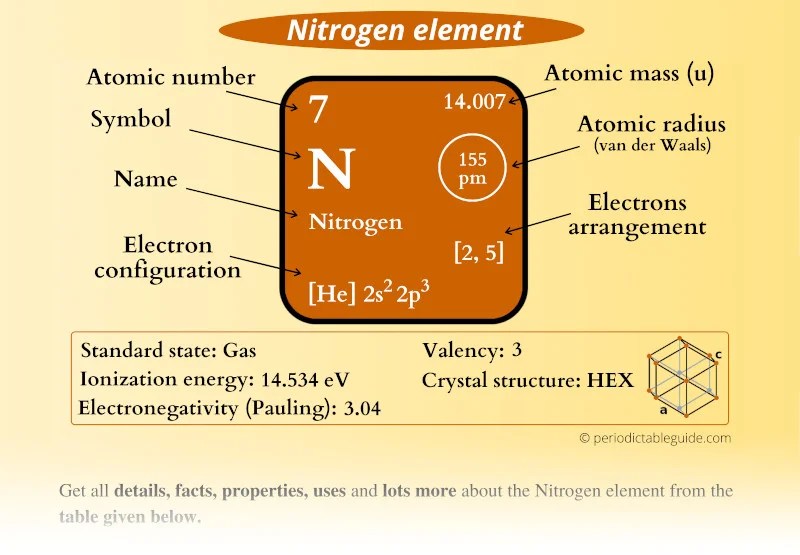
Nitrogen’s identity in the periodic table is defined by its atomic number 7, placing it in Group 15 (the pnictogens) and Period 2, sandwiched between carbon and oxygen. This positioning reflects its electron configuration: two electrons in the 1s orbital, five in the 2s and 2p subshells, leaving it just one electron short of a full octet—a trait that governs its bonding behavior. As a nonmetal, nitrogen exhibits a mix of covalent and ionic tendencies, though its most stable form is the diatomic molecule (N₂), where two nitrogen atoms share three pairs of electrons in a triple covalent bond. This bond is the strongest known in diatomic molecules, requiring 945 kJ/mol to break, which explains why nitrogen gas is so chemically inert under standard conditions.The element’s name derives from the Greek nitron (soda) and genes (forming), a nod to its presence in nitrates found in Egyptian natron deposits. Early chemists like Daniel Rutherford (1772) and Joseph Priestley (1772) independently isolated nitrogen by removing oxygen from air, though its true significance emerged only later. Nitrogen’s atomic mass of 14.007 u (with a stable isotope, ¹⁴N, comprising 99.6% of natural nitrogen) and its electronegativity of 3.04 (on the Pauling scale) further define its reactivity. These properties make nitrogen a chalcophile—an element that bonds readily with metals (e.g., in ammonia synthesis)—while its triple bond ensures stability in the absence of catalysts or extreme conditions.
Historical Background and Evolution
The story of nitrogen’s discovery is intertwined with the birth of modern chemistry. In the late 18th century, scientists like Antoine Lavoisier sought to classify the components of air, then considered a single, homogeneous substance. Rutherford’s breakthrough came when he removed oxygen from air by absorbing it into potassium hydroxide, leaving behind a gas that neither supported combustion nor sustained life—nitrogen. Priestley, meanwhile, had earlier isolated "nitrous air" (nitric oxide, NO) from burning metals, but Rutherford’s work clarified nitrogen’s role as a distinct, inert component of the atmosphere.The 19th century cemented nitrogen’s importance as Justus von Liebig demonstrated its critical role in plant nutrition, linking nitrogen cycles to agriculture. His research revealed that while plants could not extract nitrogen directly from the air, bacteria in root nodules (like Rhizobium) could fix atmospheric nitrogen into usable forms like ammonia (NH₃). This biological process, later quantified by Sergei Winogradsky in the 1890s, became the foundation for modern fertilizers. Meanwhile, Fritz Haber’s 1909 ammonia synthesis process—using high-pressure catalysis—revolutionized industrial nitrogen fixation, enabling mass production of fertilizers and explosives, a development that reshaped global food security and warfare.
Core Mechanisms: How It Works
Nitrogen’s chemical behavior is governed by its electron configuration (1s² 2s² 2p³) and the strength of its N≡N triple bond. This bond, formed by one sigma (σ) and two pi (π) bonds, gives N₂ its exceptional stability. To react, nitrogen must first overcome this bond energy, typically requiring high temperatures (e.g., lightning), catalysts (e.g., iron in the Haber-Bosch process), or biological enzymes (e.g., nitrogenase in bacteria). Once activated, nitrogen can form a vast array of compounds, from ammonia (NH₃) and nitric oxide (NO) to nitrates (NO₃⁻), each playing distinct roles in nature and industry.The nitrogen cycle exemplifies this reactivity in action. In the atmosphere, N₂ is inert, but soil bacteria convert it into ammonia through nitrogen fixation. Plants absorb ammonia as nitrate (NO₃⁻), incorporating it into proteins and nucleic acids. Decomposers then release nitrogen back into the soil or atmosphere via denitrification, where bacteria convert nitrates into N₂O (nitrous oxide) or N₂. This cycle underscores nitrogen’s dual role: as a limiting nutrient for plant growth and a greenhouse gas when disrupted by human activity (e.g., agricultural runoff).
Key Benefits and Crucial Impact
Nitrogen’s influence extends from the microscopic—where it builds the molecules of life—to the macroscopic, where it powers economies and ecosystems. As the most abundant element in Earth’s atmosphere (78% by volume), nitrogen regulates temperature, pressure, and even the habitability of planets. In industry, it enables food production (fertilizers), energy storage (liquid nitrogen), and advanced materials (e.g., nitrogen-doped graphene). Yet its impact is not without consequences: excess nitrogen from synthetic fertilizers fuels eutrophication, while nitrous oxide (N₂O), a byproduct of denitrification, is 300 times more potent than CO₂ as a greenhouse gas.The element’s versatility is matched only by its necessity. Without nitrogen, DNA couldn’t store genetic information, proteins couldn’t fold into enzymes, and explosives like TNT wouldn’t detonate. Even the preservation of food relies on nitrogen’s inert properties in modified atmosphere packaging (MAP), where N₂ displaces oxygen to prevent spoilage. These applications highlight nitrogen’s dual nature: a silent guardian of stability and a catalyst for transformation.
"Nitrogen is the difference between a barren field and a bountiful harvest, between a silent explosion and a controlled one, between life as we know it and life as we might not." — Carl Sagan (adapted from Cosmos)
Major Advantages
- Biological Essentiality: Nitrogen is a building block of amino acids, nucleic acids, and chlorophyll, making it indispensable for all terrestrial life. Without it, photosynthesis—and thus the oxygen we breathe—would collapse.
- Industrial Versatility: From ammonia (NH₃) for fertilizers to nitrogen gas (N₂) for semiconductor manufacturing, nitrogen enables technologies that feed billions and power electronics.
- Environmental Regulation: Nitrogen cycles moderate Earth’s climate by absorbing infrared radiation (via N₂O) and influencing cloud formation. Its presence in the atmosphere also stabilizes atmospheric pressure.
- Safety and Preservation: Liquid nitrogen (LN₂) at -196°C is used in cryopreservation, food storage, and medical procedures, while gaseous N₂ prevents oxidation in packaging and welding.
- Energy Efficiency: The Haber-Bosch process—which fixes atmospheric nitrogen into ammonia—accounts for ~1% of global energy use but produces 400 million tons of fertilizer annually, directly supporting 40% of the world’s population.
Comparative Analysis
| Property | Nitrogen (N) | Oxygen (O) |
|---|---|---|
| Atomic Number | 7 | 8 |
| Electron Configuration | 1s² 2s² 2p³ | 1s² 2s² 2p⁴ |
| Bonding in Diatomic Form | Triple bond (N≡N, 945 kJ/mol) | Double bond (O=O, 498 kJ/mol) |
| Reactivity | Inert at room temperature; requires catalysts/energy to react | Highly reactive; forms oxides readily |
Future Trends and Innovations
The next frontier in nitrogen science lies in sustainable fixation and precision applications. Current industrial methods (e.g., Haber-Bosch) consume ~2% of global energy, and researchers are exploring electrochemical nitrogen fixation using renewable energy to produce ammonia at room temperature. Nitrogen-doped materials, such as graphene and quantum dots, are also emerging in electronics and catalysis, potentially replacing rare metals in batteries and sensors.Environmentally, the focus is on closing the nitrogen cycle to mitigate pollution. Techniques like biochar amendment and controlled denitrification aim to reduce N₂O emissions while maintaining agricultural productivity. Meanwhile, space exploration is turning to nitrogen as a propellant (hydrazine derivatives) and a life-support gas for long-duration missions. As climate change intensifies, nitrogen’s role in soil health and atmospheric balance will demand innovative solutions—balancing its benefits with its ecological footprint.
Conclusion
Nitrogen’s story is one of contrasts: an element that is both everywhere and invisible, essential yet elusive, stable yet transformative. From the air we exhale to the food we eat, what is nitrogen in the periodic table is a question with answers that shape biology, industry, and environmental policy. Its mastery—whether through ancient bacterial symbiosis or modern chemical engineering—has defined human progress, yet its challenges (e.g., over-fertilization, greenhouse gas emissions) remind us of nature’s delicate equilibria.As science advances, nitrogen will remain a keystone of discovery, from carbon-neutral ammonia synthesis to next-generation semiconductors. Understanding its properties isn’t just an academic exercise; it’s a necessity for sustaining life, innovating technology, and safeguarding the planet. In the periodic table, nitrogen may be just one of 118 elements, but in the grand tapestry of existence, it is a thread woven into every breath, every cell, and every breakthrough.
Comprehensive FAQs
Q: Why is nitrogen gas (N₂) so unreactive compared to other diatomic molecules like O₂ or Cl₂?
A: Nitrogen’s unreactivity stems from its triple covalent bond (N≡N), which requires 945 kJ/mol to break—far more energy than the double bond in O₂ (498 kJ/mol) or the single bond in Cl₂ (242 kJ/mol). This bond strength makes N₂ kinetically inert at standard temperatures, though it can react under extreme conditions (e.g., lightning, industrial catalysts) or with highly reactive species (e.g., lithium metal).
Q: How does nitrogen fixation in plants differ from industrial nitrogen fixation?
A: Biological fixation occurs via nitrogenase enzymes in bacteria (e.g., Rhizobium in legumes), which convert N₂ to ammonia (NH₃) at room temperature and pressure, using ATP energy. Industrial fixation (e.g., Haber-Bosch) relies on high-pressure (200 atm) and high-temperature (400–500°C) catalysts (iron-based), producing ammonia at a 1000x faster rate but with far higher energy costs and CO₂ emissions.
Q: What are the environmental risks of excess nitrogen in ecosystems?
A: Excess nitrogen from fertilizers, wastewater, and fossil fuel combustion leads to:
- Eutrophication: Algal blooms deplete oxygen, creating "dead zones" (e.g., Gulf of Mexico).
- Nitrous Oxide (N₂O) Emissions: A potent greenhouse gas 300x stronger than CO₂, contributing to climate change.
- Acidification: Nitrates form nitric acid (HNO₃), lowering soil and water pH, harming aquatic life.
- Biodiversity Loss: Disrupts nitrogen cycles, favoring fast-growing weeds over native species.
Q: Can nitrogen be used as a fuel or energy source?
A: Directly, no—N₂ is thermally inert and doesn’t combust. However, nitrogen compounds are critical in energy:
- Ammonia (NH₃): A hydrogen carrier for clean energy storage (e.g., "green ammonia" from renewable electricity).
- Hydrazine (N₂H₄): Used in rocket propellants (e.g., Apollo missions).
- Nitrogen oxides (NOₓ): Byproducts of combustion that contribute to smog and acid rain.
Q: How does nitrogen contribute to the greenhouse effect?
A: While N₂ itself is not a greenhouse gas, its byproducts are:
- Nitrous Oxide (N₂O): 300x more potent than CO₂ over 100 years, primarily from agricultural soils and industrial processes.
- Nitrogen Dioxide (NO₂): A short-lived climate forcer that absorbs heat and forms aerosols affecting cloud formation.
Q: Are there any health risks associated with nitrogen exposure?
A: Pure nitrogen gas (N₂) is non-toxic and inert, but prolonged exposure to low-oxygen environments (e.g., nitrogen-rich atmospheres) can cause hypoxia (oxygen deprivation), leading to:
- Asphyxiation: In confined spaces with <16% oxygen (e.g., cargo holds, wells).
- Cryogenic Burns: Liquid nitrogen (-196°C) causes instant frostbite on contact.
- Decompression Sickness: Rapid pressure changes in scuba diving (using N₂/O₂ mixes) can cause "the bends."
Leave a Comment
Comments are moderated before appearing. The data you submit is processed according to the Privacy Policy of versiliasolutions.oneagency.co.