The Hidden Power of Nitrogen in the Periodic Table: Science Behind the Element
Table of Contents
- The Complete Overview of Nitrogen in the Periodic Table
- Historical Background and Evolution
- Core Mechanisms: How It Works
- Key Benefits and Crucial Impact
- Major Advantages
- Comparative Analysis
- Future Trends and Innovations
- Conclusion
- Comprehensive FAQs
- Q: Why is nitrogen in the periodic table so abundant in Earth’s atmosphere, yet so difficult for most organisms to use?
- Q: How does nitrogen in the periodic table contribute to air pollution?
- Q: Can nitrogen in the periodic table be used as a fuel?
- Q: What role does nitrogen play in the human body?
- Q: Are there any safety risks associated with handling nitrogen in the periodic table?
- Q: How is nitrogen in the periodic table studied in astrobiology?
- Q: What are the most promising future applications of nitrogen in the periodic table?
Nitrogen in the periodic table occupies a position of paradoxical prominence—an element so ubiquitous it’s invisible, yet so essential that its absence would unravel the fabric of life as we know it. With atomic number 7 and symbol N, it sits between carbon and oxygen, a silent participant in the chemical symphony that sustains ecosystems, fuels industrial revolutions, and defines the boundaries of modern science. Its inertness at standard conditions belies its reactivity under the right circumstances, making it a master of disguise: a gas that breathes life into plants, a component that stabilizes explosives, and a building block for pharmaceuticals that heal humanity. Yet, despite its omnipresence—comprising 78% of Earth’s atmosphere—nitrogen in the periodic table remains one of the most misunderstood elements, its true potential often overshadowed by more flamboyant neighbors like hydrogen or gold.
The story of nitrogen in the periodic table begins not with its discovery but with its misunderstanding. Early chemists mistook it for a compound, dubbing it "phlogiston" or "azote" (from the Greek a "without" and zoe "life"), assuming it could not support combustion. It wasn’t until the late 18th century that scientists like Joseph Priestley and Daniel Rutherford isolated it as a distinct element, proving its independence and unlocking its role in the nitrogen cycle—a natural process that would later become the cornerstone of agriculture and environmental science. Today, nitrogen in the periodic table stands as a testament to the elegance of chemical balance: an element that, when harnessed, can fertilize fields or, when mishandled, poison rivers. Its duality is a microcosm of the periodic table itself—a system where simplicity masks complexity, and where every element, no matter how mundane, holds the key to unlocking breakthroughs.
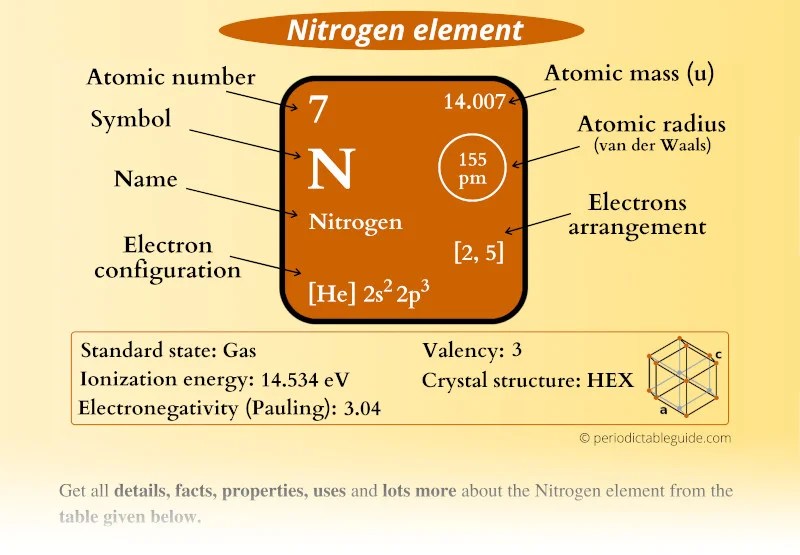
What makes nitrogen in the periodic table uniquely fascinating is its atomic architecture. A lone nitrogen atom consists of seven protons, seven neutrons (in its most common isotope), and seven electrons, arranged in a way that allows it to form triple bonds with itself or other elements like carbon and hydrogen. This bonding versatility is the reason nitrogen-based compounds—from ammonia (NH₃) to nitrates (NO₃⁻)—are the linchpins of biological and industrial processes. The element’s electron configuration (1s² 2s² 2p³) leaves it with one unpaired electron in its outer shell, a trait that drives its reactivity in specific conditions. Yet, at room temperature, nitrogen gas (N₂) exists as a diatomic molecule with an exceptionally strong triple bond (N≡N), making it one of the most stable and least reactive gases on Earth. This duality—reactive in compounds, inert in its pure form—explains why nitrogen in the periodic table is both a silent observer and an active participant in the chemical world.

The Complete Overview of Nitrogen in the Periodic Table
Nitrogen in the periodic table is a study in contrasts: an element that is everywhere yet rarely noticed, a nonmetal that defies expectations by being both a life-giver and a potential toxin. Its position in Group 15 (the pnictogens) and Period 2 of the periodic table classifies it as a nonmetal, though its properties blur the lines between gases, liquids, and solids depending on its molecular state. The element’s atomic weight of approximately 14.007 u reflects its simplicity, yet its isotopic variations—¹⁴N (99.63% abundance) and ¹⁵N (0.37%)—reveal a deeper complexity that scientists continue to explore for applications in radiocarbon dating and nuclear medicine. What sets nitrogen apart from its groupmates (phosphorus, arsenic, etc.) is its ability to form covalent bonds with a staggering array of elements, creating compounds that range from the mundane (like urea in urine) to the revolutionary (like the nitrogen cycle’s role in soil fertility).The periodic table’s placement of nitrogen also highlights its role in the broader narrative of elemental chemistry. As a member of the "diatomic nonmetals" (alongside hydrogen, oxygen, and the halogens), nitrogen in the periodic table embodies the principle that stability often masks latent potential. Its triple bond is the strongest among diatomic molecules, requiring immense energy to break—yet, under controlled conditions, this bond can be split to produce reactive nitrogen species (RNS) like nitric oxide (NO), which play critical roles in cellular signaling and atmospheric chemistry. The element’s electron affinity and electronegativity (3.04 on the Pauling scale) further explain its tendency to form polar bonds, influencing everything from the acidity of rain to the synthesis of amino acids. In essence, nitrogen in the periodic table is not just an element; it’s a chemical chameleon, adapting its behavior to suit its environment.
Historical Background and Evolution
The journey of nitrogen in the periodic table from obscurity to indispensability is a saga of scientific perseverance. The element’s discovery was accidental, emerging from the study of air itself. In 1772, Scottish physician Daniel Rutherford isolated nitrogen by removing oxygen and carbon dioxide from air, leaving behind a gas that did not support combustion—a finding that contradicted the prevailing theory that air was a single, homogeneous substance. This "fixed air" (as it was then called) was later named nitrogen by French chemist Jean-Antoine Chaptal in 1800, derived from the Greek nitron (soda) and genes (forming), reflecting its presence in nitrates. The 19th century saw nitrogen’s role in agriculture come to light, as scientists like Justus von Liebig demonstrated how nitrates in soil were essential for plant growth, laying the foundation for the Haber-Bosch process (1908–1913), which revolutionized synthetic fertilizer production.The evolution of nitrogen in the periodic table also mirrors broader scientific revolutions. The Haber-Bosch process, for instance, transformed nitrogen—once an atmospheric curiosity—into an industrial powerhouse, enabling the synthesis of ammonia (NH₃) from nitrogen and hydrogen under high pressure and temperature. This breakthrough not only fed a growing global population but also had unintended consequences, such as the over-fertilization of ecosystems and the creation of nitrogen oxides (NOₓ), which contribute to smog and acid rain. Meanwhile, the discovery of nitrogen’s isotopes in the early 20th century opened doors to nuclear physics and archaeology, with ¹⁵N becoming a tracer in metabolic studies and ¹⁴N serving as a benchmark for radiocarbon dating. Today, nitrogen in the periodic table remains a focal point for research into climate change, renewable energy, and even extraterrestrial life, as its compounds are found in meteorites and the atmospheres of other planets.
Core Mechanisms: How It Works
The reactivity of nitrogen in the periodic table is governed by its electronic structure and bonding capabilities. In its diatomic form (N₂), the triple bond between two nitrogen atoms (one sigma and two pi bonds) is so strong that it requires temperatures above 2,000°C or electrical discharge (like lightning) to break. This stability is why nitrogen gas is inert under normal conditions, making it ideal for preserving food (as in modified atmosphere packaging) or as a coolant in industrial processes. However, when nitrogen is exposed to high-energy conditions—such as in combustion engines or during the Haber-Bosch reaction—it can dissociate into reactive nitrogen species (RNS), including nitric oxide (NO) and nitrogen dioxide (NO₂), which are critical for both atmospheric chemistry and biological functions.The nitrogen cycle, one of the most vital biochemical processes on Earth, exemplifies how nitrogen in the periodic table transitions between inert and reactive states. The cycle begins with atmospheric nitrogen (N₂), which is "fixed" by bacteria, lightning, or industrial processes into ammonia (NH₃) or nitrates (NO₃⁻). Plants absorb these compounds through their roots, incorporating nitrogen into amino acids and proteins. Animals then consume these plants, and when they excrete waste or die, decomposers like bacteria convert the nitrogen back into ammonia or nitrites (NO₂⁻), which are further oxidized into nitrates or released as N₂ gas. This closed-loop system ensures that nitrogen in the periodic table is continually recycled, though human activities—such as fossil fuel combustion and excessive fertilizer use—have disrupted its balance, leading to issues like eutrophication and ozone depletion.
Key Benefits and Crucial Impact
Nitrogen in the periodic table is the unsung hero of modern civilization, its influence spanning agriculture, medicine, and technology. Without it, the green revolution would not have been possible, nor would the synthesis of life-saving drugs like nitroglycerin (used in treating angina) or the development of high-performance materials like nylon. Its ability to form millions of organic compounds makes it indispensable in pharmaceuticals, where nitrogen-containing molecules account for nearly all drugs on the market. Even in everyday products, from explosives to rocket propellants, nitrogen in the periodic table plays a pivotal role, demonstrating how an element’s properties can be harnessed for both constructive and destructive purposes.The impact of nitrogen extends beyond the laboratory into the natural world, where it shapes ecosystems and climates. The nitrogen cycle, for instance, is a cornerstone of biodiversity, ensuring that nutrients are distributed across food webs. Meanwhile, nitrogen oxides (NOₓ) in the atmosphere act as both a blessing and a curse: they help form ozone (O₃), which protects life from ultraviolet radiation, but they also contribute to air pollution and climate change when emitted in excess. This duality underscores the delicate balance that nitrogen in the periodic table maintains—a balance that humans are only beginning to understand and manage responsibly.
"Nitrogen is the difference between life and death, between abundance and scarcity, between innovation and stagnation. It is the element that reminds us how deeply interconnected chemistry and biology truly are."
— Linus Pauling, Nobel Prize-winning chemist
Major Advantages
- Biological Essentiality: Nitrogen is a building block of proteins, DNA, and RNA, making it critical for all known life forms. Without nitrogen in the periodic table, the genetic code itself would collapse.
- Agricultural Revolution: The Haber-Bosch process, which fixes atmospheric nitrogen into ammonia, has doubled global food production since the 20th century, preventing mass famine.
- Industrial Versatility: Nitrogen’s compounds are used in fertilizers, explosives, dyes, and even as cryogenic coolants in electronics and space exploration.
- Medical Applications: Nitrogen-based drugs (e.g., antibiotics, anesthetics) and diagnostic tools (e.g., MRI contrast agents) rely on nitrogen’s unique chemical properties.
- Environmental Regulation: Nitrogen cycles help mitigate greenhouse gases and maintain soil health, though human interference has led to ecological challenges like dead zones in oceans.
Comparative Analysis
| Property | Nitrogen (N) | Phosphorus (P) |
|---|---|---|
| Group in Periodic Table | Group 15 (Pnictogens), Period 2 | Group 15 (Pnictogens), Period 3 |
| Atomic Number | 7 | 15 |
| Key Compounds | Ammonia (NH₃), Nitric Acid (HNO₃), Nitrogen Gas (N₂) | Phosphoric Acid (H₃PO₄), Phosphates (PO₄³⁻), DNA Backbone |
| Biological Role | Proteins, amino acids, nucleic acids | ATP, bones, cell membranes, energy transfer |
Future Trends and Innovations
The future of nitrogen in the periodic table is being reshaped by two competing forces: the need for sustainable practices and the pursuit of technological advancement. On one front, scientists are developing "green ammonia" production methods that eliminate the carbon footprint of the Haber-Bosch process, using renewable energy to fix nitrogen without fossil fuels. On the other, research into nitrogen-doped materials—such as graphene or carbon nanotubes—promises breakthroughs in electronics, catalysis, and even quantum computing, where nitrogen’s electron configuration enhances conductivity and magnetic properties. Additionally, the study of nitrogen’s role in exoplanetary atmospheres could redefine our search for extraterrestrial life, as nitrogen oxides (NOₓ) are biomarkers for biological activity.Another frontier is the use of nitrogen in energy storage and propulsion. Liquid nitrogen (LN₂) is being explored as a cleaner alternative to hydraulic fluids in vehicles, while nitrogen-based fuels for rockets and hypersonic aircraft are being tested for their high energy density and low environmental impact. Meanwhile, in medicine, nitrogen’s ability to form stable isotopes is paving the way for precision diagnostics, such as PET scans using ¹⁵N-labeled compounds. As we stand on the brink of a nitrogen-centric scientific revolution, one thing is clear: this element, once relegated to the margins of the periodic table, is now at the heart of solving some of humanity’s most pressing challenges.
Conclusion
Nitrogen in the periodic table is a masterclass in chemical duality—an element that is both ubiquitous and enigmatic, reactive and stable, life-sustaining and potentially lethal. Its story is a reminder that the most profound scientific discoveries often lie in the elements we take for granted, those that humbly occupy the background yet quietly shape the world. From the fields where it feeds billions to the laboratories where it unlocks new medicines, nitrogen’s influence is inescapable. Yet, as we harness its power, we must also reckon with the consequences of our actions, ensuring that our innovations do not disrupt the delicate balance that nitrogen in the periodic table has maintained for eons.The journey of nitrogen is far from over. As technology advances and our understanding deepens, this element will continue to redefine the boundaries of chemistry, biology, and industry. Whether it’s through sustainable agriculture, next-generation materials, or the search for life beyond Earth, nitrogen in the periodic table remains a beacon of possibility—a silent partner in humanity’s greatest achievements and a cautionary tale of our impact on the natural world.
Comprehensive FAQs
Q: Why is nitrogen in the periodic table so abundant in Earth’s atmosphere, yet so difficult for most organisms to use?
A: Nitrogen gas (N₂) is abundant because it’s inert and unreactive under standard conditions, making it chemically "locked" in its diatomic form. Most organisms cannot use N₂ directly; they rely on nitrogen-fixing bacteria (or industrial processes like Haber-Bosch) to convert it into ammonia (NH₃) or nitrates (NO₃⁻), which plants can absorb. This biological limitation is why the nitrogen cycle is so critical—it’s the only way nitrogen becomes accessible to life.
Q: How does nitrogen in the periodic table contribute to air pollution?
A: Nitrogen oxides (NOₓ), primarily nitric oxide (NO) and nitrogen dioxide (NO₂), form when nitrogen and oxygen react at high temperatures (e.g., in car engines or power plants). These compounds contribute to smog, acid rain, and ground-level ozone pollution. Additionally, agricultural runoff of nitrates (from fertilizers) leads to eutrophication in water bodies, creating "dead zones" where oxygen levels drop too low to support aquatic life.
Q: Can nitrogen in the periodic table be used as a fuel?
A: While nitrogen itself isn’t a fuel, its compounds—like hydrazine (N₂H₄) and ammonia (NH₃)—are used as rocket propellants due to their high energy density and stability. Liquid nitrogen (LN₂) is also being tested as a cryogenic fluid in hybrid vehicles to replace hydraulic systems. However, pure nitrogen gas (N₂) is too inert to combust, making it unsuitable as a direct fuel source.
Q: What role does nitrogen play in the human body?
A: Nitrogen is the fourth most abundant element in the human body by mass, primarily found in proteins (20% nitrogen by weight), nucleic acids (DNA/RNA), and amino acids. It’s essential for muscle growth, enzyme function, and even neurotransmitter production (e.g., serotonin and dopamine). Without adequate nitrogen intake (via proteins), humans would suffer from malnutrition, weakened immunity, and impaired growth.
Q: Are there any safety risks associated with handling nitrogen in the periodic table?
A: Yes. While nitrogen gas (N₂) is non-toxic, it poses asphyxiation risks in confined spaces by displacing oxygen. Liquid nitrogen (LN₂) can cause severe frostbite on contact and may explode if it rapidly vaporizes in a sealed container. Reactive nitrogen compounds, such as ammonia or nitrogen oxides, are corrosive and toxic, requiring proper ventilation and protective gear. Industrial handling of nitrogen-based explosives (e.g., TNT, nitroglycerin) also carries significant explosion hazards.
Q: How is nitrogen in the periodic table studied in astrobiology?
A: Scientists analyze nitrogen isotopes (¹⁴N/¹⁵N ratios) in meteorites, comets, and exoplanetary atmospheres to infer the presence of biological or geological processes. For example, an imbalance in nitrogen isotopes on Mars could suggest past microbial activity, while nitrogen oxides (NOₓ) in exoplanet atmospheres might indicate volcanic or biological nitrogen fixation. The James Webb Space Telescope is now probing these signatures to assess habitability beyond Earth.
Q: What are the most promising future applications of nitrogen in the periodic table?
A: Emerging research focuses on:
1. Green ammonia for carbon-neutral shipping and energy storage.
2. Nitrogen-doped graphene for ultra-fast electronics and sensors.
3. Precision medicine using ¹⁵N-labeled tracers for cancer diagnostics.
4. Hypersonic propulsion with nitrogen-based fuels for next-gen aircraft.
5. Soil microbiome engineering to enhance nitrogen fixation in crops, reducing fertilizer dependency.
Leave a Comment
Comments are moderated before appearing. The data you submit is processed according to the Privacy Policy of versiliasolutions.oneagency.co.