Nitrogen on the Periodic Table: The Element Shaping Life and Science
Table of Contents
- The Complete Overview of Nitrogen on the Periodic Table
- Historical Background and Evolution
- Core Mechanisms: How It Works
- Key Benefits and Crucial Impact
- Major Advantages
- Comparative Analysis
- Future Trends and Innovations
- Conclusion
- Comprehensive FAQs
- Q: Why is nitrogen gas (N₂) so unreactive compared to other diatomic molecules like O₂ or Cl₂?
- Q: How does nitrogen fixation work in nature, and why can’t plants use atmospheric N₂ directly?
- Q: What are the environmental consequences of excess nitrogen in ecosystems?
- Q: Can nitrogen be used as a fuel, and if so, how?
- Q: How does nitrogen’s position in Group 15 influence its chemical behavior?
- Q: What role does nitrogen play in the human body beyond proteins and DNA?
- Q: Are there any emerging technologies that could reduce nitrogen pollution?
- Q: How does nitrogen’s isotope composition (¹⁴N vs. ¹⁵N) help scientists?
Nitrogen occupies a unique position among the elements. As the seventh entry on the periodic table, it stands at the intersection of inert stability and dynamic reactivity, quietly sustaining life while enabling breakthroughs in materials science. Its abundance—78% of Earth’s atmosphere—masks its paradoxical nature: a gas that resists bonding yet forms the backbone of amino acids, DNA, and explosives. The story of nitrogen on the periodic table is not just about its atomic structure but about its invisible yet omnipresent influence on every living organism and industrial process.
This element’s journey from an elusive "mephitic air" to a cornerstone of modern chemistry reveals how scientific curiosity reshapes our understanding of matter. Its triple-bonded diatomic form (N₂) defies conventional reactivity, yet under pressure, it transforms into fertilizers feeding global agriculture or fuels propelling spacecraft. The periodic table’s arrangement isn’t arbitrary; nitrogen’s placement in Group 15 reflects its electron configuration, but its real significance lies in how it bridges the gap between the inert noble gases and the reactive halogens—a testament to nature’s balance.
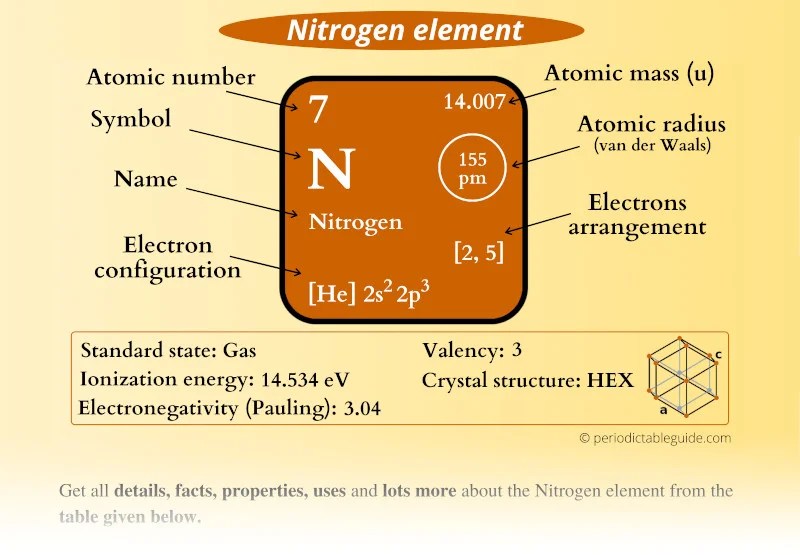
The periodic table’s structure is a map of elemental relationships, and nitrogen’s role is pivotal. Its atomic number (7) and electron configuration (1s² 2s² 2p³) position it as a chameleon among elements: capable of forming covalent bonds across organic and inorganic compounds. Whether in the nitrogen cycle of ecosystems or the synthesis of pharmaceuticals, this element’s versatility underscores why chemists and biologists alike consider it indispensable.
###

The Complete Overview of Nitrogen on the Periodic Table
Nitrogen’s position in the periodic table isn’t just a numerical designation—it’s a reflection of its duality. As a nonmetal in Group 15 (the pnictogens), it shares traits with phosphorus and arsenic but distinguishes itself through its atmospheric dominance and biological necessity. Its electron configuration, with five valence electrons, enables it to form three covalent bonds, a trait exploited in everything from protein synthesis to high-energy explosives. The periodic table’s organization isn’t just about atomic weights; it’s about predicting behavior, and nitrogen’s placement reveals its role as a mediator between reactivity and stability.The element’s symbol, N, derives from the Latin nitrogenium, meaning "niter-forming," a nod to its historical association with saltpeter (potassium nitrate). This connection to early gunpowder formulations hints at nitrogen’s dual legacy: both a sustainer of life and a catalyst for destruction. Modern science has refined our understanding of nitrogen on the periodic table, revealing it as a linchpin in nitrogen fixation, where atmospheric N₂ is converted into biologically usable forms by bacteria and industrial processes. This transformation is critical, as most organisms cannot directly utilize nitrogen gas, making the element’s chemistry a cornerstone of ecological and agricultural systems.
###
Historical Background and Evolution
The discovery of nitrogen on the periodic table unfolded through centuries of experimentation and debate. In the late 18th century, scientists like Joseph Priestley and Daniel Rutherford isolated "noxious air" (nitrogen gas) by removing oxygen from atmospheric samples. Rutherford’s 1772 experiments demonstrated that this residual gas—unlike oxygen—did not support combustion or respiration, earning it the name "azote" (Greek for "lifeless"). This period marked the first scientific acknowledgment of nitrogen’s inertness, though its biological and industrial potential remained unexplored.The 19th century brought clarity to nitrogen’s role in the periodic table. French chemist Jean-Antoine Chaptal coined the term nitrogen in 1809, recognizing its role in forming nitrates and its presence in organic compounds. By the mid-1800s, chemists like Justus von Liebig linked nitrogen to plant nutrition, sparking the agricultural revolution. The Haber-Bosch process (1909), which artificially fixed atmospheric nitrogen into ammonia, further cemented nitrogen’s status as a resource of global significance. Today, nitrogen on the periodic table is synonymous with both scientific progress and environmental challenges, from greenhouse gas emissions to the nitrogen cycle’s disruption by human activity.
###
Core Mechanisms: How It Works
Nitrogen’s atomic structure dictates its behavior. With seven protons and seven electrons, its neutral state is stable, but its five valence electrons seek to fill the octet, leading to diverse bonding patterns. The most stable form, N₂, features a triple covalent bond between two nitrogen atoms, requiring immense energy to break—a property exploited in high-pressure industrial applications. This bond also explains nitrogen’s resistance to chemical reactions at standard conditions, a trait that makes it inert yet critical for preserving atmospheric composition.The element’s reactivity becomes apparent under specific conditions. In the presence of catalysts (e.g., nitrogenase enzymes in bacteria or the Haber-Bosch iron catalyst), N₂ can undergo fixation, forming ammonia (NH₃) or nitrates (NO₃⁻). These compounds are essential for synthesizing amino acids, nucleic acids, and chlorophyll, underscoring nitrogen’s biological indispensability. Conversely, nitrogen oxides (NOₓ), formed during combustion, contribute to smog and acid rain, illustrating the element’s double-edged sword in environmental chemistry.
###
Key Benefits and Crucial Impact
Nitrogen’s influence extends across disciplines, from sustaining ecosystems to powering technological advancements. In biology, it is the fourth most abundant element in the human body, integral to proteins, DNA, and neurotransmitters like serotonin. Industrially, nitrogen’s inert properties make it ideal for preserving food (modified atmosphere packaging), cryogenic freezing, and electronics manufacturing. Even in space exploration, liquid nitrogen serves as a coolant for rocket engines. The element’s versatility stems from its ability to exist in multiple oxidation states, enabling roles as both a reducing agent (in ammonia synthesis) and an oxidizing agent (in nitric acid production).The periodic table’s classification of nitrogen as a pnictogen highlights its role in bridging inorganic and organic chemistry. Its presence in fertilizers, for instance, directly impacts global food security, while its use in explosives reflects humanity’s ability to harness its high-energy bonds. Yet, nitrogen’s environmental footprint—through eutrophication from agricultural runoff or stratospheric ozone depletion via NOₓ emissions—serves as a reminder of its delicate balance. Understanding nitrogen on the periodic table is not just about atomic theory; it’s about recognizing an element that shapes life, industry, and the planet’s future.
"Nitrogen is the silent architect of life’s building blocks. Without it, the proteins that define us, the DNA that codes our existence, and the ecosystems that sustain us would not exist in their current form." — Linus Pauling, Nobel Laureate in Chemistry
Major Advantages
- Biological Essentiality: Nitrogen is a core component of amino acids, nucleic acids, and chlorophyll, making it indispensable for all known life forms.
- Industrial Versatility: From ammonia production (Haber-Bosch process) to cryogenic applications, nitrogen enables advancements in agriculture, electronics, and energy.
- Environmental Regulation: Its inertness at standard conditions stabilizes atmospheric composition, though its reactive forms (e.g., NOₓ) necessitate careful management to mitigate pollution.
- Technological Innovation: Liquid nitrogen’s ultra-low temperatures (-196°C) are critical for superconductors, MRI machines, and food preservation.
- Sustainability Challenges: Balancing nitrogen fixation for agriculture with ecological harm (e.g., dead zones from runoff) requires precision in chemical engineering and policy.
Comparative Analysis
| Property | Nitrogen (N) | Phosphorus (P) |
|---|---|---|
| Group & Period | Group 15, Period 2 | Group 15, Period 3 |
| Atomic Number | 7 | 15 |
| Key Bonding | Triple bond in N₂; forms 3 covalent bonds | Forms P₄ tetrahedra; 5 covalent bonds |
| Biological Role | Amino acids, DNA, proteins | ATP, phospholipids, bone mineralization |
| Industrial Use | Fertilizers, cryogenics, explosives | Phosphoric acid, detergents, matches |
Future Trends and Innovations
The study of nitrogen on the periodic table is evolving with advancements in green chemistry and materials science. Researchers are exploring biological nitrogen fixation alternatives to the energy-intensive Haber-Bosch process, using enzymes like nitrogenase to create sustainable ammonia production. In medicine, nitrogen-based compounds are being investigated for targeted drug delivery and cancer therapy, leveraging their ability to form stable yet reactive intermediates. Meanwhile, atmospheric nitrogen’s role in climate change—through nitrous oxide (N₂O), a potent greenhouse gas—is driving innovations in catalytic converters and precision agriculture to minimize emissions.Emerging technologies may also redefine nitrogen’s industrial applications. Graphene-nitrogen composites, for instance, are being developed for lightweight, high-strength materials in aerospace, while nitrogen-doped quantum dots show promise in next-generation solar cells. As climate policies tighten, nitrogen’s management will become a critical focus, balancing its agricultural benefits with environmental costs. The future of nitrogen on the periodic table lies in harmonizing its dual nature: an element that sustains life while demanding responsible stewardship.
###
Conclusion
Nitrogen’s place on the periodic table is a testament to the element’s paradoxical nature—both ubiquitous and elusive, reactive yet stable. Its discovery and mastery have shaped modern science, from the foundations of organic chemistry to the green revolution in agriculture. Yet, nitrogen’s story is far from over; it remains a frontier for innovation, whether in sustainable energy, medical breakthroughs, or environmental conservation. The periodic table is more than a catalog of elements; it’s a roadmap to understanding the forces that govern our world, and nitrogen stands as one of its most vital waypoints.As research progresses, nitrogen on the periodic table will continue to reveal new layers of complexity, challenging scientists to explore its potential while mitigating its risks. The element’s journey—from an enigmatic "lifeless air" to the cornerstone of life—embodies the periodic table’s power to connect the microscopic and the macroscopic, the inert and the dynamic. In nitrogen, we see not just an element, but a mirror reflecting humanity’s ability to harness nature’s building blocks for progress.
###
Comprehensive FAQs
Q: Why is nitrogen gas (N₂) so unreactive compared to other diatomic molecules like O₂ or Cl₂?
A: Nitrogen’s triple bond (N≡N) is the strongest among diatomic molecules, requiring 945 kJ/mol to break—far more energy than the double bond in O₂ (498 kJ/mol) or single bonds in halogens. This high bond dissociation energy makes N₂ kinetically inert at standard conditions, though catalysts or extreme conditions (e.g., lightning, industrial furnaces) can induce reactions.
Q: How does nitrogen fixation work in nature, and why can’t plants use atmospheric N₂ directly?
A: Nitrogen fixation converts inert N₂ into ammonia (NH₃) or nitrates (NO₃⁻) via biological (e.g., rhizobia bacteria in legumes), physical (lightning), or industrial (Haber-Bosch) processes. Plants lack the enzyme nitrogenase to break N₂’s triple bond, so they rely on fixed nitrogen absorbed through roots as nitrates or ammonium ions.
Q: What are the environmental consequences of excess nitrogen in ecosystems?
A: Excess nitrogen from fertilizers or wastewater causes eutrophication, leading to algal blooms that deplete oxygen in water bodies (creating "dead zones"). It also contributes to nitrous oxide (N₂O) emissions, a greenhouse gas 300 times more potent than CO₂, and acidifies soil and water through nitrate leaching.
Q: Can nitrogen be used as a fuel, and if so, how?
A: While nitrogen itself isn’t combustible, its compounds like hydrazine (N₂H₄) or ammonium perchlorate (NH₄ClO₄) are high-energy fuels used in rockets and explosives. Liquid nitrogen isn’t a fuel but serves as a coolant for fuel systems or to pressurize liquid hydrogen in aerospace applications.
Q: How does nitrogen’s position in Group 15 influence its chemical behavior?
A: As a pnictogen, nitrogen exhibits properties between metals and nonmetals, with 5 valence electrons enabling it to form 3 covalent bonds (e.g., NH₃, NO₃⁻). This contrasts with heavier Group 15 elements (e.g., phosphorus), which form more bonds due to expanded octets, or lighter elements like boron, which are electron-deficient.
Q: What role does nitrogen play in the human body beyond proteins and DNA?
A: Nitrogen is critical for neurotransmitters (e.g., serotonin, dopamine), hormones (e.g., melatonin), and cellular signaling. It also contributes to the structure of urea (a waste product excreted via urine) and is a component of hemoglobin’s heme group, though iron is the primary metal there.
Q: Are there any emerging technologies that could reduce nitrogen pollution?
A: Yes. Innovations include biochar-based fertilizers to slow nitrate leaching, anaerobic digestion to capture ammonia from wastewater, and catalytic converters designed to break down N₂O emissions. Research into "green" nitrogen fixation (mimicking biological processes) could also replace energy-intensive industrial methods.
Q: How does nitrogen’s isotope composition (¹⁴N vs. ¹⁵N) help scientists?
A: The ratio of nitrogen isotopes (¹⁴N:¹⁵N) is used in paleoclimatology to study past atmospheric conditions, in archaeology to date organic materials, and in ecology to trace nutrient cycles. ¹⁵N is also a stable isotope tracer in medical research to track metabolic processes.
Leave a Comment
Comments are moderated before appearing. The data you submit is processed according to the Privacy Policy of versiliasolutions.oneagency.co.