Why Percent Yield in Chemistry Matters More Than You Think
Table of Contents
- The Complete Overview of Percent Yield in Chemistry
- Historical Background and Evolution
- Core Mechanisms: How It Works
- Key Benefits and Crucial Impact
- Major Advantages
- Comparative Analysis
- Future Trends and Innovations
- Conclusion
- Comprehensive FAQs
- Q: Can percent yield ever exceed 100%?
- Q: How does temperature affect percent yield in chemistry?
- Q: Why might a reaction have a 0% yield?
- Q: Is percent yield the same as atom economy?
- Q: How do chemists improve low percent yields?
Chemical reactions rarely deliver the theoretical perfection promised by stoichiometry. Even with precise measurements and ideal conditions, real-world outcomes fall short—often by significant margins. This discrepancy isn’t a flaw; it’s the foundation of percent yield in chemistry, a metric that exposes the gap between expectation and reality. Mastering this concept isn’t just about crunching numbers; it’s about understanding why reactions behave as they do, from industrial-scale synthesis to delicate pharmaceutical production.
The term "percent yield in chemistry" encapsulates efficiency, a silent arbiter in laboratories where margins matter. A 95% yield might seem acceptable in bulk manufacturing, but in high-purity drug synthesis, even a 1% deviation could mean failed batches or costly retests. The metric forces chemists to confront inefficiencies—whether from side reactions, impure reagents, or unforeseen kinetic barriers—and optimize processes accordingly.
Yet for all its practical importance, percent yield in chemistry remains misunderstood. Many students memorize the formula (actual yield ÷ theoretical yield × 100) without grasping its implications. Others dismiss it as a mere academic exercise, unaware that it underpins everything from battery technology to environmental remediation. The truth? This concept is the Rosetta Stone of reaction control, translating raw data into actionable insights.
The Complete Overview of Percent Yield in Chemistry
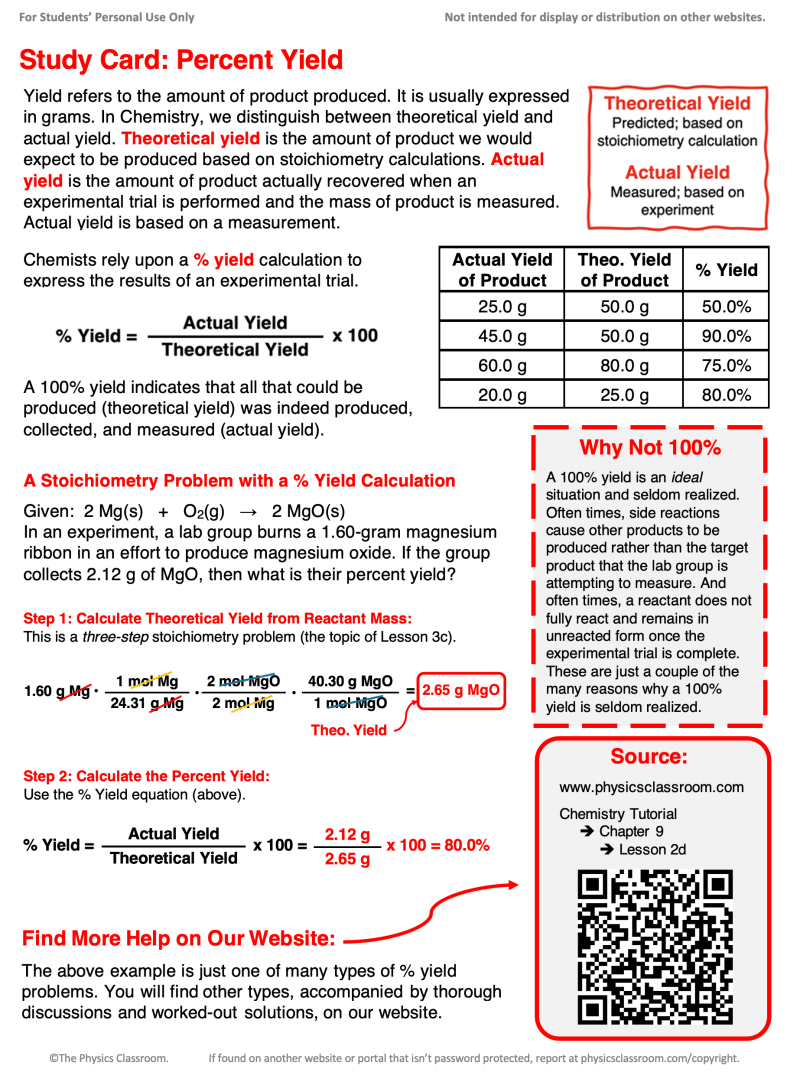
At its core, percent yield in chemistry quantifies how effectively a reaction converts reactants into desired products. Theoretical yield—calculated from stoichiometric ratios—serves as the ceiling, while actual yield reflects what’s actually obtained after purification. The ratio between these two, expressed as a percentage, reveals the reaction’s true efficiency. This isn’t just a theoretical exercise; it’s a diagnostic tool. A yield of 70% might signal reversible reactions or competing pathways, prompting chemists to adjust catalysts, temperatures, or solvents.The metric’s power lies in its simplicity. Unlike complex kinetic models or quantum mechanical simulations, percent yield in chemistry distills performance into a single, intuitive number. It bridges the gap between lab bench and industrial scale, where even minor yield improvements can translate to millions in savings. For instance, a 5% yield boost in a large-scale synthesis of ethylene oxide (used in detergents and antifreeze) could mean hundreds of thousands of dollars annually. The stakes are high, yet the principle remains the same: measure, analyze, and optimize.
Historical Background and Evolution
The origins of percent yield in chemistry trace back to the 19th century, when quantitative analysis became a cornerstone of chemical science. Early pioneers like Justus von Liebig emphasized precision in measurements, laying the groundwork for yield calculations. By the early 20th century, industrial chemists recognized that theoretical yields—derived from balanced equations—rarely matched real-world outcomes. This discrepancy spurred the development of systematic error analysis, including yield as a key performance indicator.The evolution of percent yield in chemistry mirrors broader advancements in analytical techniques. The advent of chromatography in the 1940s and 1950s allowed for more accurate product quantification, refining yield calculations. Today, automated systems and computational modeling further enhance precision, but the fundamental concept remains unchanged: yield is a measure of how well a reaction adheres to its theoretical potential. Historical context reveals why chemists treat yield as non-negotiable—it’s the litmus test for reaction design.
Core Mechanisms: How It Works
The calculation of percent yield in chemistry hinges on two pillars: theoretical yield (based on stoichiometry) and actual yield (empirically determined). Theoretical yield is derived from the limiting reagent’s moles, converted to grams via molar mass. Actual yield, however, accounts for losses—whether through incomplete reactions, side products, or purification steps. The formula:(Actual Yield / Theoretical Yield) × 100% transforms these values into a percentage, revealing efficiency.
What makes this metric indispensable is its diagnostic value. A low yield often points to specific issues: reversible reactions (Le Chatelier’s principle), competing reactions, or kinetic barriers. For example, in the synthesis of aspirin, acetylsalicylic acid yield drops if sulfuric acid isn’t properly removed, indicating a side reaction. By tracking percent yield in chemistry over multiple trials, chemists identify patterns—such as temperature-dependent efficiency—that guide process optimization.
Key Benefits and Crucial Impact
The percent yield in chemistry isn’t just a number; it’s a compass for reaction optimization. In pharmaceuticals, where regulatory standards demand purity and consistency, yield deviations can lead to rejected batches. Even a 2% drop in yield for a high-value compound like ritonavir (an HIV treatment) could cost millions in lost production. The metric forces rigor, ensuring that every gram of product meets quality benchmarks.Beyond economics, percent yield in chemistry drives innovation. Researchers in renewable energy, for instance, use yield data to improve catalytic converters for biofuel production. A higher yield means more efficient energy conversion, directly impacting sustainability goals. The ripple effects extend to materials science, where yield improvements in graphene synthesis could revolutionize electronics. This isn’t abstract theory—it’s the backbone of modern chemical engineering.
"The percent yield is the silent partner in every reaction—it doesn’t speak, but it tells you everything you need to know about what’s going wrong." — Dr. Linda J. Broadbelt, Northwestern University
Major Advantages
- Process Optimization: Identifies bottlenecks in multi-step syntheses, allowing chemists to target specific stages for improvement (e.g., adjusting catalyst load in a palladium-catalyzed coupling).
- Cost Efficiency: Reduces waste by highlighting reactions with inherently low yields, prompting alternative routes or reagent substitutions.
- Quality Control: Ensures consistency in manufacturing, critical for industries like food additives (e.g., high-fructose corn syrup production) where yield variations affect product safety.
- Safety Compliance: Low yields in hazardous reactions (e.g., explosive intermediates) signal the need for safer alternatives, aligning with OSHA and REACH regulations.
- Scalability Insights: Lab-scale yields that don’t translate to industrial scales often indicate mass-transfer limitations or heat dissipation issues, guiding pilot-plant design.
Comparative Analysis
| Aspect | Percent Yield in Chemistry | Alternative Metrics (e.g., Selectivity) |
|---|---|---|
| Focus | Overall reaction efficiency (all products) | Specific product distribution (e.g., 80% desired product, 20% side products) |
| Use Case | General reaction assessment (e.g., lab reports, teaching) | Targeted optimization (e.g., pharmaceutical synthesis) |
| Limitations | Doesn’t distinguish between useful and waste products | Requires additional data (e.g., GC/MS analysis) |
| Industry Standard | Universal in academic and industrial labs | Specialized (e.g., petrochemicals, fine chemicals) |

Future Trends and Innovations
The future of percent yield in chemistry lies in integration with real-time monitoring and AI-driven predictions. Emerging technologies like Raman spectroscopy and machine learning are enabling dynamic yield calculations during reactions, allowing immediate adjustments. For example, in flow chemistry systems, sensors can track yield in real time, optimizing conditions on the fly—a game-changer for continuous manufacturing.Another frontier is green chemistry, where yield is recalculated to include atom economy (a metric of sustainability). A reaction with a 90% yield might still waste 50% of atoms if side products are toxic. Future chemists will need to balance traditional percent yield in chemistry with environmental metrics, designing reactions that maximize both efficiency and eco-friendliness. The shift toward circular economies will make yield data even more critical, as industries seek to minimize waste entirely.
Conclusion
Percent yield in chemistry is more than a textbook formula—it’s the language of reaction efficiency, spoken across labs, factories, and research institutions. Its simplicity belies its depth, serving as both a diagnostic tool and a benchmark for progress. As chemistry evolves, so too will the ways we interpret yield, but its core purpose remains unchanged: to bridge the gap between what we hope a reaction will produce and what it actually delivers.The next generation of chemists will wield yield data as a precision instrument, guided by AI and sustainable design principles. For now, the metric stands as a testament to the discipline’s relentless pursuit of perfection—one percentage point at a time.
Comprehensive FAQs
Q: Can percent yield ever exceed 100%?
A: No. A yield over 100% would imply creating more product than theoretically possible, which violates the law of conservation of mass. However, miscalculations (e.g., incorrect molar masses) or contamination (e.g., weighing impure products) can appear to inflate yields. Always verify purity before reporting.
Q: How does temperature affect percent yield in chemistry?
A: Temperature influences yield in two ways: (1) Equilibrium shifts (Le Chatelier’s principle)—higher temps favor endothermic reactions but may reduce exothermic yields; (2) Kinetic effects—extreme temps can accelerate side reactions, lowering selectivity and thus apparent yield. For example, the Haber process (NH₃ synthesis) uses high pressure but moderate temps (400–500°C) to balance yield and catalyst efficiency.
Q: Why might a reaction have a 0% yield?
A: A 0% yield typically indicates one of four issues: (1) No reaction occurred (e.g., incorrect catalysts or conditions); (2) All product decomposed (e.g., unstable intermediates); (3) Purification removed everything (e.g., sublimation of desired product); or (4) Human error (e.g., mislabeling reagents). Always cross-check with control experiments or spectroscopic data.
Q: Is percent yield the same as atom economy?
A: No. Percent yield measures how much product is obtained relative to theory, while atom economy assesses how efficiently atoms from reactants are incorporated into the desired product (ignoring side products). A reaction can have high yield but low atom economy (e.g., if 60% of atoms end up as waste). Green chemistry prioritizes both metrics.
Q: How do chemists improve low percent yields?
A: Strategies include:
- Adjusting stoichiometry to minimize limiting reagent waste.
- Optimizing catalysts (e.g., switching from homogeneous to heterogeneous catalysts).
- Controlling reaction conditions (e.g., pressure, solvent polarity).
- Adding scavengers to trap impurities or side products.
- Using protective groups in multi-step syntheses to prevent degradation.
Leave a Comment
Comments are moderated before appearing. The data you submit is processed according to the Privacy Policy of versiliasolutions.oneagency.co.