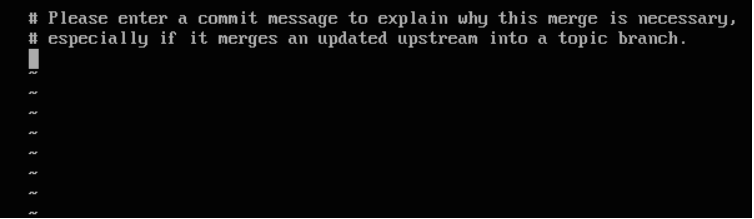
Why Your Git Merge Commit Message Matters: # please enter a commit message to explain why this merge is necessary
Table of Contents
- The Complete Overview of Git Merge Commit Messages
- Historical Background and Evolution
- Core Mechanisms: How It Works
- Key Benefits and Crucial Impact
- Major Advantages
- Comparative Analysis
- Future Trends and Innovations
- Conclusion
- Comprehensive FAQs
- Q: What happens if I skip the merge commit message prompt?
- Q: Should I include the same message for every upstream merge?
- Q: How can I ensure merge messages are consistent across a team?
- Q: What’s the difference between a merge commit message and a regular commit message?
- Q: Can I automate merge message generation?
- Q: How do merge messages affect CI/CD pipelines?
- Q: What’s the best format for a merge message when integrating upstream?
The first time a developer ignores the prompt "# please enter a commit message to explain why this merge is necessary"—especially when merging an upstream branch into a feature branch—they’re not just skipping a formality. They’re eroding the project’s historical integrity, complicating future debugging, and leaving teammates in the dark about critical decisions. This oversight isn’t trivial; it’s a systemic risk in collaborative coding, where context often decays faster than the code itself.
Consider a scenario where a security patch lands in `main`, but the team’s experimental `feature-x` branch, built atop an older `main`, silently absorbs those changes without explanation. Months later, when `feature-x` is finally reviewed, no one remembers why the merge happened—or whether it introduced unintended side effects. The commit message, in such cases, isn’t optional; it’s the difference between a maintainable codebase and a technical debt time bomb.
The stakes rise further when working with open-source projects or distributed teams. A well-crafted merge message—particularly one addressing "why this merge is necessary"—serves as a timestamped justification, aligning developers across time zones and ideologies. It’s not about writing novels; it’s about leaving breadcrumbs for the next engineer who must untangle the same knot.
The Complete Overview of Git Merge Commit Messages
At its core, a Git merge commit message is a metadata layer that bridges the gap between mechanical version control and human collaboration. When you see the prompt "# please enter a commit message to explain why this merge is necessary", Git isn’t just asking for a placeholder—it’s enforcing a discipline that prevents "why did we do that?" from becoming a recurring nightmare. This practice isn’t confined to specific workflows; it’s a universal principle in distributed version control, whether you’re using GitFlow, GitHub Flow, or a custom branching model.The message’s purpose evolves based on context. For a straightforward `main` branch merge, a brief note like "Merge upstream fixes for CVE-2023-XXXX" suffices. But when integrating an updated upstream into a topic branch, the stakes shift. Here, the message must clarify:
1. What changed upstream (e.g., "Upstream updated Node.js dependency to v18.x"),
2. Why it matters to this branch (e.g., "Required for new ES modules support in feature-y"),
3. Potential risks or trade-offs (e.g., "Breaks legacy browser compatibility; see #123 for mitigation").
Ignoring this prompt in such cases isn’t just sloppy—it’s a failure to document the intentionality behind a merge, which is critical for audit trails, compliance, or even legal defensibility in some industries.
Historical Background and Evolution
The concept of commit messages predates Git itself, tracing back to early version control systems like CVS and Subversion, where log entries were the primary means of tracking changes. However, Git’s merge commit messages took on a new level of importance due to its decentralized nature and emphasis on branching. Linus Torvalds’ insistence on semantic commit messages (e.g., "Fix memory leak in parser" over "fixed stuff") set a precedent that later influenced tools like GitHub’s pull request templates and Husky’s commitlint.The evolution of merge strategies—from `recursive` to `ort` (Git’s default since v2.33)—further highlighted the need for clear merge messages. Modern Git workflows, especially those involving upstream integration, now treat merge messages as first-class citizens. Tools like `git merge --no-ff` (which forces a merge commit) and CI/CD pipelines that parse commit logs for changelog generation underscore this shift. The prompt "# please enter a commit message to explain why this merge is necessary" isn’t arbitrary; it’s a reflection of Git’s maturation from a low-level tool to a collaborative platform.
Core Mechanisms: How It Works
Under the hood, Git merge commit messages are stored in the object database alongside the merge commit itself. When you execute `git merge`, Git:1. Creates a merge base (the common ancestor of the two branches),
2. Generates a merge commit (a new SHA-1 object with two parents),
3. Prompts for a message (or uses a default if none is provided).
The message is then embedded in the commit object’s metadata, accessible via `git show`, `git log --oneline`, or APIs like GitHub’s `/repos/{owner}/{repo}/commits/{sha}`. For upstream merges, the process differs slightly:
The message’s structure isn’t enforced by Git itself (unlike commit hooks), but conventions like Conventional Commits or GitMoji provide frameworks. When merging upstream, the message should ideally include:
Key Benefits and Crucial Impact
The immediate benefit of adhering to "# please enter a commit message to explain why this merge is necessary" is reduced cognitive load for future developers. Without context, even a simple merge can become a black box. For example, a team might merge `main` into a `refactor-ui` branch without noting that the upstream included a breaking change to the CSS framework. Months later, when the refactor is deployed, the UI fails silently—because no one remembered the merge’s purpose.Beyond debugging, these messages serve as implicit documentation. In regulated industries (e.g., healthcare, finance), they can be critical for compliance audits. A well-documented merge proves that changes were intentional, tested, and reviewed. Even in open-source, where contributions are anonymous, merge messages act as social contracts, signaling to maintainers that a contributor understood the implications of their changes.
> "Code is read more than it is written." — Guido van Rossum
> This axiom applies doubly to merge commit messages. The developer who writes the message may forget its contents in weeks; the developer who reads it (often under pressure) has no such luxury. A merge message isn’t just for the present—it’s for the future, when the original context has faded.
Major Advantages
- Debugging Efficiency: Messages like "Merge upstream to resolve #42 (security fix for auth bypass)" allow developers to trace issues to their root cause without manual inspection of every changed file.
- Collaboration Clarity: Distributed teams avoid "Why did we merge this?" discussions by having the rationale documented at the point of change.
- Risk Mitigation: Explicitly noting trade-offs (e.g., "Merged upstream to drop Python 3.7 support; see #100 for upgrade guide") prevents surprises during deployment.
- Automation Support: Tools like `git-changelog` or `standard-version` parse commit messages to generate release notes, reducing manual work.
- Legal/Compliance Traceability: In industries with audit requirements, merge messages can serve as evidence of deliberate, reviewed changes (e.g., GDPR compliance updates).
Comparative Analysis
| Scenario | Merge Message Practice |
|---|---|
| Fast-forward merge (no new commits) | Git often skips the message prompt entirely. Risk: No record of why the branch was updated. Workaround: Use `git merge --no-ff` to force a commit. |
| Upstream merge into a topic branch | Critical to explain why the upstream changes matter to the topic branch (e.g., dependency updates, breaking changes). Poor practice: Generic messages like "Merge branch 'main' into feature-x." |
| Rebase vs. Merge | Rebases rewrite history, making merge messages irrelevant. Merges preserve context but require careful messaging. Best practice: Prefer merges for shared branches. |
| Open-source contributions | Messages should reference PRs/issues (e.g., "Merge #42: Fix memory leak in parser"). Poor practice: Vague messages like "Updated code." |

Future Trends and Innovations
As Git ecosystems mature, we’ll see greater integration between merge messages and AI-assisted documentation. Tools like GitHub Copilot or internal LLM models could auto-suggest merge messages based on diff analysis, reducing friction while maintaining quality. However, this risks over-automation—relying on AI to generate messages without human oversight could lead to context loss if the model misinterprets the changes.Another trend is structured merge metadata, where messages adhere to schemas (e.g., JSON payloads embedded in commit notes). This would enable:
For now, the human element remains irreplaceable. The prompt "# please enter a commit message to explain why this merge is necessary" will persist because it enforces intentionality—something no algorithm can fully replicate.
Conclusion
The next time you see "# please enter a commit message to explain why this merge is necessary", treat it as more than a formality. It’s a checkpoint in a larger system where context preservation is as critical as the code itself. Skipping it isn’t just bad habit—it’s a technical debt that compounds over time, making future work slower, riskier, and more frustrating.For teams, this means enforcing policies (e.g., branch protection rules requiring merge messages) and fostering a culture where documentation is valued as highly as functionality. For individuals, it’s about adopting the mindset that every merge is a story, and future you (or your teammate) will thank present you for writing it clearly.
Comprehensive FAQs
Q: What happens if I skip the merge commit message prompt?
A: Git will use a default message like "Merge branch 'X' into Y", which provides zero context. This can lead to confusion during debugging, especially when merging upstream into a topic branch. Always provide a descriptive message, even if it’s brief.
Q: Should I include the same message for every upstream merge?
A: No. While templates can save time, each merge should reflect its unique purpose. For example, merging a security patch differs from merging a dependency update. Tailor the message to the impact on your branch.
Q: How can I ensure merge messages are consistent across a team?
A: Use tools like commitlint to enforce patterns (e.g., requiring a body for upstream merges). Pair this with code reviews that explicitly check merge rationale.
Q: What’s the difference between a merge commit message and a regular commit message?
A: Merge messages should focus on why the merge happened (e.g., "Integrated upstream fixes for #42"), while regular commits describe what changed (e.g., "Fixed null pointer in UserService"). Merge messages are about context; regular messages are about implementation.
Q: Can I automate merge message generation?
A: Partially. Scripts can extract diff summaries (e.g., "Merged upstream: updated lodash to v4.17.21"), but human oversight is still needed to ensure accuracy—especially when merging upstream into a topic branch with custom logic.
Q: How do merge messages affect CI/CD pipelines?
A: Well-structured messages enable pipelines to parse and act on merge intent. For example, a message like "Merge: breaking change in API v2" could trigger additional tests or notifications. Poor messages may cause pipelines to miss critical updates.
Q: What’s the best format for a merge message when integrating upstream?
A: Follow this structure:
- Header: "Merge upstream [version]"
- Body: "Key changes: [list items]. Relevant to this branch: [explain impact]."
- Footer: "See #123 for context. Risks: [none/mitigated]."
Leave a Comment
Comments are moderated before appearing. The data you submit is processed according to the Privacy Policy of versiliasolutions.oneagency.co.