Decoding the Vertex Angle in Isosceles Triangle: Geometry’s Hidden Precision
Table of Contents
- The Complete Overview of the Vertex Angle in Isosceles Triangle
- Historical Background and Evolution
- Core Mechanisms: How It Works
- Key Benefits and Crucial Impact
- Major Advantages
- Comparative Analysis
- Future Trends and Innovations
- Conclusion
- Comprehensive FAQs
- Q: How do you calculate the vertex angle in an isosceles triangle if you know the base angles?
- Q: Can an isosceles triangle have a vertex angle of 180°?
- Q: Why is the vertex angle important in trigonometry?
- Q: How does the vertex angle relate to the triangle’s area?
- Q: Are there real-world examples where the vertex angle in an isosceles triangle is critical?
- Q: Can an isosceles triangle have more than one vertex angle?
- Q: How does the vertex angle change if the isosceles triangle is reflected?
The vertex angle in an isosceles triangle is more than a label—it’s the linchpin of symmetry, a defining feature that distinguishes this shape from its scalene and equilateral counterparts. Unlike the base angles, which remain equal only when the sides are congruent, the vertex angle anchors the triangle’s balance, dictating its proportions and stability. Architects leverage this principle to design bridges and domes; engineers use it to calculate stress distributions in symmetric structures. Even in nature, the isosceles triangle’s vertex angle appears in the branching patterns of trees or the formation of snowflakes, where identical angles create harmonious repetition.
Yet for students and professionals alike, mastering the vertex angle in isosceles triangles often hinges on understanding its relationship with the base angles—a dynamic interplay governed by Euclidean geometry’s most fundamental theorems. The sum of angles in any triangle is 180°, but in an isosceles configuration, the vertex angle’s measure directly influences the base angles, creating a predictable ratio. This isn’t just abstract theory; it’s a tool for precision. Whether you’re solving for an unknown angle in a proof or optimizing a design’s aesthetic balance, the vertex angle serves as both constraint and opportunity.
The elegance of the isosceles triangle lies in its simplicity: two sides equal, two angles equal, and a vertex angle that holds the key to unlocking the rest. But this simplicity belies its complexity. The vertex angle isn’t just a static value—it’s a variable that, when altered, reshapes the entire triangle. Double it, and the base angles halve; halve the vertex, and the base angles swell. This reciprocal relationship is why the vertex angle in isosceles triangles remains a cornerstone of geometric education, bridging basic algebra and advanced trigonometry.

The Complete Overview of the Vertex Angle in Isosceles Triangle
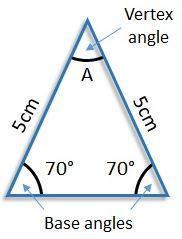
At its core, the vertex angle in an isosceles triangle is the angle opposite the base—the unequal side when the other two sides are congruent. This angle, often denoted as θ, is flanked by two equal base angles, each measuring (180° − θ)/2. The symmetry isn’t accidental; it’s a geometric necessity. If you bisect the vertex angle, the resulting triangle is not just divided but transformed—the bisector becomes the altitude, median, and angle bisector simultaneously, a trifecta of congruence that underscores the triangle’s stability.What makes the vertex angle particularly intriguing is its role in defining the triangle’s "personality." A vertex angle approaching 0° would flatten the triangle into a line, while one nearing 180° would stretch it into a nearly straight edge. In between, the isosceles triangle exhibits a spectrum of shapes, each with distinct properties. For instance, when the vertex angle is exactly 60°, the triangle becomes equilateral—a special case where all angles are equal. This fluidity explains why the vertex angle in isosceles triangles is a focal point in both theoretical and applied geometry.
Historical Background and Evolution
The study of the vertex angle in isosceles triangles traces back to ancient civilizations, where geometry was both an art and a science. The Babylonians and Egyptians, around 2000 BCE, used rudimentary forms of these triangles in land measurement and pyramid construction, though their understanding was empirical rather than axiomatic. It was the Greeks, particularly Euclid in his Elements (c. 300 BCE), who formalized the properties of isosceles triangles, proving that the angles opposite equal sides are equal—a foundational theorem still taught today.The Renaissance saw a revival of geometric rigor, with mathematicians like Leonardo da Vinci applying these principles to perspective drawing. His sketches often featured isosceles triangles to create balanced compositions, demonstrating how the vertex angle could dictate visual harmony. By the 17th century, the advent of coordinate geometry allowed for algebraic treatments of the vertex angle, enabling precise calculations of its measure given side lengths or other angles. This evolution reflects a broader shift: from intuitive geometry to analytical precision, where the vertex angle in isosceles triangles became a bridge between art and mathematics.
Core Mechanisms: How It Works
The mechanics of the vertex angle in an isosceles triangle are governed by two primary laws: the Isosceles Triangle Theorem and the Triangle Angle Sum Property. The former states that angles opposite equal sides are congruent, meaning the two base angles are always equal. The latter ensures that the sum of all three angles—vertex angle (θ) plus two base angles (α)—equals 180°. Since the base angles are equal, each measures (180° − θ)/2, creating a direct relationship between the vertex angle and the base angles.Practical applications of this relationship extend beyond pure geometry. In trigonometry, the vertex angle determines the triangle’s trigonometric ratios. For example, if the vertex angle is 40°, the base angles are each 70°, and trigonometric functions like sine or cosine can be applied to these angles to solve for side lengths or other angles in more complex figures. This interplay between angles and sides is why the vertex angle in isosceles triangles is indispensable in fields like navigation, where bearings and courses often rely on symmetric angle distributions.
Key Benefits and Crucial Impact
The vertex angle in isosceles triangles isn’t just a geometric curiosity—it’s a tool for efficiency, symmetry, and problem-solving. In architecture, for instance, the vertex angle dictates the pitch of roofs or the curvature of arches, ensuring structural integrity while minimizing material waste. Engineers use it to calculate load distribution in symmetric frameworks, reducing stress concentrations. Even in computer graphics, algorithms often exploit the properties of isosceles triangles to render 3D models with realistic shading, where the vertex angle influences light reflection patterns.Beyond practical applications, the vertex angle embodies a deeper philosophical principle: constraint breeds creativity. By fixing one angle, the isosceles triangle forces the other two to adapt, creating a system where precision meets flexibility. This duality is why the concept appears in diverse disciplines, from music theory (where note intervals can be modeled using angle ratios) to biology (where protein folding often relies on symmetric angular structures).
"Geometry will draw the soul toward truth and create the spirit of philosophy." —Plato
Major Advantages
- Predictability: The vertex angle in an isosceles triangle allows for exact calculations of base angles, eliminating guesswork in geometric proofs or design specifications.
- Symmetry Optimization: Symmetric structures—from bridges to molecular bonds—rely on isosceles triangles to distribute forces evenly, enhancing durability.
- Educational Foundation: Mastery of the vertex angle simplifies the study of more complex shapes, including trapezoids, kites, and even trigonometric functions.
- Versatility in Problem-Solving: Whether in algebra (solving for unknown angles) or calculus (integrating angle-based functions), the vertex angle provides a starting point for deeper analysis.
- Real-World Applications: From surveying land plots to designing smartphone screens (where touch-sensitive corners often form isosceles triangles), the concept is universally applicable.
Comparative Analysis
| Feature | Vertex Angle in Isosceles Triangle | Equilateral Triangle | Scalene Triangle |
|---|---|---|---|
| Angle Relationships | One unique vertex angle (θ); two equal base angles ((180° − θ)/2). | All three angles equal (60° each). | All angles distinct; no fixed relationship. |
| Symmetry | One line of symmetry (along the altitude from the vertex). | Three lines of symmetry. | No lines of symmetry. |
| Applications | Architecture, engineering, computer graphics. | Tiling patterns, equilateral structures (e.g., trusses). | General-purpose geometry, irregular designs. |
| Mathematical Utility | Simplifies angle calculations; useful in trigonometric identities. | Serves as a special case for testing general theorems. | Requires Law of Sines/Cosines for angle-side relationships. |
Future Trends and Innovations
As computational geometry advances, the vertex angle in isosceles triangles is poised to play a larger role in algorithmic design. Machine learning models that analyze spatial data—such as autonomous vehicles navigating symmetric road layouts—rely on geometric primitives like isosceles triangles to interpret environments efficiently. Additionally, advancements in nanotechnology may exploit the precision of vertex angles to engineer materials with atomic-scale symmetry, where angular defects determine properties like conductivity or strength.In education, interactive simulations are making the vertex angle more tangible. Virtual labs allow students to manipulate isosceles triangles in real-time, observing how changes to the vertex angle affect base angles or side lengths. This hands-on approach could democratize geometric understanding, bridging the gap between abstract theory and practical application. The future of the vertex angle in isosceles triangles, therefore, lies not just in its mathematical purity but in its adaptability to emerging technologies.
Conclusion
The vertex angle in an isosceles triangle is a testament to geometry’s power to simplify complexity. By anchoring two equal sides and dictating the behavior of the remaining angles, it embodies the harmony between order and variability. Whether you’re a student grappling with proofs or an engineer designing a suspension bridge, this angle is a constant reminder that precision is the foundation of innovation.Its ubiquity—from ancient pyramids to modern algorithms—proves that some geometric truths transcend time. The vertex angle isn’t just a measure; it’s a language, a way to describe symmetry, balance, and structure. As mathematics continues to evolve, so too will our understanding of how this seemingly simple angle shapes the world around us.
Comprehensive FAQs
Q: How do you calculate the vertex angle in an isosceles triangle if you know the base angles?
A: If both base angles are equal (let’s call each α), subtract their sum from 180° to find the vertex angle (θ). The formula is θ = 180° − 2α. For example, if each base angle is 50°, the vertex angle is 180° − (2 × 50°) = 80°.
Q: Can an isosceles triangle have a vertex angle of 180°?
A: No. A vertex angle of 180° would collapse the triangle into a straight line, as all three angles would lie on a single plane. The maximum possible vertex angle in a valid isosceles triangle is just under 180° (approaching it asymptotically).
Q: Why is the vertex angle important in trigonometry?
A: The vertex angle determines the triangle’s trigonometric ratios (sine, cosine, tangent) for the base angles. For instance, if the vertex angle is 36°, the base angles are each 72°, and trigonometric functions can be used to find side lengths or other angles in related triangles, such as those formed by bisectors or altitudes.
Q: How does the vertex angle relate to the triangle’s area?
A: The area of an isosceles triangle depends on its base (b) and height (h), which can be derived from the vertex angle. If the equal sides are s, the height splits the triangle into two right triangles, each with angle θ/2 (half the vertex angle). Using trigonometry, h = s × sin(θ/2), and the area is (1/2) × b × h.
Q: Are there real-world examples where the vertex angle in an isosceles triangle is critical?
A: Yes. In architecture, the vertex angle of an isosceles triangle determines the slope of a gable roof. In engineering, it’s used to calculate the stress distribution in symmetric trusses. Even in sports, such as basketball, the angle of a free-throw arc often approximates an isosceles triangle’s vertex angle for optimal shot trajectory.
Q: Can an isosceles triangle have more than one vertex angle?
A: No. By definition, an isosceles triangle has exactly one vertex angle—the angle opposite the base. The other two angles (the base angles) are equal but not considered "vertex" angles. However, if you mistakenly refer to the base angles as vertex angles, you’d be describing a different configuration (e.g., a triangle with two equal angles, which is still isosceles but requires redefining the "base").
Q: How does the vertex angle change if the isosceles triangle is reflected?
A: Reflecting an isosceles triangle over its axis of symmetry (the altitude from the vertex) preserves the vertex angle’s measure. The base angles remain unchanged, and the triangle’s overall shape is congruent. However, if reflected over a different line (e.g., one of its legs), the vertex angle’s position changes, but its measure stays the same.
Leave a Comment
Comments are moderated before appearing. The data you submit is processed according to the Privacy Policy of versiliasolutions.oneagency.co.