The Hidden Geometry: Vertex Angle of Isosceles Triangle Explained
Table of Contents
- The Complete Overview of the Vertex Angle of Isosceles Triangle
- Historical Background and Evolution
- Core Mechanisms: How It Works
- Key Benefits and Crucial Impact
- Major Advantages
- Comparative Analysis
- Future Trends and Innovations
- Conclusion
- Comprehensive FAQs
- Q: How do I calculate the base angles of an isosceles triangle if I only know the vertex angle?
- Q: Can the vertex angle of an isosceles triangle be 180°?
- Q: Why is the vertex angle important in roof design?
- Q: How does the vertex angle relate to the triangle’s height?
- Q: Are there real-world examples where the vertex angle is critical?
- Q: Can an isosceles triangle have a vertex angle greater than 90°?
The vertex angle of an isosceles triangle isn’t just a passive measurement—it’s the linchpin that defines symmetry, balance, and structural integrity in shapes we encounter daily. From the sleek lines of modern architecture to the precision of engineering blueprints, this angle governs stability and aesthetic harmony. Yet, its mathematical elegance often goes unnoticed, buried beneath layers of geometric complexity. The isosceles triangle, with its two equal sides and congruent base angles, thrives on this vertex angle, a silent architect of proportion.
What makes this angle truly fascinating is its dual role: a geometric constraint and a creative enabler. In pure mathematics, it’s the angle opposite the equal sides, a fixed point around which the triangle’s symmetry pivots. But in applied fields—whether in physics, computer graphics, or even art—it becomes a variable, a tool to manipulate form and function. The way this angle interacts with the base angles (always summing to 180°) reveals deeper truths about triangular stability, a principle engineers exploit when designing bridges or trusses.
The vertex angle of an isosceles triangle also bridges theory and practice. While textbooks reduce it to a formula—180° minus twice the base angle—its real-world implications stretch far beyond algebra. Architects use it to distribute weight evenly; game developers rely on it for collision detection in 3D environments; and artists leverage its symmetry to create visually pleasing compositions. Understanding this angle isn’t just about solving for x—it’s about unlocking a fundamental language of balance.

The Complete Overview of the Vertex Angle of Isosceles Triangle
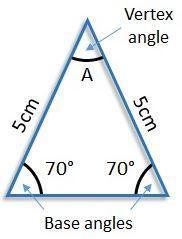
At its core, the vertex angle of an isosceles triangle is the angle formed by the two equal sides, positioned opposite the base. This angle is not arbitrary; it’s intrinsically linked to the triangle’s symmetry, dictating how the remaining two angles (the base angles) behave. When the vertex angle changes, the base angles adjust proportionally, maintaining the triangle’s isosceles property—a relationship governed by the Isosceles Triangle Theorem. This theorem states that angles opposite equal sides are equal, meaning the two base angles are congruent, and their measures are always (180° − vertex angle) / 2.The significance of this angle extends beyond pure geometry. In trigonometric applications, it influences the triangle’s height, area, and even its circumradius. For instance, if you bisect the vertex angle, the resulting right triangles formed can be analyzed using trigonometric ratios (sine, cosine, tangent), providing a bridge between angular measurements and side lengths. This interplay is critical in fields like surveying, where precise angle calculations determine land boundaries or structural alignments.
Historical Background and Evolution
The study of the vertex angle of isosceles triangles traces back to ancient civilizations, where geometry was both a practical necessity and a philosophical pursuit. The Babylonians and Egyptians, around 2000 BCE, used triangular measurements for construction, though their understanding was empirical rather than theoretical. It was the Greeks—particularly Euclid in his Elements (c. 300 BCE)—who formalized the properties of isosceles triangles, including the relationship between the vertex angle and base angles. Euclid’s Proposition I.5 explicitly states that in an isosceles triangle, the angles opposite the equal sides are equal, laying the foundation for modern geometric proofs.During the Islamic Golden Age (8th–14th centuries), mathematicians like Alhazen expanded on these ideas, integrating trigonometry to solve problems involving angular measurements. Their work laid the groundwork for later European mathematicians, including René Descartes, who systematized coordinate geometry in the 17th century. Descartes’ analytical approach allowed for the vertex angle to be expressed algebraically, enabling solutions to problems that were once purely geometric. Today, the vertex angle of an isosceles triangle remains a cornerstone of both classical and computational geometry, illustrating how ancient insights continue to shape modern innovation.
Core Mechanisms: How It Works
The mechanics of the vertex angle of an isosceles triangle hinge on two fundamental principles: angle sum properties and side congruence. First, the sum of all interior angles in any triangle is always 180°. In an isosceles triangle, if the vertex angle is denoted as V, then each base angle (B) must satisfy the equation:V + 2B = 180° Solving for B yields:
B = (180° − V) / 2 This relationship ensures that the triangle remains isosceles—any deviation from this formula would disrupt the equality of the base angles.
Second, the vertex angle’s position dictates the triangle’s orientation and stability. For example, in a triangle with a vertex angle of 30°, the base angles would each be 75°, creating a shape that’s wider at the base than at the apex. Conversely, a vertex angle of 120° would produce base angles of 30°, resulting in a narrower, more acute triangle. This variability is why the vertex angle is critical in structural engineering: a steeper vertex angle (closer to 180°) distributes force differently than a shallower one, affecting everything from roof designs to suspension bridges.
Key Benefits and Crucial Impact
The vertex angle of an isosceles triangle is more than a theoretical abstraction—it’s a practical tool with far-reaching implications. In engineering, it ensures that load-bearing structures distribute weight efficiently, reducing stress concentrations. Architects leverage its symmetry to create visually harmonious designs, while computer scientists use it in algorithms for mesh generation and collision detection. Even in nature, biological structures like protein folding and leaf venation often exploit triangular symmetry, where the vertex angle plays a role in optimizing space and strength.The elegance of this angle lies in its simplicity and versatility. Whether you’re calculating the dimensions of a truss, designing a logo, or analyzing the trajectory of a projectile, the principles governing the vertex angle remain constant. Its influence is so pervasive that it appears in unexpected places—from the pitch of a roof to the angle of a guitar’s soundhole, where acoustic properties depend on triangular resonance.
"Geometry will draw the soul toward truth and create the spirit of philosophy." — Plato
Major Advantages
- Structural Stability: The vertex angle determines how forces are distributed in triangular frameworks. A well-calculated vertex angle minimizes bending moments, making structures like bridges and domes more resilient.
- Aesthetic Symmetry: In art and design, the isosceles triangle’s balanced proportions create visual appeal. The vertex angle allows designers to control the triangle’s "sharpness" or "bluntness," influencing perception.
- Trigonometric Precision: The angle’s relationship with base angles enables exact calculations in navigation, astronomy, and physics. For example, satellite dish alignment relies on precise angular measurements derived from isosceles properties.
- Algorithmic Efficiency: In computer graphics, isosceles triangles are used to render 3D models efficiently. The vertex angle helps optimize rendering by reducing the number of calculations needed for lighting and shading.
- Educational Foundation: Teaching the vertex angle of an isosceles triangle introduces students to core geometric principles, including angle relationships, congruence, and algebraic problem-solving.
Comparative Analysis
| Property | Isosceles Triangle (Vertex Angle Focus) | Equilateral Triangle |
|---|---|---|
| Angle Distribution | One distinct vertex angle; two equal base angles. | All three angles are 60° (equal sides and angles). |
| Symmetry | One line of symmetry (along the altitude from the vertex). | Three lines of symmetry (each altitude is a symmetry axis). |
| Applications | Used in engineering for load distribution, art for dynamic compositions. | Common in tiling, honeycomb structures, and minimalist designs. |
| Mathematical Flexibility | Vertex angle can vary (e.g., 40° to 140°), allowing diverse shapes. | Fixed angles (60° each), limiting variability. |
Future Trends and Innovations
As computational geometry advances, the vertex angle of an isosceles triangle will play an increasingly pivotal role in emerging technologies. In generative design, algorithms use triangular meshes to optimize material usage in 3D-printed structures, where the vertex angle dictates how forces are channeled. Similarly, augmented reality (AR) applications rely on precise angular measurements to overlay digital elements seamlessly onto physical spaces, often using isosceles triangles for calibration.Another frontier is biomimicry, where engineers study natural isosceles structures—such as the triangular patterns in spider webs—to improve synthetic materials. The vertex angle’s influence on tensile strength and flexibility could lead to breakthroughs in lightweight, high-performance fabrics or medical implants. Meanwhile, in quantum computing, geometric principles like those governing the vertex angle are being explored to model complex systems, hinting at a future where classical geometry intersects with quantum mechanics.
Conclusion
The vertex angle of an isosceles triangle is a testament to the beauty of mathematical precision—a single measurement that encapsulates symmetry, stability, and creativity. Its study transcends academic exercises, permeating fields from architecture to artificial intelligence. By mastering this angle, one gains not just a tool for solving problems but a lens through which to understand the ordered chaos of the natural and built worlds.Yet, its power lies in its simplicity. No advanced calculus or esoteric theorems are required to grasp its essence—only an appreciation for balance and proportion. As geometry continues to evolve, the vertex angle remains a constant reminder that even the most fundamental concepts hold the key to innovation.
Comprehensive FAQs
Q: How do I calculate the base angles of an isosceles triangle if I only know the vertex angle?
A: Subtract the vertex angle from 180° and divide the result by 2. For example, if the vertex angle is 50°, the base angles are (180° − 50°) / 2 = 65° each.
Q: Can the vertex angle of an isosceles triangle be 180°?
A: No. A vertex angle of 180° would make the triangle degenerate (a straight line), as the two equal sides would lie flat, collapsing the shape.
Q: Why is the vertex angle important in roof design?
A: The vertex angle determines the roof’s pitch, affecting water runoff, snow load distribution, and structural support. A steeper vertex angle (e.g., 90°) sheds snow better but requires stronger framing.
Q: How does the vertex angle relate to the triangle’s height?
A: The height (h) of an isosceles triangle can be derived using trigonometry. If s is the length of the equal sides and V is the vertex angle, the height is h = s × sin(V/2).
Q: Are there real-world examples where the vertex angle is critical?
A: Yes. In suspension bridges, the vertex angle of triangular trusses determines how tension is distributed. In gaming, collision detection algorithms often use isosceles triangles to simplify 3D object interactions.
Q: Can an isosceles triangle have a vertex angle greater than 90°?
A: Absolutely. A vertex angle between 90° and 180° creates an obtuse isosceles triangle, where the base angles are acute (less than 90°). For example, a 100° vertex angle yields base angles of 40° each.
Leave a Comment
Comments are moderated before appearing. The data you submit is processed according to the Privacy Policy of versiliasolutions.oneagency.co.