The Hidden Role of Nitrogen: What Is Nitrogen in the Periodic Table?
Table of Contents
- The Complete Overview of Nitrogen in the Periodic Table
- Historical Background and Evolution
- Core Mechanisms: How It Works
- Key Benefits and Crucial Impact
- Major Advantages
- Comparative Analysis
- Future Trends and Innovations
- Conclusion
- Comprehensive FAQs
- Q: Why is nitrogen called "inert" even though it forms compounds?
- Q: How does nitrogen fixation work, and why is it important?
- Q: Are there any health risks associated with nitrogen exposure?
- Q: Can nitrogen be found in other planets or stars?
- Q: How do nitrogen fertilizers contribute to environmental problems?
- Q: What are the most stable nitrogen compounds?
Nitrogen occupies a position of paradox in the periodic table—an element so abundant it makes up 78% of Earth’s atmosphere yet remains invisible to the naked eye. Its inertness at room temperature belies a role as the backbone of organic compounds, from DNA to explosives. Scientists trace its discovery to 1772, when Danish pharmacist Ole Christensen Rømer first isolated it, though its true significance in what is nitrogen periodic table emerged only after Antoine Lavoisier classified it as an essential element. Today, nitrogen’s dual identity—both a life-sustaining nutrient and a silent participant in environmental crises—demands closer examination.
The periodic table’s Group 15 (or VA) places nitrogen (symbol N, atomic number 7) between phosphorus and arsenic, reflecting its electron configuration with five valence electrons. This arrangement explains its reactivity: nitrogen forms three covalent bonds, enabling it to stitch together amino acids, proteins, and even the nitrogenous bases of genetic material. Yet its triple-bonded diatomic form (N₂) resists most chemical reactions, a stability that has made it the preservative of choice in food packaging and medical applications. The tension between its reactivity and inertness lies at the heart of what nitrogen does in the periodic table—a balance that defines its biological and industrial utility.
While nitrogen’s atmospheric dominance might suggest ubiquity, its availability in usable forms is limited. Plants rely on nitrogen-fixing bacteria to convert N₂ into ammonia (NH₃), a process critical for agriculture but also a target for synthetic fertilizers that now disrupt ecosystems. Meanwhile, in high-energy environments like lightning strikes or industrial Haber-Bosch reactors, nitrogen transforms into nitrates, fueling both plant growth and smog formation. Understanding where nitrogen sits in the periodic table isn’t just academic—it’s a lens into the delicate equilibrium of Earth’s systems.

The Complete Overview of Nitrogen in the Periodic Table
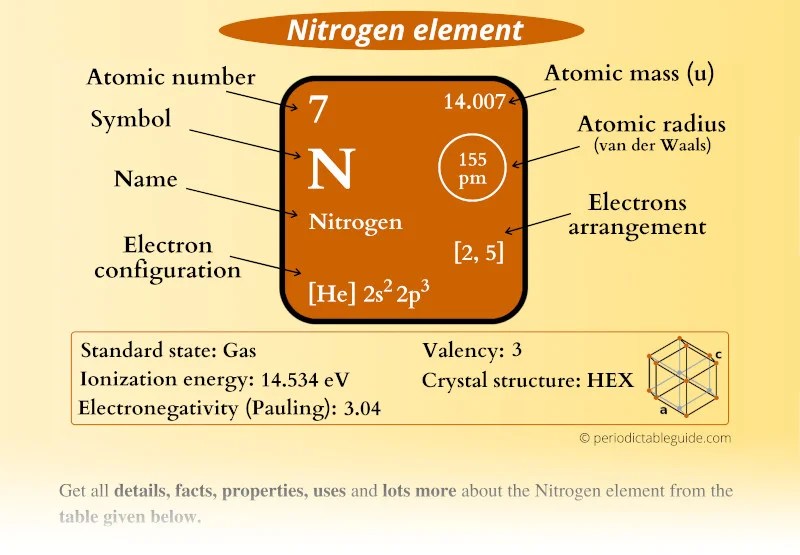
Nitrogen’s placement in the periodic table isn’t arbitrary; it’s a reflection of its atomic architecture. With seven protons and seven electrons, nitrogen’s electron configuration ([He] 2s² 2p³) positions it as the lightest member of Group 15, where elements share similar chemical behaviors. This group includes phosphorus, arsenic, antimony, and bismuth, but nitrogen’s small atomic size and high electronegativity set it apart. Its triple bond in N₂ (N≡N) is the strongest among diatomic molecules, requiring 945 kJ/mol to break—a stability that explains why nitrogen gas remains largely unreactive under standard conditions.The periodic table also reveals nitrogen’s role as a bridge between nonmetals and metalloids. While it lacks metallic properties, its ability to form compounds with both metals (e.g., nitrides like TiN) and nonmetals (e.g., nitrogen oxides NOₓ) underscores its versatility. This duality is evident in what nitrogen’s position in the periodic table implies: an element that thrives at the intersection of biology, chemistry, and environmental science. From the nitrogen cycle’s role in soil fertility to its use in semiconductor manufacturing (e.g., silicon nitride), nitrogen’s periodic table identity is a testament to its adaptability.
Historical Background and Evolution
The story of nitrogen’s discovery is intertwined with the birth of modern chemistry. In the late 18th century, scientists studying air composition noticed that a portion of it—about 21%—supported combustion (later identified as oxygen), while the remaining 78% (nitrogen) did not. Joseph Priestley and Carl Wilhelm Scheele independently isolated nitrogen in 1772, but it was Lavoisier who, in 1787, named it azote (Greek for "lifeless") due to its inability to sustain flames. The misnomer persisted until the 19th century, when Justus von Liebig demonstrated nitrogen’s essential role in plant nutrition, earning it the name nitrogen (from nitrum, the Latin for soda niter, and genes, meaning "forming").The periodic table’s evolution further clarified nitrogen’s significance. When Dmitri Mendeleev arranged elements by atomic weight in 1869, nitrogen’s placement in Group 15 (alongside phosphorus) highlighted its nonmetallic traits. Later refinements, such as Henry Moseley’s atomic number ordering, confirmed nitrogen’s atomic number 7, cementing its role as the lightest p-block element. These milestones in what is nitrogen’s role in the periodic table transformed it from a chemical curiosity into a cornerstone of scientific understanding.
Core Mechanisms: How It Works
Nitrogen’s chemical behavior is governed by its electron configuration and bond-forming tendencies. The five valence electrons (2s² 2p³) allow nitrogen to achieve a stable octet by sharing electrons, typically forming three covalent bonds (e.g., in NH₃ or N₂). This triply bonded N₂ molecule is kinetically inert due to its high bond dissociation energy, requiring extreme conditions (e.g., high temperatures or catalysts) to react. In contrast, nitrogen’s allotropes—such as the highly reactive nitrogen monoxide (NO) or the explosive nitrogen dioxide (NO₂)—demonstrate its capacity for oxidation states ranging from -3 to +5.The nitrogen cycle, a natural mechanism for converting nitrogen between its various forms, exemplifies these principles. Atmospheric N₂ is fixed into ammonia (NH₃) by bacteria or industrial processes, then assimilated by plants into amino acids. Denitrifying bacteria later convert nitrates back into N₂, completing the cycle. This interplay between what nitrogen does in the periodic table and its environmental transformations underscores its dynamic role in sustaining life while also posing challenges like eutrophication and ozone depletion.
Key Benefits and Crucial Impact
Nitrogen’s impact spans biology, industry, and ecology, making it one of the most consequential elements in the periodic table. In agriculture, synthetic nitrogen fertilizers have doubled global food production since the mid-20th century, yet their overuse has led to dead zones in oceans and groundwater contamination. Meanwhile, in medicine, liquid nitrogen’s cryogenic properties enable preserving biological samples and treating conditions like warts. Even in technology, nitrogen-doped graphene enhances battery performance, illustrating how what is nitrogen’s function in the periodic table extends beyond traditional chemistry.The element’s versatility is matched by its environmental duality. While nitrogen oxides (NOₓ) contribute to acid rain and smog, nitrous oxide (N₂O) is a potent greenhouse gas 300 times more effective than CO₂. These trade-offs highlight the need for sustainable nitrogen management, from precision farming to catalytic converters that reduce NOₓ emissions. The periodic table’s classification of nitrogen as a nonmetal with unique bonding capabilities thus serves as a reminder of its complex legacy.
"Nitrogen is the silent architect of life’s building blocks, yet its overabundance in modern systems has become a silent crisis." — Dr. Rachel Carson, environmental scientist
Major Advantages
- Biological Essentiality: Nitrogen is a constituent of amino acids, nucleic acids (DNA/RNA), and chlorophyll, making it indispensable for all known life forms.
- Industrial Versatility: Used in ammonia synthesis (Haber-Bosch process), explosives (nitroglycerin), and as an inert atmosphere in food packaging and electronics manufacturing.
- Environmental Regulation: Nitrogen cycles maintain soil fertility and water quality, though human disruption has led to ecosystem imbalances.
- Technological Innovation: Nitrogen-doped materials (e.g., graphene, semiconductors) improve energy storage, computing, and medical devices.
- Cryogenic Applications: Liquid nitrogen’s -196°C temperature enables cryopreservation, superconductivity research, and rapid freezing in food processing.
Comparative Analysis
| Nitrogen (N) | Phosphorus (P) |
|---|---|
| Atomic number: 7 Group: 15 (VA) Electron configuration: [He] 2s² 2p³ Key compounds: N₂, NH₃, NOₓ |
Atomic number: 15 Group: 15 (VA) Electron configuration: [Ne] 3s² 3p³ Key compounds: P₄, H₃PO₄, P₂O₅ |
| Abundance: 78% of Earth’s atmosphere Reactivity: Forms strong triple bonds (N≡N); inert as N₂ |
Abundance: 0.1% in Earth’s crust Reactivity: Highly reactive; forms P-P single bonds in P₄ |
| Biological Role: Protein synthesis, DNA/RNA Industrial Use: Fertilizers, cryogenics, explosives |
Biological Role: ATP, phospholipids, bone mineralization Industrial Use: Fertilizers, detergents, match heads |
Future Trends and Innovations
The next decade may redefine what nitrogen’s role in the periodic table looks like as sustainability drives innovation. Researchers are exploring bioengineered nitrogen-fixing crops to reduce reliance on synthetic fertilizers, while catalytic converters and plasma-based air purification aim to mitigate NOₓ emissions. In materials science, nitrogen-doped quantum dots and nanotubes could revolutionize solar cells and sensors. Meanwhile, the quest for room-temperature superconductors—some of which incorporate nitrogen—promises to upend energy transmission.Climate policy will also shape nitrogen’s future. The Paris Agreement’s focus on non-CO₂ greenhouse gases has spotlighted nitrous oxide (N₂O), pushing industries to adopt "nitrogen-smart" practices. As what nitrogen means in the periodic table evolves from a static classification to a dynamic field of study, its intersection with environmental science and technology will determine whether humanity can harness its benefits without exacerbating its drawbacks.
Conclusion
Nitrogen’s journey from an inert atmospheric gas to a linchpin of modern science exemplifies the periodic table’s power to reveal hidden connections. Its position in Group 15 is more than a classification—it’s a blueprint for understanding reactivity, bonding, and elemental behavior. Whether in the nitrogen cycle’s delicate balance or the high-tech applications of doped materials, what nitrogen represents in the periodic table is a story of duality: an element that sustains life yet demands careful stewardship.As research pushes boundaries—from nitrogen-rich exoplanet atmospheres to lab-grown nitrogen-fixing enzymes—the element’s narrative will continue to unfold. The challenge lies in translating scientific understanding into action, ensuring that nitrogen’s legacy remains one of innovation rather than imbalance. In the periodic table, nitrogen is more than an entry; it’s a mirror reflecting humanity’s relationship with the elements that define our world.
Comprehensive FAQs
Q: Why is nitrogen called "inert" even though it forms compounds?
The term "inert" refers specifically to diatomic nitrogen gas (N₂), which has an extremely strong triple bond (945 kJ/mol) that resists breaking under normal conditions. While N₂ itself is unreactive, nitrogen atoms readily form compounds (e.g., NH₃, NO) when energy or catalysts overcome this bond. This duality is why what is nitrogen’s reactivity in the periodic table depends on its molecular form.
Q: How does nitrogen fixation work, and why is it important?
Nitrogen fixation converts atmospheric N₂ into ammonia (NH₃) or related compounds, primarily through biological processes (e.g., rhizobia bacteria in legumes) or industrial methods (Haber-Bosch process). This is critical because most organisms cannot use N₂ directly; fixed nitrogen is the raw material for amino acids and nucleic acids. Without fixation, ecosystems would lack the nitrogen necessary for growth, making it a cornerstone of what nitrogen’s biological role in the periodic table entails.
Q: Are there any health risks associated with nitrogen exposure?
While nitrogen gas (N₂) is non-toxic, other nitrogen compounds pose risks. For example, nitrogen dioxide (NO₂) irritates lungs and worsens respiratory conditions, while nitrous oxide (N₂O) is a potent greenhouse gas and anesthetic at high doses. Liquid nitrogen can cause frostbite upon contact. Understanding what nitrogen’s hazards in the periodic table involve requires distinguishing between its inert form (N₂) and reactive derivatives (NOₓ, NH₃).
Q: Can nitrogen be found in other planets or stars?
Yes. Nitrogen is detected in the atmospheres of gas giants like Jupiter and Saturn, where it forms hydrazine (N₂H₄) under extreme pressures. In stars, nitrogen is produced via the CNO cycle (carbon-nitrogen-oxygen cycle), where it acts as a catalyst in nuclear fusion. These cosmic occurrences highlight nitrogen’s ubiquity beyond Earth, reinforcing its significance in what the periodic table reveals about elemental distribution in the universe.
Q: How do nitrogen fertilizers contribute to environmental problems?
Synthetic nitrogen fertilizers (e.g., urea, ammonium nitrate) increase crop yields but also lead to runoff that triggers algal blooms, depleting oxygen in water bodies (eutrophication). Additionally, excess nitrates contaminate groundwater, while nitrous oxide (N₂O), a byproduct of fertilizer decomposition, is a major greenhouse gas. Balancing agricultural needs with nitrogen management is key to mitigating these effects, a challenge tied to what nitrogen’s ecological impact in the periodic table demonstrates.
Q: What are the most stable nitrogen compounds?
The most stable nitrogen compounds are those with strong covalent bonds and minimal reactivity. Dinitrogen gas (N₂) is the most stable due to its triple bond, followed by ammonia (NH₃) and nitrogen trifluoride (NF₃). In contrast, nitrogen oxides (NO, NO₂) are highly reactive and unstable. This stability hierarchy reflects nitrogen’s periodic table properties, where bond strength and electron configuration dictate compound behavior.
Leave a Comment
Comments are moderated before appearing. The data you submit is processed according to the Privacy Policy of versiliasolutions.oneagency.co.