Precision in Chemistry: The Science Behind Calculation of Molecular Mass
Table of Contents
- The Complete Overview of Calculation of Molecular Mass
- Historical Background and Evolution
- Core Mechanisms: How It Works
- Key Benefits and Crucial Impact
- Major Advantages
- Comparative Analysis
- Future Trends and Innovations
- Conclusion
- Comprehensive FAQs
- Q: Why do atomic masses in the periodic table have decimals?
- Q: How does mass spectrometry distinguish between isotopes?
- Q: Can molecular mass calculations account for hydrogen bonding?
- Q: What’s the difference between molecular mass and molar mass?
- Q: How do chemists handle molecular mass calculations for polymers?
- Q: Are there any limitations to theoretical molecular mass calculations?
The calculation of molecular mass is the invisible backbone of modern chemistry—an operation so precise it dictates everything from drug dosages to material properties. Without it, fields like pharmacology, materials science, and environmental analysis would collapse into guesswork. Yet, for all its criticality, the process remains misunderstood outside specialized labs, where it’s treated as a rote exercise rather than a fusion of theory, experiment, and computational rigor.
At its core, the calculation of molecular mass is a marriage of atomic weights and structural formulas. A single misplaced decimal in a peptide sequence or polymer chain can alter reactivity, solubility, or even toxicity. This is why chemists and biochemists spend years refining their ability to derive molecular weights—whether through pen-and-paper stoichiometry or high-precision mass spectrometry. The stakes are high: in pharmaceuticals, an off-by-one error in molecular mass can mean the difference between a viable drug and a failed clinical trial.
The evolution of this discipline reflects broader scientific progress. From early atomic theories to today’s quantum-mechanical refinements, the calculation of molecular mass has been both a product and a driver of innovation. What began as rough estimates based on relative atomic masses (thanks to Dalton and Berzelius) now relies on isotopic distributions, computational algorithms, and instruments capable of measuring masses with parts-per-billion accuracy.
The Complete Overview of Calculation of Molecular Mass
The calculation of molecular mass is a systematic approach to determining the total mass of a molecule by summing the atomic masses of its constituent atoms, adjusted for their quantities in the molecular formula. This process is governed by two fundamental principles: atomic mass units (u or Da) and molecular composition. The atomic mass unit, defined as 1/12th the mass of a carbon-12 atom, provides a standardized scale, while the molecular formula (e.g., C₆H₁₂O₆ for glucose) dictates how many atoms of each element are present.Modern techniques for molecular mass determination have expanded beyond traditional methods. While theoretical calculations using periodic table values remain foundational, experimental approaches—such as mass spectrometry (MS), nuclear magnetic resonance (NMR), and X-ray crystallography—offer empirical validation. These methods are particularly vital for complex molecules like proteins or synthetic polymers, where theoretical predictions alone may be insufficient due to isotopic variations or structural ambiguities.
Historical Background and Evolution
The origins of the calculation of molecular mass trace back to the early 19th century, when John Dalton proposed his atomic theory. Dalton’s work established that elements combine in fixed ratios by mass, laying the groundwork for relative atomic masses. However, it wasn’t until 1808, with Joseph Louis Gay-Lussac’s experiments on gas volumes, that chemists began quantifying molecular weights with greater precision. The breakthrough came in 1860 at the Karlsruhe Congress, where Stanislao Cannizzaro resolved discrepancies in atomic mass determinations by advocating for Avogadro’s hypothesis—that equal volumes of gases contain equal numbers of molecules.The 20th century transformed the calculation of molecular mass into a high-precision science. The discovery of isotopes by Frederick Soddy in 1913 introduced the need to account for natural abundance variations, complicating but also enriching molecular weight calculations. By the 1950s, mass spectrometry emerged as the gold standard for experimental determination, capable of resolving masses to within 0.0001 Da. Today, computational tools like density functional theory (DFT) and machine learning algorithms further refine predictions, bridging the gap between theory and experiment.
Core Mechanisms: How It Works
The theoretical calculation of molecular mass follows a straightforward algorithm: multiply each atom’s atomic mass by its count in the molecule, then sum the results. For example, water (H₂O) has a molecular mass of:(2 × 1.008 u for hydrogen) + (1 × 15.999 u for oxygen) = 18.015 u.
This method assumes monoisotopic masses (single isotope per element), but real-world applications often require average atomic masses, which account for isotopic distributions (e.g., chlorine’s Cl-35 and Cl-37 isotopes).
Experimental techniques, particularly mass spectrometry, operate on a different principle. In electrospray ionization (ESI-MS), molecules are ionized and accelerated through an electric field, where their mass-to-charge ratio (m/z) is measured. By comparing m/z values to known standards, the exact molecular mass can be deduced. For large biomolecules, tandem MS (MS/MS) further dissects fragment ions to confirm structure and mass. These methods are indispensable for verifying theoretical calculations, especially in drug discovery or proteomics.
Key Benefits and Crucial Impact
The calculation of molecular mass is not merely an academic exercise—it is the linchpin of quantitative chemistry. In pharmaceutical development, accurate molecular mass ensures correct dosing, metabolic pathway modeling, and regulatory compliance. A miscalculation in a peptide drug’s molecular weight could lead to subtherapeutic effects or adverse reactions. Similarly, in materials science, polymers with precise molecular masses exhibit predictable mechanical properties, critical for applications like biodegradable implants or high-performance fibers.Beyond industry, the calculation of molecular mass underpins environmental monitoring, forensic analysis, and even archeological studies. For instance, carbon dating relies on the isotopic mass ratios of carbon-12 and carbon-14 to determine artifact ages. In forensics, mass spectrometry profiles molecular masses to identify unknown substances in crime scenes. The ripple effects of precise molecular mass determination are vast, touching nearly every scientific and industrial domain.
"Chemistry is the science of transformations, and molecular mass is the metric that quantifies those transformations. Without it, we’d be navigating chemistry blindfolded."
— Roald Hoffmann, Nobel Laureate in Chemistry (1981)
Major Advantages
- Precision in Synthesis: Enables chemists to design molecules with exact atomic compositions, critical for targeted drug delivery or catalytic efficiency.
- Quality Control: Mass spectrometry-based molecular mass verification ensures batch consistency in pharmaceuticals and industrial chemicals.
- Structural Elucidation: By comparing theoretical and experimental masses, researchers can deduce molecular structures, especially for novel compounds.
- Regulatory Compliance: Accurate molecular mass data is mandatory for drug approvals (e.g., FDA’s International Council for Harmonisation guidelines).
- Cross-Disciplinary Applications: From astrochemistry (analyzing cosmic dust) to nanotechnology (engineering quantum dots), molecular mass is a universal tool.
Comparative Analysis
| Method | Accuracy and Use Cases |
|---|---|
| Theoretical Calculation | ±0.001 u for small molecules; relies on periodic table values. Ideal for preliminary screening but limited by isotopic variations. |
| Mass Spectrometry (MS) | ±0.0001 u (high-resolution MS); gold standard for empirical validation. Essential for proteins, peptides, and complex mixtures. |
| NMR Spectroscopy | Indirect mass inference via molecular connectivity; less precise but useful for structural confirmation in organic synthesis. |
| Computational Modeling (DFT) | ±0.01 u for theoretical predictions; bridges gaps where experimental data is scarce (e.g., unstable intermediates). |

Future Trends and Innovations
The future of the calculation of molecular mass is being reshaped by artificial intelligence and automation. Machine learning models are now trained to predict molecular masses with minimal experimental input, reducing reliance on labor-intensive MS workflows. For example, deep learning algorithms can analyze spectral data in real time, identifying molecular masses in complex mixtures (e.g., metabolomics) with near-human accuracy.Another frontier is quantum computing, which promises to simulate molecular structures and masses at unprecedented scales. While still in early stages, quantum algorithms could revolutionize drug discovery by predicting molecular masses and reactivity before synthesis. Additionally, portable mass spectrometers are democratizing access to high-precision molecular mass analysis, enabling field applications in environmental monitoring or point-of-care diagnostics.
Conclusion
The calculation of molecular mass is a testament to chemistry’s precision—a discipline where theory and experiment converge to define the very fabric of matter. From Dalton’s humble atomic weights to today’s AI-driven mass spectrometry, each advancement has expanded the boundaries of what’s measurable and, by extension, what’s achievable. As techniques become more sophisticated, the calculation of molecular mass will continue to be a cornerstone of innovation, ensuring that chemistry remains both an exact science and a creative art.Yet, the field’s progress hinges on one constant: the need for rigor. Whether in a university lab or a pharmaceutical R&D center, the calculation of molecular mass demands attention to detail, an understanding of isotopic nuances, and the ability to cross-validate theoretical and empirical data. In an era where molecular engineering drives breakthroughs in medicine, energy, and materials, mastering this fundamental skill is not optional—it’s essential.
Comprehensive FAQs
Q: Why do atomic masses in the periodic table have decimals?
Atomic masses are weighted averages accounting for an element’s natural isotopic distribution. For instance, chlorine’s atomic mass is 35.45 u because it’s a mix of ~75% Cl-35 and ~25% Cl-37. This reflects real-world elemental compositions, not just the mass of the most abundant isotope.
Q: How does mass spectrometry distinguish between isotopes?
Mass spectrometers separate ions based on their mass-to-charge ratio (m/z). Isotopes of the same element (e.g., carbon-12 vs. carbon-13) produce distinct m/z peaks, allowing precise isotopic abundance measurements. High-resolution MS can even resolve differences of 0.0001 Da.
Q: Can molecular mass calculations account for hydrogen bonding?
No. Molecular mass calculations sum atomic masses based on a molecule’s formula and do not account for intermolecular forces like hydrogen bonding. However, techniques like thermogravimetric analysis (TGA) or calorimetry can infer such interactions indirectly.
Q: What’s the difference between molecular mass and molar mass?
Molecular mass (or molecular weight) is the mass of a single molecule in atomic mass units (u). Molar mass is the mass of one mole of that molecule (grams per mole), numerically equal to the molecular mass but expressed in grams. For example, glucose has a molecular mass of 180.16 u and a molar mass of 180.16 g/mol.
Q: How do chemists handle molecular mass calculations for polymers?
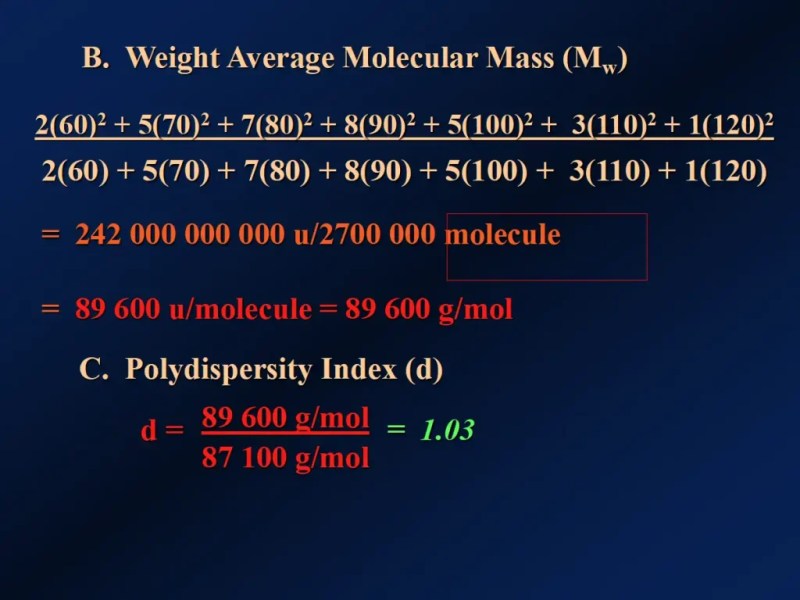
Polymers often have degree of polymerization (DP) distributions, making exact molecular mass determination challenging. Chemists use number-average molecular weight (Mn) or weight-average molecular weight (Mw), derived from techniques like gel permeation chromatography (GPC) or light scattering, to characterize polymer samples statistically.
Q: Are there any limitations to theoretical molecular mass calculations?
Yes. Theoretical calculations assume monoisotopic or average atomic masses and ignore:
1. Isotopic effects (e.g., natural abundance variations).
2. Solvation or adduct formation (e.g., [M+H]+ ions in MS).
3. Structural isomers (same formula, different connectivity).
For complex cases, experimental validation (e.g., MS) is indispensable.
Leave a Comment
Comments are moderated before appearing. The data you submit is processed according to the Privacy Policy of versiliasolutions.oneagency.co.